Tech-led.com


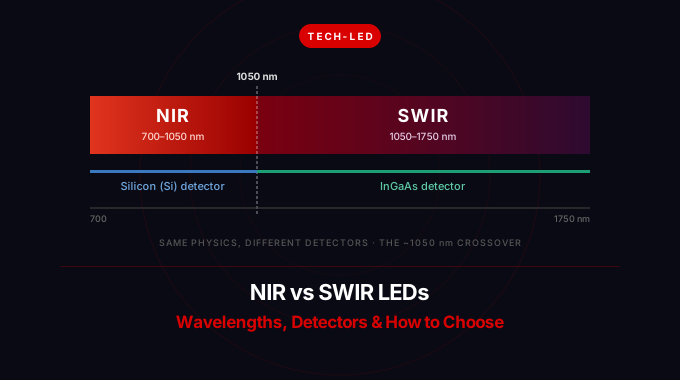
Industrial SWIR (short wave infrared) LED lighting operates in the 1050-1750 nm band, beyond the silicon detector cutoff at roughly 1100 nm. SWIR LEDs enable imaging, sensing, and machine vision applications that silicon-based cameras and photodetectors cannot see: through-fog and through-silicon-wafers imaging at 1050-1200 nm (including silicon wafer inspection), moisture detection at 1450 nm, eye-safe industrial sensing at 1550 nm, and oil-and-plastic sorting at 1650 nm. SWIR LEDs are built on InGaAs semiconductor material (versus InGaN for UV-visible LEDs and GaAs for NIR), which limits available wavelengths, lowers wall-plug efficiency, and increases cost per milliwatt by roughly 10-100x versus visible LEDs. Multispectral LED systems combine multiple SWIR wavelengths, and often visible / NIR wavelengths, in arrays to capture spectral signatures single-wavelength sources cannot, used in food inspection, hyperspectral imaging supplements, NDT, machine vision lighting, and biomedical applications. This guide covers wavelength selection, packaging, SWIR illumination system-level design, and Marubeni's industrial SWIR LED portfolio for OEM integration.
The SWIR spectrum at a glance
| Wavelength | Primary applications | Key spectral feature | Cluster article |
|---|---|---|---|
| 1050 nm | Short-range SWIR imaging, machine vision, silicon wafer inspection | Just beyond silicon cutoff; high quantum efficiency on InGaAs sensors | 1050nm SWIR LEDs |
| 1200 nm | IR-SWIR crossover, semiconductor inspection, agricultural sensing | Useful boundary band, InGaAs and extended-InGaAs both respond | 1200nm LED at IR-SWIR crossover |
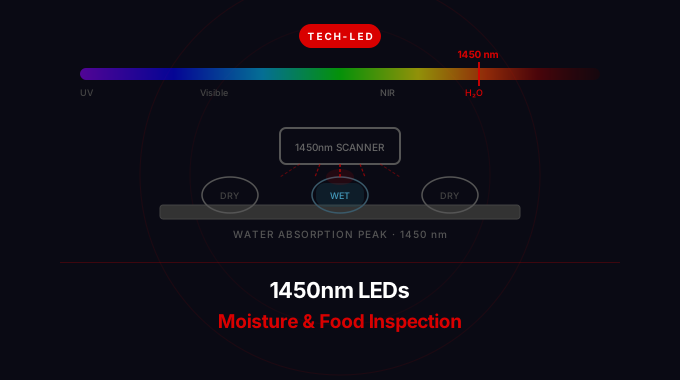
| 1450 nm | Moisture detection, food inspection, agricultural sorting | Strong water absorption peak | 1450nm LEDs for moisture and food |
| 1550 nm | Eye-safe industrial sensing, telecom, LiDAR | Eye-safe (vitreous fluid absorbs); aligned with telecom optics | 1550nm LEDs for eye-safe sensing |
| 1650 nm | Oil and plastic sorting, recycling, hydrocarbon detection | C-H bond overtone absorption | 1650nm LEDs for oil and plastic sorting |
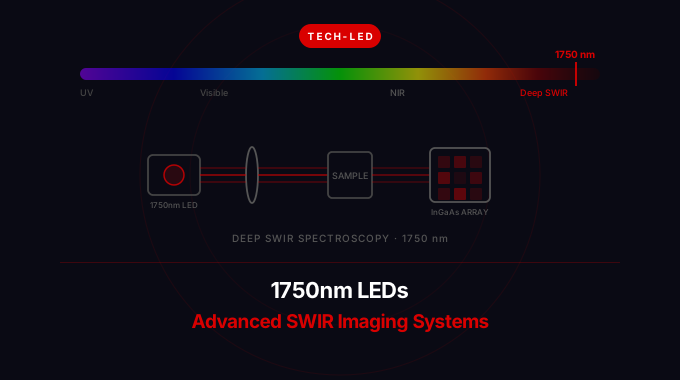
| 1750 nm | Advanced SWIR imaging, spectroscopy, deeper SWIR sensing | Near the edge of standard InGaAs sensor response | 1750nm LEDs for advanced SWIR imaging |
What makes SWIR different from visible and NIR LEDs
Three fundamental differences drive the SWIR LED component selection process:
1. InGaAs vs. silicon detection. Silicon CMOS and CCD sensors (and silicon photodiodes / photodetectors) have quantum efficiency curves that drop sharply past 950-1000 nm and are effectively blind past ~1100 nm. SWIR cameras and SWIR photodetectors use indium gallium arsenide (InGaAs) sensors, which are sensitive across 900-1700 nm (standard InGaAs) or up to 2600 nm with extended InGaAs. This sensor change is the largest cost driver of any SWIR system, InGaAs cameras typically cost 10-50x more than equivalent silicon cameras. SWIR LED selection must match the SWIR camera's spectral response curve. Note that SWIR is distinct from thermal imaging (MWIR / LWIR, 3-14 μm), SWIR uses reflected illumination from active LED sources, while thermal imaging detects emitted heat from objects themselves.
2. Cost per milliwatt of optical output. SWIR LEDs use InGaAs semiconductor material (versus InGaN for UV/visible and GaAs/AlGaAs for NIR). The standard composition Ga₀.₄₇In₀.₅₃As, lattice-matched to indium phosphide substrates, has an optical absorption cutoff at ~1.68 μm, with extended-InGaAs reaching beyond 2.5 μm. The material is harder to fabricate, has lower yields, and lower wall-plug efficiency than blue/green/red LED materials. Industrial SWIR LEDs typically cost 10-100x more per milliwatt of optical output than visible LEDs of similar package size. This shapes system design, SWIR illumination is power-budgeted and pulse-driven for efficiency.
3. Eye-safety advantage above 1400 nm. Light at wavelengths above approximately 1400 nm is strongly absorbed by water in the cornea and aqueous humor of the eye before reaching the retina, providing an inherent eye-safety margin not available at shorter wavelengths. This is reflected in the IEC 60825-1 laser/LED safety classification framework, which assigns more permissive accessible-emission limits to wavelengths in this band. The eye-safety property makes 1550 nm particularly attractive for industrial sensing, automotive LiDAR, and outdoor surveillance where exposure cannot be controlled. See the 1550nm cluster article for application-specific safety classification details.
Selecting a SWIR LED by application
| Application | Recommended wavelength | Primary selection criterion |
|---|---|---|
| Silicon wafer inspection (through-silicon imaging) | 1050 nm | Just past silicon cutoff; transmits through silicon wafers for defect detection |
| Through-fog and security imaging | 1050-1200 nm | Reduced scattering through atmospheric particles |
| Moisture content measurement | 1450 nm | Water absorption peak; sensitive to small moisture differences |
| Food / produce inspection (bruising, ripeness) | 1450 nm + multispectral | Moisture-related contrast at 1450 nm; multi-wavelength for composition |
| Eye-safe outdoor sensing / LiDAR | 1550 nm | Eye-safe absorption above 1400 nm; telecom-aligned optics availability |
| Oil and hydrocarbon detection / plastic sorting | 1650 nm | C-H bond absorption overtone; distinguishes polymer types |
| Hyperspectral imaging illumination | Multi-wavelength array (1050-1750 nm) | Spans the InGaAs sensitivity window; multiple discrete bands for spectral classification |
| Machine vision lighting (industrial inspection) | Wavelength-dependent by target | SWIR illumination reveals contrast invisible to standard visible / NIR machine vision systems |
| Pharmaceutical inspection (active ingredient, coating) | 1450 nm + multispectral | NIR/SWIR spectroscopy for non-destructive analysis |
| Biomedical imaging and wearable sensing | 1050-1300 nm | SWIR penetrates tissue and skin pigmentation more uniformly than visible / NIR |
| Recycling / material identification | 1650 nm + multispectral | Polymer / composite differentiation by absorption signature |
| Night vision augmentation (covert SWIR illumination) | 1050-1550 nm | SWIR is invisible to standard night vision goggles; covert active illumination |
Multispectral LED arrays
A multispectral LED array combines two or more discrete wavelengths in a single optical assembly to capture richer spectral information than a single-wavelength source can deliver. For OEM integration, multispectral arrays solve a class of problems that monochromatic illumination cannot: distinguishing materials with similar visible appearance but different SWIR absorption signatures, characterizing surface coatings, and supplementing hyperspectral imaging systems.
Array architecture options
- Interleaved arrays, multiple LED dies on the same substrate or PCB, each emitting a different wavelength. Optical output is spatially mixed across the illumination plane. Suited to applications where the target is in motion (food conveyor, manufacturing line) and time-multiplexed sampling is acceptable.
- Sequential / multiplexed drive, single optical path with multiple LED packages, driven in time sequence. Camera captures one frame per wavelength. Cleaner spectral separation, slower frame rate, requires synchronized drive electronics.
- Custom modules, assembled by component supplier to OEM specification. Combines the optimal wavelength set, drive electronics, and optical packaging for a specific imaging application.
Multispectral system design considerations
- Current matching across wavelengths, different SWIR LED wavelengths have different forward voltage and efficiency characteristics; uniform optical output per wavelength requires per-channel current regulation, not a single constant-current source for the whole array
- Spectral overlap, adjacent SWIR wavelengths (e.g., 1450 nm and 1550 nm) have ~30-40 nm FWHM and may overlap; spectral classification algorithms must account for this
- Optical uniformity, diffusers, light pipes, or integrating spheres are commonly used to spatially homogenize multispectral output before it reaches the target
- Thermal management, heat generated by multiple high-power LEDs in close proximity requires careful PCB design; metal-core substrates and active cooling are typical
- Synchronization with camera, multispectral systems require precise timing between LED drive pulses and camera exposure; trigger signals are usually delivered from a central controller
System-level design for SWIR illumination and machine vision lighting
A complete SWIR imaging or machine vision lighting system has four interdependent components, the SWIR LED light source is one of them:
- SWIR LED illumination, selected by wavelength, optical power, beam angle, lighting uniformity, and drive characteristics
- SWIR cameras (InGaAs sensor) or InGaAs photodiode/photodetector, selected by spectral response, pixel resolution, sensitivity, dynamic range
- Optics, silicon and crown glass lenses do not transmit past ~1100 nm; SWIR optics use quartz, sapphire, magnesium fluoride, or specialized SWIR-coated glasses
- Drive electronics + timing, pulsed drive (typical duty cycle 10-50%) maximizes peak optical output while managing thermal load; precise pulse timing synchronizes the SWIR LED lighting with camera exposure
Component matching matters. A 1550 nm LED paired with a standard SWIR camera (InGaAs sensor) is the strongest signal-to-noise combination because that wavelength is near the InGaAs sensitivity peak. The same camera paired with a 1750 nm LED sees significantly reduced signal because the sensor's responsivity is dropping near the edge of its sensitive range. Selecting an extended-InGaAs camera resolves the 1750 nm sensitivity issue at increased cost.
For machine vision lighting applications, beam uniformity across the inspection field is critical, non-uniform SWIR illumination produces inconsistent contrast that complicates downstream image analysis. Diffusers, light pipes, or multi-emitter arrays homogenize the SWIR light source output before it reaches the inspection target.
For optics, polycarbonate and acrylic are transparent in the visible but absorb strongly in SWIR. Use SWIR-rated glass, quartz, or sapphire for any windows, lenses, or beam-shaping optics in the LED path. Standard silicone LED encapsulants are SWIR-transparent up to about 1700 nm and are generally acceptable inside the LED package.
Hyperspectral vs. multispectral imaging, clarifying the terms
The two terms are often used interchangeably but describe different imaging approaches. Per the standard distinction, hyperspectral imaging uses continuous and contiguous ranges of wavelengths (e.g., 400-1100 nm in 1 nm steps), while multispectral imaging uses a subset of targeted wavelengths at chosen locations (e.g., 400-1100 nm in 20 nm steps):
| Multispectral | Hyperspectral | |
|---|---|---|
| Number of bands | 3-10 discrete bands | 100-1000+ contiguous narrow bands |
| Typical illumination | Discrete LED wavelengths in arrays | Broadband + dispersive optics, or tunable laser |
| Data per pixel | Vector of N band intensities | Full spectrum (resolved to ~1-10 nm) |
| Use case | Targeted classification (known signatures) | Discovery / unknown-signature analysis |
| Cost | Lower (LEDs + standard camera) | Higher (specialized spectrograph + sensor) |
| Typical applications | Industrial sorting, food inspection, machine vision | Remote sensing, scientific research, forensics |
SWIR LEDs are typically deployed in multispectral systems, not hyperspectral. Hyperspectral systems usually need contiguous-band coverage that discrete LED arrays cannot provide; they use broadband sources (halogen, supercontinuum lasers) plus prism or grating spectrometers. That said, SWIR LEDs supplement hyperspectral systems in some configurations, providing high-power illumination at key absorption peaks while the spectrometer captures the full spectrum.
Packaging considerations for SWIR LEDs
SWIR LEDs come in compact surface-mount packages for board-level integration, plus larger COB and customized array packages for high-power systems:
- SMD packages, standard surface-mount footprints (0603, 0805, larger ceramic packages) suited to PCB integration. Marubeni's ultra-compact 0603 SWIR LED is designed for space-constrained wearable and miniaturized OEM applications.
- Low-profile flip-chip packages, minimize package height for slim form factors. Useful in optical systems where multiple emitters need tight vertical stacking.
- High-power packages, multiple SWIR chips on a ceramic substrate with copper heat-spreaders. Used for long-range sensing and high-irradiance applications.
- COB (chip-on-board), many SWIR chips mounted directly on a substrate for high optical output and uniform area illumination. Used in industrial inspection illuminators and multispectral arrays.
Two materials notes specific to SWIR packaging:
- Encapsulant choice matters. Standard LED-grade silicones transmit reasonably well through 1700 nm. For 1750 nm and beyond, low-water-content silicones or unencapsulated chips on hermetic packages give cleaner spectral output.
- Window materials must be SWIR-transparent. Standard borosilicate glass works to about 2500 nm. Quartz and sapphire are clean choices for high-temperature or chemically harsh environments.
Marubeni SWIR LED portfolio
Tech-led distributes Marubeni's industrial SWIR LED portfolio for OEM integration. Standard wavelengths cover 1050 nm through 1750 nm in surface-mount and high-power packaging:
- 1050 nm and 1200 nm SMD packages for short-range SWIR imaging, machine vision, and silicon-related applications
- 1450 nm and 1550 nm SMD and high-power packages for moisture detection, food inspection, and eye-safe sensing
- 1650 nm and 1750 nm packages for hydrocarbon detection, recycling, and advanced SWIR imaging
- Ultra-compact and low-profile packages for wearable and space-constrained designs (see ultra-compact 0603 SWIR LED release and low-profile SWIR flip-chip release)
- Custom multispectral arrays built from the standard wavelength portfolio for OEM application requirements
For complete specifications, datasheets, and sample requests, see the SWIR LED product category or contact Tech-led engineering for OEM-specific component recommendations.
Frequently asked questions
What is a SWIR LED?
A SWIR LED is a light-emitting diode that emits short-wave infrared light, typically in the 1050-1750 nm range. SWIR LEDs are built on indium gallium arsenide (InGaAs) semiconductor material and require InGaAs camera sensors for detection because they emit beyond the silicon detector cutoff at ~1100 nm.
Which SWIR LED wavelength should I use for my application?
Selection depends on the target's absorption profile. For moisture detection: 1450 nm (water absorption peak). For eye-safe outdoor sensing: 1550 nm (above the 1400 nm vitreous absorption threshold). For oil and plastic sorting: 1650 nm (C-H bond absorption). For machine vision through silicon or fog: 1050-1200 nm. For multispectral imaging: combine multiple wavelengths in an array.
What's the difference between SWIR LEDs and NIR LEDs?
NIR (near-infrared) LEDs emit at 750-1000 nm and are detected by silicon cameras and photodiodes. SWIR (short-wave infrared) LEDs emit at 1050-1700 nm and require InGaAs sensors. SWIR LEDs reveal information silicon-based systems cannot see, material composition through absorption signatures, water content, hydrocarbon presence, and through-fog imaging.
Are SWIR LEDs eye-safe?
SWIR wavelengths above approximately 1400 nm (e.g., 1450, 1550, 1650, 1750 nm) are strongly absorbed by the vitreous fluid in the eye before reaching the retina, providing an inherent eye-safety advantage. This is why 1550 nm is the standard for eye-safe industrial sensing and automotive LiDAR. SWIR LEDs below 1400 nm (1050, 1200 nm) do not have this advantage and require IEC 60825-1 laser/LED safety classification per application.
Can I use a regular CMOS or CCD camera with SWIR LEDs?
No. Silicon-based image sensors (CMOS, CCD) become insensitive past approximately 1000 nm and are effectively blind by 1100 nm. SWIR LEDs require InGaAs or extended-InGaAs sensors for detection. This is the largest cost driver in SWIR system design, InGaAs cameras typically cost 10-50x more than equivalent silicon cameras.
Why are SWIR LEDs more expensive than NIR LEDs?
SWIR LEDs use InGaAs semiconductor material, which is harder to fabricate, has lower wall-plug efficiency, and lower production volume than the InGaN (UV/visible) or GaAs (NIR) materials used in shorter-wavelength LEDs. Industrial SWIR LEDs typically cost 10-100x more per milliwatt of optical output than equivalent visible LEDs. Volume pricing improves as commercial demand grows for SWIR imaging applications.
What's the typical lifetime of a SWIR LED?
Industrial SWIR LEDs rate L70 (time to 70% output) at 10,000-30,000 hours when operated within thermal and electrical specifications. Lifetime is highly sensitive to junction temperature; derating drive current and adding heat sinking can substantially extend operational life. Pulsed operation (low duty cycle) also extends lifetime by reducing average junction temperature.
How do I design a multispectral SWIR imaging system?
Four interlocked components: (1) select the wavelength set based on the target's spectral signatures; (2) match the SWIR LEDs and InGaAs camera spectral responses; (3) use SWIR-transparent optics (quartz, sapphire, SWIR-rated glasses, silicon and standard polymers don't work); (4) drive the LEDs with per-channel current regulation and synchronize pulses with camera exposure. Custom multispectral array modules from a SWIR LED component supplier are often more cost-effective than building from individual emitters for production volumes.
Related guides
- LED Wavelength Guide: From UV to Infrared, parent pillar covering the full LED spectrum
- Industrial UV LED Guide, sibling pillar for UV-A, UV-B, and UV-C
- Near Infrared (NIR) LED Guide, sibling pillar for 750-1000 nm
- 1050nm Infrared LEDs · 1200nm LED · 1450nm LEDs · 1550nm LEDs · 1650nm LEDs · 1750nm LEDs, wavelength-specific cluster articles
- SWIR LED product category, Marubeni SWIR LED component portfolio
Need help selecting a SWIR LED or designing a multispectral system for your OEM application? Contact Tech-led engineering for component recommendations, datasheets, and sample requests.