Tech-led.com


Optical sorters separate materials at speed by reading a light signal and firing an air jet or ejector at items that don't match. The LED light source is what makes the distinction possible, and the wavelength is chosen by what you're sorting on: visible light for color (ripe vs. unripe, product vs. foreign matter), SWIR around 1650 nm to identify plastics by polymer type, SWIR around 1450 nm to read moisture and reveal subsurface bruising, NIR to separate organic from inorganic material, and UV (365–405 nm) to make fluorescent contaminants glow. This guide maps wavelength to sorting task across food, recycling, and industrial lines.
| Sorting task | Wavelength | What it distinguishes |
|---|---|---|
| Color sorting (produce, grain, defects) | Visible (450–660 nm) | Color and surface appearance |
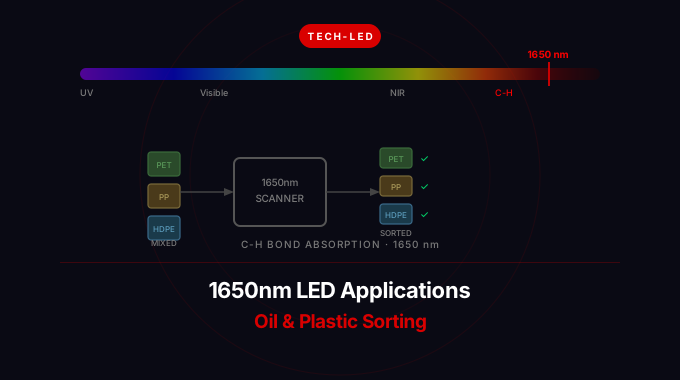
| Plastic / polymer identification | SWIR ~1650 nm | Polymer type by absorption signature |
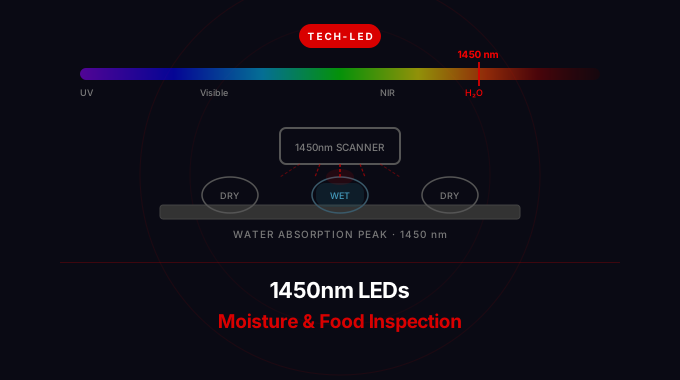
| Moisture, bruising, ripeness | SWIR ~1450 nm | Water content, subsurface defects |
| Organic vs. inorganic, foreign material | NIR (780–1050 nm) | Material composition, contaminants |
| Fluorescent contaminants, markers | UV (365–405 nm) | Fluorescence under near-UV excitation |
How optical sorting works
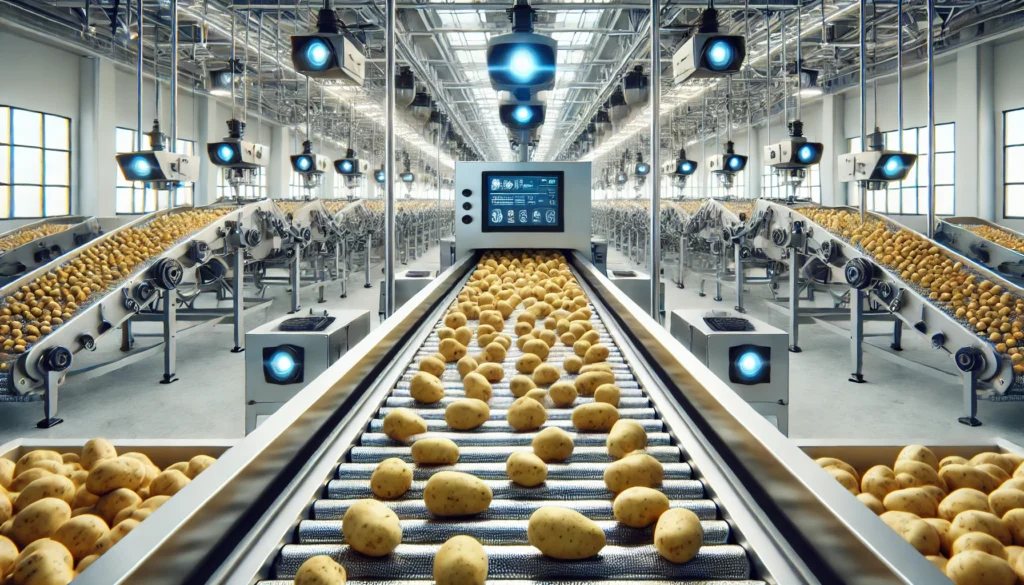
An optical sorter moves product past a light source and a camera or photodetector on a fast conveyor or freefall chute. The detector reads each item's reflected or transmitted light, a processor classifies it against the accept/reject criteria, and a precisely timed air jet or mechanical arm ejects the rejects. The whole cycle happens in milliseconds, thousands of times per second.
The contrast between accept and reject items is created by the light source. Choosing a wavelength where the target property (color, polymer, moisture) produces a strong, repeatable difference is what makes the sort reliable, which is why wavelength selection, not raw brightness, is the first decision.
Sorting by wavelength
Visible light, color sorting
Visible LEDs (blue through red) drive classic color sorting: separating ripe from unripe produce, removing discolored grains or defective product, and pulling foreign matter that differs in color. Monochromatic visible light, or a controlled combination, gives sharper color discrimination than broadband white and is stable enough for consistent classification across a shift.
SWIR ~1650 nm, plastic and polymer identification
Different plastics, PET, HDPE, PP, PVC, have distinct absorption signatures in the short-wave infrared. A 1650 nm SWIR LED lets a recycling sorter identify polymer type and separate plastics by resin, the backbone of modern plastics recycling. SWIR also distinguishes oils and hydrocarbons. SWIR imaging requires an InGaAs sensor rather than silicon.
SWIR ~1450 nm, moisture and hidden defects
Water absorbs strongly near 1450 nm, so a 1450 nm SWIR LED reads moisture content and reveals subsurface defects, bruising under an apple's skin, internal damage, that are invisible at the surface. Used for ripeness assessment, moisture control in processed foods, and produce-quality grading.
NIR, composition and foreign material
Near-infrared (780–1050 nm) separates organic from inorganic material and flags contaminants like stones or glass that look similar to product under visible light. It penetrates surfaces better than visible light and is widely used in food and waste-stream sorting.
UV, fluorescent contaminants
UV/violet LEDs (365–405 nm) excite fluorescence in contaminants and markers, certain molds, biological residues, and UV-tagged materials glow under near-UV light, letting the sorter detect and remove what visible inspection would miss.
Multi-wavelength sorting
The hardest sorts combine wavelengths. A single pass under UV + visible + SWIR illumination captures color, fluorescence, and material composition together, classifying items that no single band could separate. Multi-wavelength LED arrays, or several illumination bars at different wavelengths along the conveyor, deliver this, and matching the SWIR LED set to the SWIR camera's response is the key integration task. See the SWIR LED Lighting Guide for multispectral array design.
Design considerations
- Wavelength match to the discriminating property and to the detector's spectral response (silicon for visible/NIR; InGaAs for SWIR).
- Output stability and uniformity across the inspection width, drift or hotspots cause misclassification.
- Strobing synchronized to the line speed to freeze fast-moving product and raise peak intensity.
- Optical materials, SWIR and UV require appropriate transmitting optics (quartz/sapphire for UV; SWIR-grade glass).
Tech-led supplies the SWIR, UV, visible, and IR/NIR LED emitters behind optical sorters. For component selection, datasheets, and samples, contact Tech-led engineering.
Frequently asked questions
How does an optical sorter use LEDs?
An LED light source illuminates product moving past a camera or photodetector; the system reads each item's reflected or transmitted light, classifies it, and fires a timed air jet to eject rejects. The LED wavelength is chosen so the property being sorted on, color, polymer, moisture, produces strong, repeatable contrast.
What wavelength is used to sort plastics for recycling?
SWIR around 1650 nm. Different polymers (PET, HDPE, PP, PVC) have distinct short-wave-infrared absorption signatures, so a 1650 nm SWIR illuminator paired with an InGaAs camera identifies and separates plastics by resin type.
How do optical sorters detect bruising or moisture in food?
With SWIR light near 1450 nm, where water absorbs strongly. Variations in water content, including subsurface bruising invisible at the surface, change the SWIR signal, letting the sorter grade ripeness, control moisture, and reject damaged produce.
Why use UV LEDs in optical sorting?
UV/violet light (365–405 nm) excites fluorescence in contaminants, molds, biological residues, and UV-tagged materials that look identical to product under visible light. The sorter detects the fluorescent glow and removes the contaminant.
Can one sorter use multiple wavelengths?
Yes. High-end sorters combine visible, UV, and SWIR illumination so a single pass captures color, fluorescence, and material composition together. Multi-wavelength LED arrays or staged illumination bars classify items no single band could separate.
Do SWIR sorters need a special camera?
Yes. SWIR wavelengths (beyond ~1000 nm) are invisible to silicon sensors, so SWIR sorting requires an InGaAs camera. This is the main cost driver of SWIR-based sorting, justified by its ability to read polymer type and moisture that silicon cameras cannot.
Why are LEDs preferred over lamps for optical sorting?
LEDs offer selectable narrow-band wavelengths, stable repeatable output, microsecond strobing to freeze fast-moving product, long life, and compact bar/array geometries. Halogen and fluorescent sources are broadband, drift as they age, and can't strobe cleanly.
Related guides
- 1650 nm LEDs for Oil and Plastic Sorting, polymer identification
- 1450 nm LEDs for Moisture and Food Inspection, moisture and subsurface defects
- SWIR LED Lighting Guide, short-wave infrared and multispectral arrays
- Machine Vision Lighting, wavelength and geometry for inspection
Building or upgrading an optical sorter? Contact Tech-led engineering for SWIR, UV, visible, and NIR LED recommendations, datasheets, and samples.