Tech-led.com


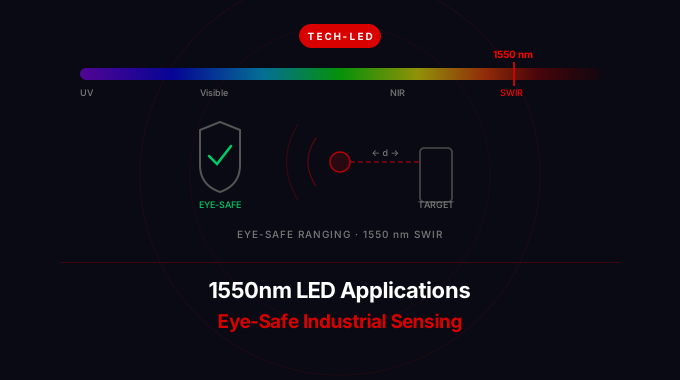
A 1550 nm LED sits in a strategically important part of the SWIR spectrum for sensing, imaging, and industrial inspection. This wavelength is often associated with eye-safer system design, detector compatibility, and specialized optical tasks where standard visible or shorter-wave IR illumination is not the best fit. For engineers evaluating industrial sensing systems, 1550 nm is worth understanding as more than just another infrared part number.
In this article, we’ll look at why 1550nm matters, how it fits into SWIR illumination and detector selection, where eye-safe framing becomes relevant, and what technical buyers should consider when comparing emitter options, system architecture, and integration requirements. If you are selecting illumination for industrial sensing, this is one of the most commercially and technically useful parts of the spectrum to understand.

For the broader SWIR LED context, how this wavelength fits within the 1050-1750 nm SWIR band, multispectral system design, and wavelength selection across the full SWIR range, see our SWIR LED Lighting Guide.
In this guide
- Why does 1550 nm matter industrial sensing?
- What does eye-safe mean at 1550 nm?
- Why is 1550 nm useful for industrial sensing applications?
- How does a SWIR LED at 1550 nm fit with detector technology?
- When should engineers choose an LED instead of a laser source?
- What role do optics, a lens, and beam control play?
- What should buyers look for in package, specification, and performance?
- How should teams think about safety compliance language?
- How does 1550 nm compare with nearby SWIR wavelengths?
- What should buyers ask before they select a product?
- So when is a 1550 nm LED the right choice?
Why does 1550 nm matter industrial sensing?
The importance of 1550 nm comes from the way it sits at the intersection of SWIR imaging, industrial sensing, and safety-conscious system design. In many environments, this part of the spectrum is useful because it supports sensing tasks that go beyond what visible light or conventional near-IR approaches can reliably reveal. A 1550 nm LED is therefore not just a niche emitter. It is often a deliberate engineering choice.
For system designers, this wavelength is especially interesting because it aligns with detector technologies already used in SWIR imaging and industrial measurement. It is also frequently discussed in relation to eye-safer optical architectures, which is one reason the term appears so often in advanced sensing conversations. That does not mean every system is automatically safe simply because it operates here, but it does explain why 1550 nm has become a serious option industrial optical design.
In practical terms, the value of this band is application-driven. Engineers choose it when the sensing problem calls for the material interaction, detector compatibility, and system behavior that this region can support. That makes it commercially relevant for machine builders, instrument developers, and inspection teams alike.
What does eye-safe mean at 1550 nm?
The phrase “eye-safe” gets used loosely, so it needs careful description. In optical engineering, 1550 nm is commonly associated with eye-safer architectures because this part of the infrared range interacts with the eye differently than shorter wavelengths. That is one reason 1550 nm appears often in discussions of ranging, sensing, and industrial optical systems. However, eye-safe is not a magic label that overrides power level, optics, duty cycle, or system geometry. For a useful technical overview of why wavelengths beyond about 1.4 μm are often discussed this way, see RP Photonics’ explainer on eye-safe lasers.
That distinction matters for safety compliance. A system designer should not assume that any source at this band is automatically acceptable under every operating condition. Real compliance depends on total radiant exposure, viewing conditions, output configuration, and the relevant standard. In other words, 1550 nm can be a strong starting point for safer system design, but compliance still requires proper engineering and verification.
For Tech-LED-style content, the right framing is careful and useful: 1550 nm is often chosen because it helps support eye-safer industrial optical systems, especially relative to some shorter-wave approaches, but final safety conclusions depend on the complete device and its operating context.
Important note on eye-safe claims
Use 1550 nm as a technically meaningful design context, not as a blanket marketing promise. A source can operate at a favorable wavelength and still require careful evaluation of optical power, beam geometry, enclosure design, and applicable standards before any formal safety statement is made.
Why is 1550 nm useful for industrial sensing applications?
A 1550 nm LED is useful industrial sensing because it supports applications where detector compatibility, material response, and controlled infrared illumination matter more than visible appearance. In many industrial systems, the goal is not to create a pretty image. The goal is to generate reliable signal for inspection, sensing, alignment, or process control. That makes SWIR illumination a strong tool when standard visible imaging falls short.
Depending on the use case, this can include object detection, material differentiation, process monitoring, optical alignment, and specialized machine-vision tasks. In some systems, the attraction is spectral behavior. In others, it is the ability to pair 1550 nm illumination with detector platforms already optimized for SWIR imaging. In still others, the attraction is the balance between sensing functionality and eye-safer system architecture.
This is why the article intent should stay application-led. The value of the emitter is not that it exists in a catalog with a long technical detail sheet. The value is that it supports a meaningful industrial sensing application where illumination quality and system reliability matter.
How does a SWIR LED at 1550 nm fit with detector technology?
At this band, detector compatibility becomes central. A SWIR LED at 1550 nm is generally paired with detector technologies intended for the short-wave infrared range, not ordinary silicon imaging hardware. That means the full system has to be designed with the right sensor in mind from the beginning. A source and detector may be individually impressive, but if they are not compatible, the resulting system will underperform.
In many cases, industrial sensing platforms at this wavelength rely on SWIR cameras or photodiode-based receiver architectures that are optimized for this spectral region. Hamamatsu’s educational material on NIR and SWIR detector selection and its overview of InGaAs cameras are useful references for understanding why silicon devices drop off and why InGaAs-based detection is commonly used in this band. That opens up system possibilities that visible-light and conventional IR components do not support as effectively. It also means that component selection should focus on the full signal path: emitter, optics, detector, enclosure, electronics, and software interpretation.
For buyers, that should shift the conversation away from isolated emitter shopping and toward system fit. A good product at 1550 nm is not simply one that can emit in that band. It is one that integrates cleanly into the broader sensing architecture and delivers usable signal under actual operating conditions.
When should engineers choose an LED instead of a laser source?
This is one of the most important distinctions in the whole topic. The NeuronWriter prompt pushes terms like laser, laser diode module, and even superluminescent led or sled, but those are not all the same thing. A 1550 nm LED should usually be discussed as part of an illumination strategy that values broad coverage, lower coherence, simpler integration, and easier optical behavior than a narrow, high-intensity laser source.
That can matter industrial sensing because a lower-coherence source may reduce unwanted artifacts and make illumination more forgiving in real-world setups. If the goal is broad-area illumination or stable short-range sensing rather than tightly focused transmission, an LED can be the better type of source. It may also simplify electronics, alignment, and optical packaging compared with a more demanding laser-based architecture.
That said, engineers still need to separate source classes clearly. A laser diode, a superluminescent led, and a conventional emitter each have different operating behavior, mode structure, and system implications. For many practical sensing systems, the best answer is not the most exotic emitter. It is the one that best supports measurement quality, integration simplicity, and safe deployment.
What role do optics, a lens, and beam control play?
At 1550 nm, optics matter just as much as the emitter itself. A poorly matched lens, enclosure, or illumination geometry can undermine an otherwise strong design. Materials, coatings, and transmission performance all affect how much useful signal reaches the target and then returns to the receiver. This is why industrial sensing teams should think in terms of optical systems, not just parts.
Beam shaping also matters. Some sensing tasks benefit from a relatively wide illumination profile, while others need more concentrated output. A packaging or optics decision that looks minor on paper may have major consequences for signal stability, stray reflections, and system repeatability. This is especially true when the source must interact with reflective metal, transparent media, or textured industrial surfaces.
In practical development, optical integration often determines whether nominal emitter performance translates into real system performance. That is one reason buyers should look beyond a basic datasheet and ask how the source behaves in a complete optical stack under realistic working conditions.
What should buyers look for in package, specification, and performance?
Once the application is clear, buyers should evaluate the emitter at the package and implementation level. The right package may depend on thermal requirements, mounting method, form-factor limits, and desired optical geometry. Some applications may prefer compact surface-mount integration, while others may need a more specialized mechanical arrangement for stability or optical alignment.
The specification review should cover more than headline numbers. Teams should understand forward voltage, operating current, thermal behavior, spectral peak, output consistency, and how the source performs across realistic operating conditions. If the seller provides meaningful integration information, that is usually a good sign. If the listing is all buzzwords and no engineering substance, that is usually a warning sign.
Buyers may also see language such as mw, output power, “high” efficiency, or “high-power” claims. Those details matter, but only in context. The best emitter is not always the one with the biggest number. It is the one whose performance characteristics optimize the sensing task the system actually has to perform.
How should teams think about safety compliance language?
Safety wording around 1550 nm should be careful, exact, and useful. The temptation in SEO content is to flatten everything into a marketing shortcut, but that is risky here. The better approach is to explain that 1550 nm is often associated with eye-safer system design and can support compliance-friendly engineering decisions, while still making clear that formal compliance depends on total system behavior.
That means teams should avoid overstating what a standalone emitter can promise. The source is one component in a larger sensing function. Enclosure design, duty cycle, target distance, exposure conditions, optics, and operating environment all matter. Any final compliance statement should come from the complete system, not from the single wavelength alone.
In content terms, this is where credibility matters most. A useful article helps the user understand why the wavelength is attractive, what questions still need technical review, and how to think responsibly about design and validation.
How does 1550 nm compare with nearby SWIR wavelengths?
1550 nm sits in an important neighborhood. Compared with 1450 nm, the conversation shifts away from moisture-sensitive inspection and more toward sensing architecture, eye-safer framing, and detector-oriented system design. Compared with 1650 nm, it is usually less about material sorting or hydrocarbon-driven contrast and more about broader industrial sensing and optical-system functionality.
This matters because Tech-LED’s wavelength cluster should not blur together. Each article needs a distinct role. The 1450 nm post belongs to moisture and food inspection. The 1550 nm post belongs to eye-safe industrial sensing. Later articles in the series can go deeper into sorting and advanced SWIR imaging. That separation helps both SEO and technical clarity.
For readers who compare multiple solutions, 1550 nm can be understood as one especially strategic point in the SWIR lineup: technically mature, commercially relevant, and strongly tied to sensing architectures where both performance and safety framing matter.
What should buyers ask before they select a product?
A buyer should ask more than “what is the price?” Good questions include: what is the actual emission profile, what detector families is the source intended to support, what thermal limits apply, what package variety exists, and what optical integration guidance is available? These questions tell you far more than a superficial part listing.
It also helps to ask how the vendor positions the source relative to adjacent source classes and reference ecosystems. For orientation, engineers sometimes compare descriptions across well-known catalogs, including names like Thorlabs, but the real selection decision should come down to system fit, not borrowed terminology. A generic model comparison is rarely enough on its own.
If the source is meant for demanding sensing work, the supplier should be able to explain operating limits, expected lifetime, integration guidance, and realistic performance conditions. That is the difference between a searchable part and a source that is truly usable in production.
So when is a 1550 nm LED the right choice?
A 1550 nm LED is the right choice when an industrial sensing system needs SWIR-compatible illumination in a wavelength band that is often associated with eye-safer optical design and detector-friendly integration. It is especially relevant when engineers need practical infrared illumination for sensing, inspection, alignment, or measurement tasks where visible or shorter-wave approaches are less suitable.
For many teams, the key is system thinking. The emitter, optics, detector, thermal design, and compliance strategy all matter together. A strong 1550 nm solution is not just a catalog feature. It is an engineered source that supports the full sensing objective under real operating conditions. In some cases that may even include specialized interfaces such as fiber output, but the same rule still applies: evaluate the whole architecture, not just the emitter in isolation.
The practical takeaway is simple. If your sensing problem requires SWIR illumination, careful safety framing, and a mature optical-system approach, 1550 nm deserves serious attention. It is one of the clearest examples of how source selection can shape industrial sensing performance from the start.
- A 1550 nm LED is especially relevant to SWIR-based industrial sensing and measurement systems.
- The wavelength is often associated with eye-safer optical design, but formal compliance depends on the full system.
- Detector compatibility is critical, source selection should be made with the sensing architecture in mind.
- LEDs, lasers, and related source classes should not be treated as interchangeable.
- Optics, lens choice, beam shape, and thermal integration all affect real-world performance.
- The best product decision starts with the application, then works backward to the right emitter and system design.
Where 1550 nm fits in the broader wavelength guide
This article fits within Tech-LED’s broader wavelength framework for infrared and SWIR source selection. For readers comparing adjacent bands and understanding where this source sits in the larger optical landscape, see the LED wavelength guide. Within that framework, 1550 nm should be understood as the eye-safe industrial sensing entry in the SWIR cluster, distinct from 1450 nm moisture analysis, 1650 nm sorting applications, and deeper SWIR imaging topics farther up the band.
" If you want, I can do one more pass to make the references feel a little more naturally woven in, but this version already keeps the article basically intact while adding credibility.