Tech-led.com



Summary: LED component lead time is the visible output of the supply chain behind a part: upstream die and package supply, production scheduling, stock position, and logistics. For an optoelectronic LED (a specific peak wavelength in a specific package, such as an 850 nm SMT emitter or a 1550 nm SWIR part) the quoted lead time also depends on how narrowly the line item is written, because an exact part number with a tight wavelength bin has fewer supply paths than a requirement several stocked parts can meet. This article explains what causes LED lead-time delays, how availability and supplier transparency shape procurement planning, where logistics adds variance, and what to put on a quote request so the lead time you receive is one you can plan a build around.
For technical buyers, lead time is never just a date on a quote. It is the visible result of a broader supply chain that includes component sourcing, manufacturing capacity, logistics, forecasting, and how well a supplier manages disruption. This article explains how LED buyers can think about availability, procurement planning, and sourcing risk in a more realistic way so they can make stronger decisions before delays become expensive.
That matters because the LED market depends on layered, global, and often fragile sourcing relationships. When one stage slips, the consequences can travel quickly across the supply chain and affect schedules, inventory, pricing, and customer commitments. If your team wants better planning, more transparency, and fewer surprises, it helps to understand what actually shapes lead time in the first place.
Why is LED lead time really a supply chain question?
Lead time often gets treated as a simple commercial number, but it is really an operational signal. A quoted date reflects the condition of the broader supply chain, including upstream components, manufacturing schedules, warehouse status, shipment timing, and the effectiveness of coordination between each partner in the ecosystem. When buyers understand that, they ask better questions and plan with more realism.
This is especially true in a global supply chain where even a small disruption can slow the flow of materials or finished goods. In LED sourcing, a delay in optics, electronics, packaging, drivers, or assembly capacity can all affect availability. That is why procurement planning should focus on system behavior, not just promises at the point of sale.
What usually causes LED lead time delays?
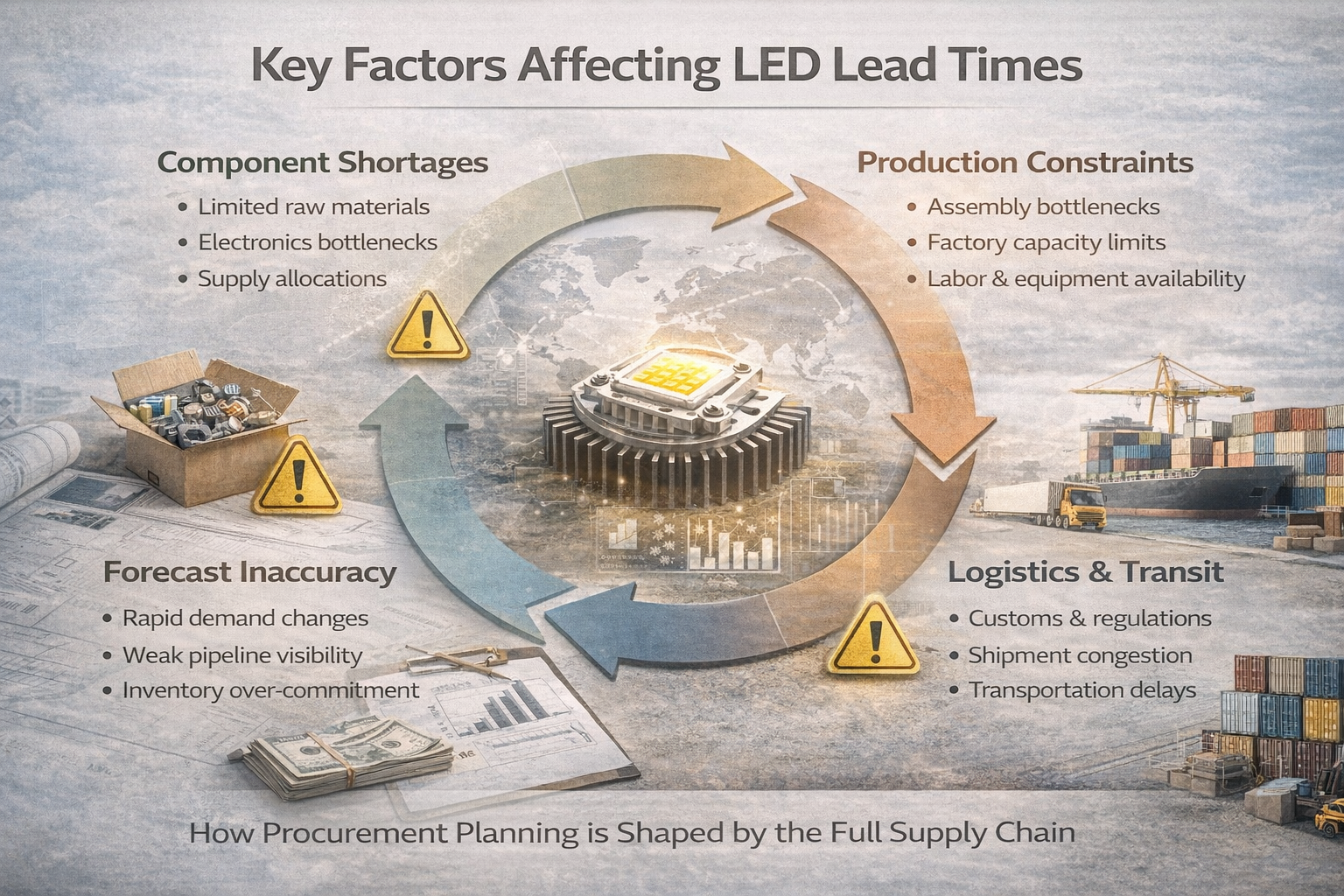
Delays usually come from a mix of complexity rather than a single failure. Common causes include component shortages, production constraints, customs delays, shipment congestion, and weak forecasting. A bottleneck at any stage can reduce throughput and create longer waits even when demand appears stable from the outside.
Buyers should also remember that the LED industry is tied to broader electronics and semiconductor conditions. If one critical component is constrained, the entire implementation timeline can shift. In that sense, lead time is not just about one supplier. It is about how well the full value chain is functioning at a given moment.
How does component availability shape procurement planning?
Component availability affects more than whether a part can be bought today. It shapes how teams forecast, how much inventory they hold, and how much flexibility they have if project priorities change. A strong supplier or provider should be able to explain not only whether a part is available now, but also how stable that availability is likely to remain.
This is where procurement discipline matters. Buyers that treat availability as dynamic instead of fixed are usually better prepared to optimize schedules and reduce risk. Instead of reacting to shortages late, they build planning around lead-time variability, alternate paths, and early insight into constrained parts.
Why does transparency matter so much in LED sourcing?
Transparency matters because bad news is usually more manageable when it arrives early. A transparent partner should be able to discuss constraints, explain changing timelines, and show what is happening across the supply chain instead of hiding behind vague updates. That kind of communication helps teams make better decisions before a small delay becomes a major schedule issue.
For enterprise buyers, increasing visibility can create real business value. If the supplier is transparent about inventory status, manufacturing windows, and logistics exposure in real time, the customer can plan more intelligently. In practice, transparent communication is one of the strongest signs of a reliable sourcing relationship.
How should buyers evaluate supplier communication and support?
Not every supplier handles updates the same way. Some provide detailed operational reporting, while others share only the minimum needed to keep an order moving. Buyers should ask what level of insight they will receive, how exceptions are escalated, and whether the team can support real-time or near-real-time updates when timing becomes critical.
This is where the quality of the partner relationship becomes visible. A good partner helps companies understand the condition of the supply chain, not just the current order line. That support can include forecast conversations, alternate recommendations, logistics review, and practical guidance about what is realistic in the current environment.
What role do logistics and cross-border exposure play?
Logistics is one of the most obvious drivers of lead-time volatility. Cross-border movement introduces customs risk, carrier variability, and jurisdiction-specific delays that may not be visible when an order is first quoted. Even if manufacturing finishes on time, a shipment can still be slowed by transportation conditions, regulatory checks, or network congestion.
That is why buyers should not separate sourcing from logistics. The supply chain only works if execution continues beyond the factory. For programs with aggressive deadlines, the smarter question is often not “When will it leave?” but “What has to go right for it to arrive on time?”
How can buyers plan for disruption instead of just reacting to it?
Every sourcing plan should assume some level of disruption. That does not mean buyers need to become pessimistic. It means they should build resilience into planning by considering alternate parts, dual paths, inventory buffers, and earlier approvals where appropriate. A strategic response to disruption is usually cheaper than a rushed reaction later.
This is also where flexibility matters. Teams that can adjust specification, volume, or rollout sequencing often handle supply shocks better than teams with rigid plans. The goal is not to eliminate all risk, which is impossible. It is to create enough resilience that one delay does not break the entire project.
Can digital tools, automation, and AI improve supply visibility?
Digital tools can improve supply visibility when they are connected to real processes. A digital supply platform, enterprise reporting system, or analytics layer may help buyers track inventory, shipment status, and forecast changes more effectively. Automation can also streamline communication and reduce lag between a problem emerging and a stakeholder learning about it.
AI can add value when used carefully for pattern detection, exception monitoring, and the ability to predict likely delays before they become obvious. That said, technology alone does not solve complex supply chain issues. The real advantage comes when tools support better insight, faster implementation, and stronger execution across the supply chain.
How do broader market and government forces affect LED availability?
LED supply is shaped by more than factory output. Government policy, trade rules, geopolitical tension, and environmental regulation can all influence sourcing conditions. In some cases, a regulatory change or new government action affects the movement of goods, raw materials, or specific product categories more than buyers expect.
These forces matter because the LED ecosystem is connected to broader business models in electronics, manufacturing, and global trade. A strategic buyer should understand that supply conditions can change because of external factors as much as internal ones. Availability is not just a warehouse number. It is a function of the larger market and policy environment.
What should buyers ask before committing to a schedule?
Before approving an order, buyers should ask what assumptions support the quoted lead time, what dependencies exist upstream, and what happens if a constrained asset becomes unavailable. They should also ask whether there is any forecast requirement, whether inventory management is proactive or reactive, and how alternate options are handled if conditions change.
These questions are especially important in a complex supply chain where one delay can cascade into others. A strong sourcing conversation should cover schedule confidence, logistics exposure, communication cadence, and whether the supplier can support practical assurance instead of vague optimism.
How can companies turn lead-time risk into better planning?
The best teams treat lead-time uncertainty as a planning input, not a surprise. They use forecast discipline, transparent communication, and better integration between sourcing, operations, and engineering to reduce avoidable chaos. That kind of transformation does not require perfect information, but it does require a more mature view of how end-to-end supply chains behave.
In practice, this helps your business move from reactive purchasing to more operational control. When buyers understand the supply chain, ask stronger questions, and work with a partner that supports real insight, they can optimize outcomes without pretending the environment is simple. That is how companies reduce risk while improving continuity.
Reducing lead-time risk on an optoelectronic LED line item
The sections above describe lead time as a system property. On an actual bill of materials, most of the risk on an LED line item is decided by how that line item is written, and a few specification choices move it more than any amount of expediting.
Write the requirement wide enough to have alternates. A line item that names one exact part number has exactly one supply path. The same line item written as a peak wavelength, a tolerance, an output floor at a named drive current, and a footprint can often be met by more than one stocked part. The Tech-LED product search filters by peak wavelength across all package families, so checking how many parts already exist at, for example, 940 nm or 1550 nm is a quick way to see how much room a requirement has before it is frozen.
Bin only as tightly as the optics need. A narrow peak-wavelength or radiant-output bin selects a smaller share of each production lot, which leaves fewer qualifying parts to ship. If the receiver is a broad silicon photodiode, a wide bin costs nothing optically. If it sits behind a narrow bandpass filter, the tight bin is a real requirement and should be flagged early so the supplier can plan for it.
Pin only the options the design uses. Marubeni part numbers carry separate codes for lens type, an integrated Zener diode, and a ceramic insulator on multi-chip parts, and each combination is a distinct variant. A drawing that copies every option code from a reference part may lock in a variant the design does not need. The part number guide shows what each segment controls.
Qualify the second option at prototype, not after a shortage. If a board can accept two footprints, or the optical budget can accept two wavelengths within the detector's response, validating both during prototype turns a future delay into a planned switch instead of a redesign.
| Lead-time lever | What to put on the quote request | Why it helps |
|---|---|---|
| Alternates | Wavelength, tolerance, output floor, and footprint alongside the reference part number | More stocked parts can satisfy the line item |
| Binning | The bin the detector and filter actually require | Wider bins leave more of each lot eligible to ship |
| Option codes | Only the lens, Zener, and insulator options the design uses | Avoids locking in a low-demand variant |
| Forecast | Annual volume, first-build date, and release cadence | Lets the supplier match stock and production to your schedule |
| Lifecycle | Expected production life and a request for change and discontinuation notice | Gives time for a last-time buy or requalification |
| Second source | Whether a qualified alternate part or footprint exists | A shortage becomes a switch, not a redesign |
For supplier evaluation beyond lead time, see the global LED supplier guide for industrial and research applications. To check stock and production lead time against a real schedule, browse the Tech-LED product catalog or contact Tech-LED with the part number or requirement, the annual volume, and the date your first build needs parts.
FAQ
What is a typical LED component lead time?
There is no single figure, because a quoted lead time blends two different situations. A part already on the shelf ships in the time it takes to pick, pack, and move it. A part that has to be produced carries the production schedule for its die and package on top of that. When comparing quotes, ask each supplier to state whether the quantity is in stock, what the lead time is for quantity beyond stock, and what assumptions the date relies on. A single undifferentiated date hides the part of the risk you most need to see.
Why do LED lead times differ for parts at the same wavelength?
Wavelength is only one attribute. Two parts at 850 nm can sit in different package families, use different chip counts or lenses, and be ordered in very different volumes, so one may be stocked while the other is produced to order. Tight wavelength or output binning also lengthens lead time, because fewer parts from each lot qualify.
How can I shorten the lead time on an LED part for production?
Widen the requirement where the optics allow it, so more than one stocked part qualifies. Bin only as tightly as the detector and filter need. Share a forecast with volumes and dates instead of placing surprise orders. Qualify an alternate part or footprint during prototype, and ask the supplier for change and discontinuation notices so a last-time buy can be planned rather than forced.
How much safety stock should I hold for an LED component?
Size it to the variation in lead time rather than the quoted figure. The buffer has to cover demand for the gap between the best-case and worst-case delivery you have actually seen on that part, plus the time needed to requalify an alternate if the part becomes unavailable. Single-source parts with tight bins justify more buffer than parts with a qualified second option.
Key takeaways
- LED lead time is a supply chain outcome, not just a sales promise.
- Availability depends on upstream components, manufacturing, warehouse status, and logistics execution.
- Transparency and early communication reduce the cost of delay.
- Cross-border exposure and shipment variability can create major timing risk.
- Resilience comes from planning, alternate paths, and realistic forecasting.
- Digital tools, automation, and AI can improve visibility, but only when tied to real process discipline.
- Better sourcing decisions come from understanding the full supply chain rather than reacting to isolated delays.