Tech-led.com


Functional near-infrared spectroscopy (fNIRS) measures brain activity by shining near-infrared light through the scalp and skull and detecting how much is absorbed by oxygenated and deoxygenated hemoglobin in the cortex. Building an fNIRS device requires at least two NIR wavelengths that straddle the ~810 nm hemoglobin isosbestic point, most commonly a pairing around 760 nm and 850 nm, so the system can resolve oxy-hemoglobin (HbO₂) and deoxy-hemoglobin (HbR) separately via the modified Beer-Lambert law. For the OEM engineer specifying the light source, the decision comes down to wavelength pair, spectral bandwidth (FWHM), radiant power, package footprint, and thermal stability. This guide covers how to select NIR LED wavelengths for fNIRS, the LED-vs-laser trade-off, the component specs that matter, optode design considerations, and Marubeni NIR LED options for integration.
What fNIRS measures, and why wavelength choice matters
fNIRS is a non-invasive optical neuroimaging method. It exploits the near-infrared "optical window" in biological tissue (roughly 650-950 nm), where water and other chromophores absorb relatively little light, so NIR photons can penetrate several centimeters, through scalp and skull and into the outer cortex, before being absorbed or scattered back out.
The two chromophores fNIRS cares about are oxygenated hemoglobin (HbO₂) and deoxygenated hemoglobin (HbR). When a region of cortex becomes active, local blood flow increases, raising HbO₂ and lowering HbR, the hemodynamic response fNIRS detects. Because HbO₂ and HbR have different absorption spectra across the NIR window, measuring light attenuation at the right wavelengths lets the system calculate concentration changes in each.
The light source is the component that determines whether those measurements are accurate. Get the wavelengths, bandwidth, and stability wrong and the hemoglobin calculation degrades, which is why wavelength selection is the first decision in fNIRS light-source design.
The two-wavelength principle
HbO₂ and HbR absorption curves cross at the isosbestic point near 800-810 nm, where the two have equal absorption. Below that point HbR absorbs more strongly; above it HbO₂ dominates. To solve for both concentrations independently, an fNIRS system needs at least two wavelengths positioned on opposite sides of the isosbestic point, one more sensitive to HbR, one more sensitive to HbO₂.
The measurement math is the modified Beer-Lambert law (MBLL), which relates measured attenuation changes at each wavelength to concentration changes in HbO₂ and HbR, using a differential pathlength factor (DPF) to account for photon scattering in tissue.
Common fNIRS wavelength pairs:
| Lower wavelength (HbR-sensitive) | Upper wavelength (HbO₂-sensitive) | Notes |
|---|---|---|
| 760 nm | 850 nm | Most common modern pairing; good separation around the isosbestic point |
| 690 nm | 830 nm | Classic pairing; 690 nm gives strong HbR contrast but lower tissue penetration |
| 730 nm | 850 nm | Used where deeper lower-wavelength penetration is needed |
| 780 nm | 850 nm | 780 nm sits closer to the isosbestic point; modest HbR sensitivity |
The further a wavelength sits from the isosbestic point, the more selectively it reports one chromophore, but very short wavelengths (below ~700 nm) penetrate tissue less and pick up more skin/melanin absorption. The 760/850 nm pairing is popular because it balances clean HbO₂/HbR separation against adequate penetration at both wavelengths.
Selecting fNIRS LED wavelengths
Three practical rules for choosing the pair:
- Straddle the isosbestic point. One wavelength clearly below ~800 nm, one clearly above. Pairs where both sit on the same side give poor HbO₂/HbR separation and noisy concentration estimates.
- Don't go too short on the lower wavelength. Below ~700 nm, tissue penetration drops and melanin/skin absorption rises, a particular concern for equitable performance across skin tones. 730-760 nm is a common sweet spot.
- Keep the upper wavelength in the 830-850 nm band. This region has strong HbO₂ sensitivity, good penetration, and is well served by mature, high-efficiency GaAs/AlGaAs NIR LEDs.
For most continuous-wave fNIRS designs, 760 nm + 850 nm is the default starting point. Systems targeting deeper structures or specific research protocols may tune the pair, and some advanced systems use three or more wavelengths to improve the conditioning of the MBLL calculation and reduce cross-talk between HbO₂ and HbR.
LED vs. laser diode for fNIRS
Both LEDs and laser diodes are used as fNIRS light sources, and the right choice depends on the measurement modality:
| Factor | NIR LED | Laser diode |
|---|---|---|
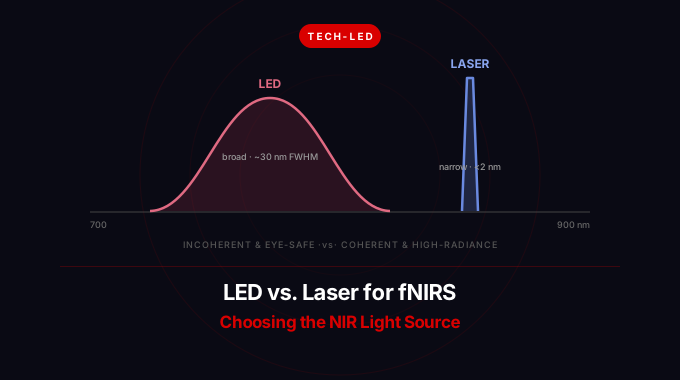
| Spectral bandwidth (FWHM) | ~20-40 nm | <1 nm |
| Eye safety | Inherently lower risk; easier to keep Class 1 | Higher irradiance; stricter IEC 60825-1 classification |
| Cost per emitter | Low | Higher |
| Drive complexity | Simple constant-current | More complex; temperature-sensitive |
| Footprint for wearables | Excellent (small SMD) | Larger, more thermal management |
| Best fit | Continuous-wave (CW) fNIRS | Frequency-domain (FD) and time-domain (TD) fNIRS |
Continuous-wave fNIRS, the most common and lowest-cost modality, and the one used in most wearable and high-density systems, overwhelmingly uses LEDs. They are eye-safe, inexpensive, easy to drive, and small enough to mount in dense optode arrays on a cap.
The main technical caveat for LEDs is their broader spectral bandwidth. A 20-40 nm FWHM means the "760 nm" channel is really a band of wavelengths, and because the differential pathlength factor is wavelength-dependent, broad emission introduces a small error into the MBLL calculation. For CW research and clinical fNIRS this error is well-characterized and acceptable; designers needing the tightest spectral precision (or doing FD/TD measurements that require modulation or short pulses) turn to laser diodes.
Key LED specifications for fNIRS device design
When specifying an fNIRS LED, the parameters that drive measurement quality:
| Specification | Why it matters for fNIRS | Typical target |
|---|---|---|
| Peak wavelength accuracy | Determines where you sit relative to the isosbestic point; affects HbO₂/HbR separation | ±5-10 nm of the target |
| Spectral bandwidth (FWHM) | Narrower reduces MBLL/DPF error | As narrow as practical (20-40 nm typical for LEDs) |
| Radiant power / intensity | Must penetrate scalp+skull and return detectable signal, while staying within skin/eye exposure limits | Application-dependent; balance signal vs. safety |
| Temporal stability | Drift directly becomes measurement noise in the hemodynamic signal | High; constant-current drive |
| Thermal wavelength stability | Peak wavelength shifts with junction temperature (~0.1-0.3 nm/°C for NIR), moving you off the target band | Low drift; thermal management |
| Package footprint | High-density and wearable optode arrays need compact emitters | SMD / small-footprint packages |
| Drive current range | Must support the modulation/multiplexing scheme (LEDs are often time-multiplexed by wavelength) | Per design |
Thermal stability deserves emphasis in wearable fNIRS: an emitter mounted against the scalp warms up, and an uncompensated wavelength shift moves the channel relative to the isosbestic point. Constant-current drive, adequate heat-sinking, and tight wavelength binning all help hold the measurement steady.
Optode and source-detector design
In fNIRS, a source (the NIR LED) and a detector (a photodiode, avalanche photodiode, or silicon photomultiplier) form an optode pair. The light from the source travels in a banana-shaped path through tissue to the detector; the depth it samples is governed by the source-detector separation.
- Source-detector separation: typically ~3 cm for adult cortical measurements. A useful rule of thumb is that the sampled depth is roughly half the separation, so a 3 cm spacing probes ~1.5 cm into tissue, reaching the outer cortex. Shorter separations (~0.8 cm) are used as "short-separation channels" to capture and regress out scalp/superficial signals.
- Detector pairing: the detector must be sensitive across both fNIRS wavelengths. Silicon photodiodes respond well across 700-900 nm; APDs and SiPMs add gain for low-light, large-separation, or high-density configurations.
- Optical coupling: hair is the enemy of scalp coupling. Optode mechanical design (spring-loaded holders, light guides, brush optodes) matters as much as the emitter for real-world signal quality.
- Wavelength multiplexing: because each detector sees both wavelengths, systems separate them in time (alternating LED illumination) or frequency (modulating each wavelength at a distinct frequency). The LED's drive characteristics must support the chosen scheme.
Marubeni NIR LEDs for fNIRS
Tech-led distributes Marubeni's near-infrared LED portfolio, which spans the wavelengths fNIRS device designers need, including emitters in the ~760 nm and ~850 nm bands that make up the standard dual-wavelength pairing, in surface-mount packages suited to dense and wearable optode arrays. Relevant wavelength-specific background:
- 780 nm NIR LEDs, near the lower fNIRS band, for optical sensing and control
- 850 nm NIR LEDs, the standard upper fNIRS wavelength, high-efficiency and well-characterized
- Near-Infrared (NIR) LED Guide, the parent guide covering the full NIR range and selection criteria
fNIRS wavelength pairs (e.g. 760 + 850 nm) and the tight binning, footprint, and thermal-stability requirements of optode arrays are exactly the kind of spec-stage decision worth confirming with an applications engineer. For component recommendations, datasheets, and samples, see the NIR LED product range or contact Tech-led engineering.
Frequently asked questions
What wavelengths are used in fNIRS?
fNIRS systems use at least two near-infrared wavelengths that straddle the hemoglobin isosbestic point near 800-810 nm, most commonly around 760 nm and 850 nm. Other pairings (690/830 nm, 730/850 nm, 780/850 nm) are also used. The lower wavelength is more sensitive to deoxy-hemoglobin (HbR) and the upper to oxy-hemoglobin (HbO₂).
Why does fNIRS need two wavelengths?
Because it measures two things, HbO₂ and HbR, and their absorption curves cross at the isosbestic point. A single wavelength can't separate the two. Using one wavelength below the isosbestic point and one above gives two independent equations, letting the modified Beer-Lambert law solve for both hemoglobin concentrations.
Should I use an LED or a laser diode for fNIRS?
For continuous-wave (CW) fNIRS, the most common modality, and standard for wearable and high-density systems, LEDs are the usual choice: eye-safe, low-cost, compact, and easy to drive. Laser diodes are used for frequency-domain and time-domain fNIRS, which need narrow bandwidth and modulation or short pulses that LEDs can't provide. The trade-off is LED spectral bandwidth (20-40 nm vs. <1 nm for lasers), which adds a small, well-characterized error to the hemoglobin calculation.
What is the isosbestic point and why does it matter for fNIRS?
The isosbestic point (~800-810 nm for hemoglobin) is the wavelength where oxy- and deoxy-hemoglobin absorb light equally. It's the reference around which fNIRS wavelengths are chosen: one wavelength below it (HbR-dominant) and one above it (HbO₂-dominant) give the cleanest separation of the two chromophores.
How deep does fNIRS measure?
Penetration depth is roughly half the source-detector separation. A typical 3 cm separation samples about 1.5 cm into tissue, enough to reach the outer cortex through scalp and skull in adults. Short-separation channels (~0.8 cm) sample only superficial scalp tissue and are used to remove that interference from the brain signal.
Are NIR LEDs eye-safe for fNIRS?
NIR LEDs at fNIRS power levels are generally low-risk and are commonly designed to meet IEC 62471 Class 1 (Exempt). Because the light is invisible and applied against skin, designers must still verify skin and eye exposure limits for the chosen radiant power and run a photobiological safety assessment at the system level, particularly for high-power or high-density arrays.
What FWHM should an fNIRS LED have?
Narrower is better for measurement accuracy, because the differential pathlength factor in the modified Beer-Lambert law is wavelength-dependent and broad emission smears it. Typical NIR LEDs have a 20-40 nm FWHM, which is acceptable for CW fNIRS. Applications needing tighter spectral precision use laser diodes (<1 nm).
Can I build a wearable fNIRS device with LEDs?
Yes, wearable and high-density fNIRS systems are a primary driver of LED adoption. Small surface-mount NIR LEDs fit dense, cap-mounted optode arrays, run on simple constant-current drive, and are eye-safe for prolonged scalp contact. The key design constraints are footprint, thermal/wavelength stability against the warm scalp, and optical coupling through hair.
How is fNIRS different from EEG or MRI?
fNIRS measures cortical hemodynamics (blood-oxygenation changes) optically; EEG measures electrical activity; fMRI measures hemodynamics via magnetic resonance. fNIRS sits between EEG and fMRI on cost and portability, more spatially specific than EEG, far more portable and lower-cost than fMRI, and tolerant of motion, which is why wearable fNIRS is a growing device category and a growing market for NIR LED components.
Related guides
- Near-Infrared (NIR) LED Guide, parent pillar: full NIR range, applications, selection
- 780 nm Infrared LED Light Sources, lower-band NIR for optical sensing
- 850 nm Infrared LEDs, the standard upper fNIRS wavelength
- How Near-Infrared LEDs Are Revolutionizing Medical Devices, broader biomedical NIR LED context
Designing an fNIRS device and selecting the light source? Contact Tech-led engineering for NIR LED wavelength-pair recommendations, datasheets, and samples for functional near-infrared spectroscopy systems.