Tech-led.com



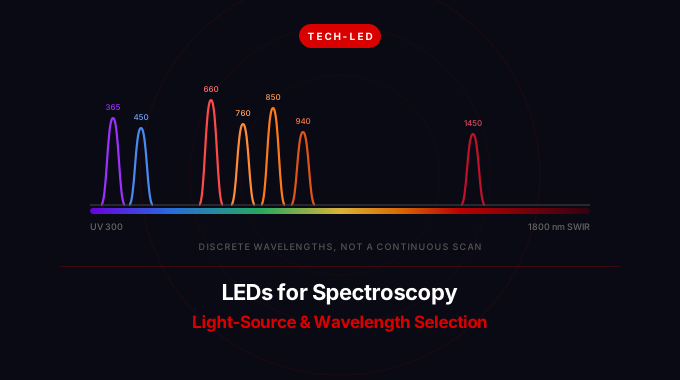
LEDs appear across medical devices in three broad roles, each defined by wavelength. In phototherapy, red (~630–660 nm) and near-infrared (~850 nm) light drive photobiomodulation for pain relief, circulation, and skin treatment. In biomedical sensing, red and infrared LEDs (660 + 940 nm) measure blood oxygen in pulse oximeters, and paired NIR wavelengths (~760 + 850 nm) measure brain activity in fNIRS. In imaging and diagnostics, NIR and SWIR light penetrates tissue for vein visualization, optical coherence tomography, and tissue-oxygenation mapping. This page maps each application to its wavelength and links to the in-depth guide for each.
| Medical application | Wavelength | In-depth guide |
|---|---|---|
| Photobiomodulation / light therapy | Red 630–660 nm, NIR 850 nm | LED light therapy · NIR light therapy |
| Pulse oximetry (SpO₂) | Red 660 nm + IR 940 nm | Pulse oximeter LED wavelengths |
| fNIRS (brain activity) | NIR ~760 + 850 nm | NIR LEDs for fNIRS |
| Biometric / optical sensors | Red 630 nm | 630 nm biometric sensing |
| Tissue imaging, vein finders, OCT | NIR / SWIR | SWIR LED guide |
Phototherapy and photobiomodulation
Photobiomodulation (PBM) uses red and near-infrared light to stimulate cellular activity — increasing ATP production and circulation, reducing inflammation, and accelerating tissue repair. Red (~630–660 nm) treats superficial tissue and skin; near-infrared (~850 nm) penetrates deeper for muscle, joint, and pain applications. These devices range from handheld units to full-body panels and are LED-based rather than laser for lower cost, larger treatment areas, and minimal heat.
For the mechanisms, evidence, and device-design considerations, see the in-depth guides: LED Light Therapy: A Technical Guide to Red and Infrared Devices and Near Infrared Light Therapy: Photobiomodulation Mechanisms and LED Design.
Biomedical sensing and monitoring
LEDs are the light source in non-invasive optical sensors that read physiological signals through the skin:
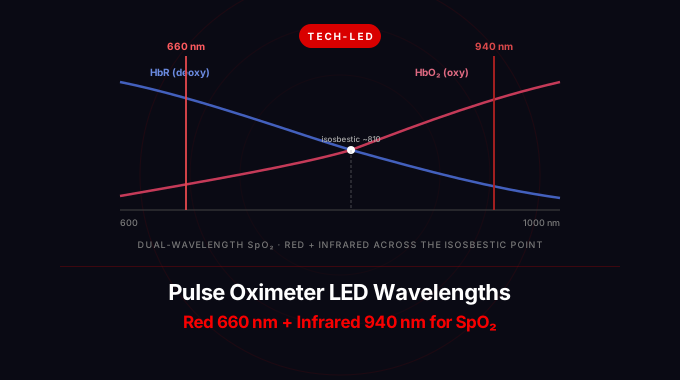
- Pulse oximetry (SpO₂) pairs a 660 nm red and 940 nm infrared LED to measure blood-oxygen saturation from the differential absorption of oxy- and deoxy-hemoglobin. See the pulse oximeter LED wavelength guide.
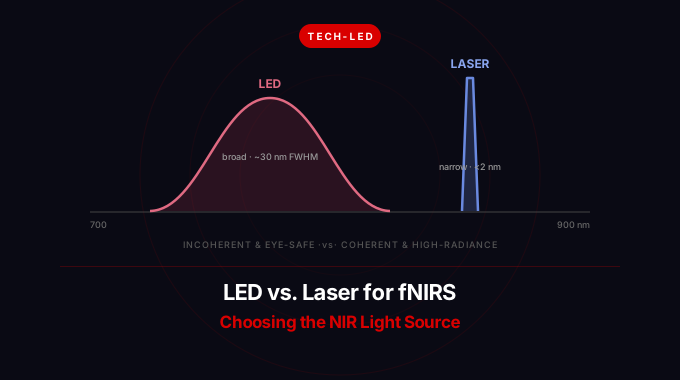
- fNIRS uses two NIR wavelengths (~760 + 850 nm) straddling the hemoglobin isosbestic point to measure cortical blood-oxygenation changes — wearable brain-activity monitoring. See the fNIRS LED guide.
- Photoplethysmography (PPG) and biometric sensors use 630 nm red and green light for heart rate and pulse, often in wearables.
The shared design discipline — wavelength accuracy, output stability, detector pairing — is covered in the LED optical sensors guide.
Imaging and diagnostics
Because near-infrared light penetrates several millimeters to centimeters into tissue, NIR and SWIR LEDs enable optical imaging that visible light cannot:
- Vein visualization — NIR (~850 nm) light is absorbed by blood and reflected by surrounding tissue, mapping subsurface veins for IV access.
- Tissue oximetry and functional imaging — multi-wavelength NIR maps oxygenation across tissue.
- OCT and deeper imaging — NIR/SWIR sources support optical coherence tomography and research imaging. See the SWIR LED guide and the broader medical NIR LED overview.
For ultraviolet medical uses — fluorescence-based diagnostics and UV phototherapy (e.g. narrow-band UV-B for dermatology) — see the UV LED Guide. Note that UV-C germicidal disinfection uses deep-UV emitters (255–280 nm) that are a separate device category from the red/NIR/SWIR emitters covered here.
Why LEDs in medical devices
- Wavelength precision matched to hemoglobin, water, and chromophore absorption.
- Stability for quantitative measurements (SpO₂, fNIRS, oximetry).
- Low heat and eye-safe operation at typical drive levels, with photobiological safety evaluated under IEC 62471.
- Compact, reliable packaging for wearables, handhelds, and bedside devices, with 50,000+ hour lifetimes.
Tech-led supplies red, visible, and IR/NIR LED emitters for medical and therapeutic devices. For component selection, datasheets, and samples, contact Tech-led engineering.
Frequently asked questions
What LED wavelengths are used in medical devices?
It depends on the function: red (630–660 nm) and near-infrared (850 nm) for photobiomodulation therapy; red (660 nm) plus infrared (940 nm) for pulse oximetry; paired NIR (~760 + 850 nm) for fNIRS brain sensing; and NIR/SWIR for tissue imaging and vein visualization. Each is matched to how light interacts with tissue and hemoglobin.
What wavelength is used for red light therapy?
Photobiomodulation uses red light around 630–660 nm for superficial/skin treatment and near-infrared around 850 nm for deeper muscle and joint applications. Many devices combine both. See our LED light therapy and NIR light therapy guides for mechanisms and device design.
How do pulse oximeters use LEDs?
A pulse oximeter shines a red (~660 nm) and an infrared (~940 nm) LED through tissue and measures how each is absorbed. Oxygenated and deoxygenated hemoglobin absorb the two wavelengths differently, so the ratio of the pulsatile signals gives blood-oxygen saturation (SpO₂).
What is fNIRS and what LEDs does it use?
Functional near-infrared spectroscopy measures brain activity by reading blood-oxygenation changes in the cortex. It uses at least two NIR wavelengths (commonly ~760 and 850 nm) that straddle the hemoglobin isosbestic point, so it can resolve oxy- and deoxy-hemoglobin separately.
Are LEDs used in medical imaging?
Yes. Near-infrared LEDs map subsurface veins for IV access, multi-wavelength NIR images tissue oxygenation, and NIR/SWIR sources support optical coherence tomography and research imaging — all exploiting near-infrared light's ability to penetrate tissue.
Does tech-led supply UV-C LEDs for medical sterilization?
Tech-led's medical portfolio centers on red, visible, NIR, and SWIR emitters for therapy, sensing, and imaging. UV-C germicidal disinfection (255–280 nm) is a separate deep-UV device category; see the UV LED Guide for how UV-C fits the broader ultraviolet picture.
Why use LEDs instead of lasers or lamps in medical devices?
LEDs deliver specific wavelengths at lower cost than lasers, illuminate larger areas, generate little heat, and are eye-safe at typical levels — ideal for therapy panels and wearable sensors. Compared to lamps, they offer narrow-band output, instant control, stability, long life, and no mercury.
Related guides
- LED Light Therapy: Red and Infrared Devices for Photobiomodulation
- Pulse Oximeter LED Wavelengths
- NIR LEDs for fNIRS
- How Near-Infrared LEDs Are Revolutionizing Medical Devices
Developing a medical or therapeutic device? Contact Tech-led engineering for LED wavelength recommendations, datasheets, and samples.