Tech-led.com


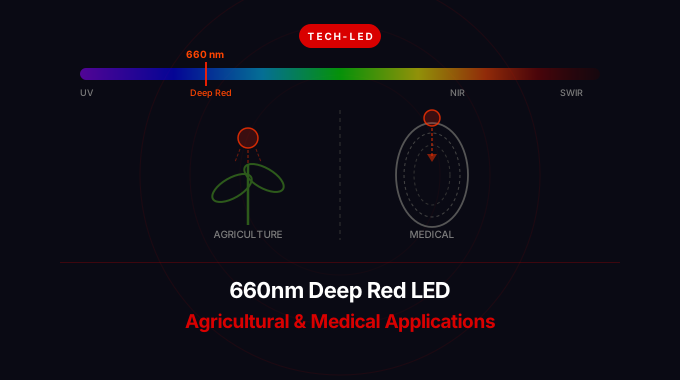
Deep red 660 nm LED emitters have become essential components in both advanced agricultural lighting and biomedical systems. At a wavelength of 660 nanometers – the heart of the red light spectrum – these LEDs align with peak chlorophyll absorption to maximize photosynthetic light for plants, while also offering an optimal balance of optical penetration and efficiency for tissue illumination. In this article, we explain why the wavelength of 660 nanometers is uniquely effective for photosynthesis, how this deep red light balances absorption with system efficiency, and why 660 nm is equally valuable in biomedical sensing and therapeutic illumination.
What defines the 660 nm LED wavelength?
At 660 nm, a deep red LED emits light in the visible red portion of the spectrum, right near the edge of human vision. For context, blue light is around 450 nm and yellow about 590 nm, while red light peaks around 660 nm; any wavelength beyond roughly 700–780 nm is considered infrared. This places 660 nm LEDs at the transition between visible red and the IR / NIR LEDs range. In practical terms, a “660 nm LED” refers to an LED chip engineered to have a dominant emission around the 660 nanometer deep red light region. Unlike a laser, an LED does not emit a single exact wavelength; rather it produces a narrow band of red wavelengths (typically with a ~20–30 nm full width at half maximum). For example, a typical deep red LED might peak at 660 nm but emit across approximately 650–670 nm. The LED’s semiconductor material (often AlGaInP for red) fixes this spectral output. As the LED warms up during operation, its peak can slightly **red-shift** (move to a longer wavelength) – on the order of ~0.2–0.3 nm per °C – meaning a device nominally 660 nm at room temperature might shift a few nanometers at higher junction temperatures. Such small shifts are usually negligible for plant or sensor applications, but they underscore that LED wavelength is not absolutely static. Overall, the 660 nm designation indicates a deep red LED source squarely within the Visible LEDs (400–800 nm) range, offering a specific red color without needing any filters. (For a broader overview of LED colors across the spectrum, see our LED wavelength guide.)

660 nm LED specifications at a glance
Typical specifications for a 660 nanometer deep-red LED:
| Parameter | Typical value (660 nm deep-red LED) |
|---|---|
| Peak wavelength | 660 nm |
| Spectral bandwidth (FWHM) | ~20 nm |
| Emission | Visible deep red |
| Semiconductor | AlGaInP |
| Forward voltage | ~2.1 V (typical) |
| Common packages | SMD, COB, SMBB, EDC |
| Typical use | Horticulture (photosynthesis), red-light therapy, optical sensing |
Why is 660 nm the core red wavelength for photosynthesis?
In horticultural lighting, **660 nm deep red** has emerged as the primary “photosynthesis” LED wavelength because it aligns exceptionally well with plants’ light absorption needs. Chlorophyll – the key pigment driving photosynthesis – absorbs light most strongly in the blue and red regions. In fact, chlorophyll a (the most abundant form) has peak absorbance around 662–665 nm in the red. This means a 660 nm LED directly targets one of chlorophyll’s optimal bands, delivering photons that plants can use efficiently to generate energy. By providing red photons at the wavelength where absorption is highest, less light is wasted and more is converted into chemical energy in the plant.
Deep red LEDs, especially 660nm LEDs, are not only effective biologically; they are also highly efficient technologically. According to horticultural research, red LED chips around 660 nm are among the most efficient at converting electricity into photosynthetically active photons. In other words, for each watt of electrical power, a quality 660 nm LED can produce a very high number of photons in the photosynthetic waveband. (This is partly because red photons carry lower energy per photon than blue photons, so a watt of red light contains more photons – contributing to a higher quantum efficacy for plant growth.) Additionally, LED manufacturers have refined aluminum gallium indium phosphide (AlGaInP) deep red chips to achieve excellent output per input watt. The result is that horticulture LED fixtures heavily emphasize 660 nm emitters – often making up 75–85% of the spectral output in grow lights – to maximize PAR (photosynthetically active radiation) delivery efficiently because of their relative quantum efficiency and cost-effectiveness. As one expert explains, deep red LEDs hit a “sweet spot”: chlorophyll absorbs red light strongly and the LED devices themselves are efficient and cost-effective, so 660 nm ends up being the workhorse wavelength for powering photosynthesis.
It’s worth noting that plants have specific photoreceptors beyond chlorophyll that also respond to red light. The pigment **phytochrome**, for example, has two interconvertible forms (Pr and Pfr) that absorb red (~660 nm) and far-red (~730 nm) light. Deep red illumination converts phytochrome to its active form (Pfr), triggering various developmental responses such as seed germination cues and suppression of shade-avoidance. Because phytochrome is highly sensitive to red, even very low intensities of 660 nm at night can impact flowering cycles – for instance, a brief pulse of red light at 660 nm during the dark period can inhibit flowering in short-day plants or promote flowering in some long-day plants. This underscores how critical the 660 nm wavelength is: it not only drives photosynthesis, but also provides signals that regulate plant morphology and timing (photoperiodism). In summary, 660 nm is considered the “core” red wavelength for plant growth because it simultaneously maximizes photosynthetic **light output** and influences key biological responses.
Chlorophyll absorption and plant response at deep red wavelengths
The importance of 660 nm becomes clear when examining chlorophyll’s absorption spectrum and plant physiology. Chlorophyll a absorbs light most strongly at two peaks – one in the blue (~430 nm) and one in the red (~662 nm) – while chlorophyll b complements this with its own peaks (around 453 nm in blue and ~642 nm in orange-red). That deep red **660nm light** corresponds almost exactly to chlorophyll a’s dominant red absorption band, meaning photons of this wavelength are readily captured by the photosystems in plant chloroplasts. When a 660 nm photon hits a leaf, it is very likely to be absorbed by chlorophyll and used in driving the electron transport chain of photosynthesis. This is why 660 nm LEDs are often called “peak growth” or “chlorophyll peak” lights in horticulture. By contrast, wavelengths significantly shorter or longer (e.g. green ~550 nm or far-red ~730 nm) are absorbed less by chlorophyll and thus are less efficient at powering photosynthesis per photon.
Plant growth experiments confirm that red light around 660 nm is highly effective at sustaining photosynthesis and biomass accumulation. In the classic McCree curve (relative quantum efficiency curve for photosynthesis), red photons (600–670 nm) were shown to be at least as effective as blue photons at driving instantaneous photosynthesis. Practically, plants grown under predominantly deep red light can photosynthesize robustly – though they may develop some morphological differences if no other colors are present. Red light tends to promote stem elongation and large, thin leaves when used alone (plants grown in pure red often appear stretched or “leggy”). This is because in the absence of blue light, the plant’s growth regulator pathways encourage extension growth. However, adding a small fraction of blue (say 10–20%) to a primarily red LED spectrum results in much more normal, compact development. Growers have found that a mix of ~80–90% red with ~10–20% blue yields an ideal balance – maximizing photosynthesis via the red, while the blue keeps plants stocky and robust.
Another consideration is the role of **far red** light (700–750 nm) in conjunction with deep red. Far-red photons are outside the traditional PAR definition (which ends at 700 nm), and chlorophyll absorbs them very weakly. Alone, far-red light doesn’t drive photosynthesis efficiently. However, recent studies indicate that combining far-red with shorter wavelengths can produce a synergistic effect: adding some 730 nm alongside 660 nm can enhance overall photosynthesis, effectively extending the usable spectrum beyond the classical limit. Far-red light also strongly affects phytochrome – converting Pfr back to the inactive Pr – which in turn influences plant architecture (e.g. inducing shade-avoidance responses like stem elongation if far-red is prevalent). Thus, in horticulture lighting, deep red is the primary engine for photosynthesis, while far-red is used carefully as a supplement to modulate flowering and canopy penetration. For example, lamps designed to regulate flowering often include 660 nm LEDs (to manipulate phytochrome) and sometimes add 730 nm to stimulate or inhibit flowering depending on the crop. In summary, a **wavelength range** centered on 660 nm provides the bulk of energy for plant growth, with blue light providing form regulation and far-red fine-tuning certain developmental signals.
Comparing 660 nm to 450 nm and 520 nm in plant systems reveals the superiority of 660nm deep red light.
Not all colors of light contribute to plant growth equally. Deep red (660 nm) often gets top billing for efficiency, but what about other parts of the spectrum like blue (~450 nm) or green (~520 nm)? In photosynthetic terms, **red vs blue vs green** each have unique roles and trade-offs. Blue photons (400–500 nm) carry more energy per photon than red, and they are also absorbed by chlorophyll (especially chlorophyll b) and accessory pigments. However, due to absorption by other molecules (like anthocyanins), blue light is actually slightly less efficient for photosynthesis than red light – about 10–20% less effective on a per-photon basis. This means if you deliver equal numbers of blue and red photons to a leaf, the red will typically drive a bit more photosynthesis. Nevertheless, blue light is crucial for plant morphology: it suppresses excessive stem elongation and leaf expansion, ensuring plants grown under LEDs remain compact and sturdy and supports balanced growth responses. Thus, most **LED grow light** systems include a fraction of blue (e.g. using 450 nm LEDs) not to maximize photosynthesis per se, but to produce healthier plant form and to prevent the “stretch” that red-alone lighting can cause.
Green light (around 520–550 nm) has an interesting dual character in plant lighting. Historically, green was thought to be mostly reflected by plants (since leaves appear green, indicating less absorption). Indeed, chlorophyll absorbs green less than red or blue. Consequently, green photons are somewhat less efficient for photosynthesis – estimates put them at around 5–10% less effective than red photons. However, green light penetrates deeper into leaves and canopies than red or blue light. While red and blue are largely absorbed in the top cell layers of a leaf, green can travel further through the mesophyll. This deeper penetration means green light can drive photosynthesis in lower chloroplasts or even in shaded leaves beneath a canopy. In practical terms, adding some green (often via white LEDs, which include a broad spectrum) can improve whole-canopy carbon gain, even if green is less efficient at the single-leaf level. Also, green makes working under grow lights easier on the human eye (a purely red/blue “magenta” environment is hard to see in). Many commercial fixtures therefore incorporate some 500–570 nm output via phosphor-converted white LEDs to balance efficiency, plant response, and visibility.
Overall, **660 nm deep red** is the heavy lifter for photosynthesis, but a combination of red + blue – and a bit of green/white – provides the best results in controlled environment agriculture. A typical high-efficiency LED grow light might use something like 90% 660 nm red LED chips paired with 5–10% 450 nm blue chips, creating a purplish light that maximizes growth. Some designs also blend in a few broad-spectrum or 520 nm green LEDs to improve color rendering and lower-canopy lighting. In contrast, wavelengths outside the visible range (e.g. UV LEDs below 400 nm) are generally not used in bulk for photosynthesis – UV can stress plants or trigger protective pigments rather than drive growth. (UV is used in small doses for specific effects like increasing flavonoids, but that’s a niche application.) Similarly, **far red** (~730 nm) is used strategically rather than as a main energy source – as mentioned, it can promote flowering or expansion but will reduce the red:far-red ratio, potentially causing stretching if overused. In summary, compared to blue (which is needed in moderation for plant form) and green (moderately effective, good for penetration), 660 nm red stands out as the most efficient wavelength to deliver photons for photosynthesis. (For deeper dives into other specific LED wavelengths, see our dedicated articles on the 450 nm LED – and the 520 nm LED and 660nm LED are often used in various applications.)
How does 660 nm compare to 850 nm for sensing and tissue penetration?
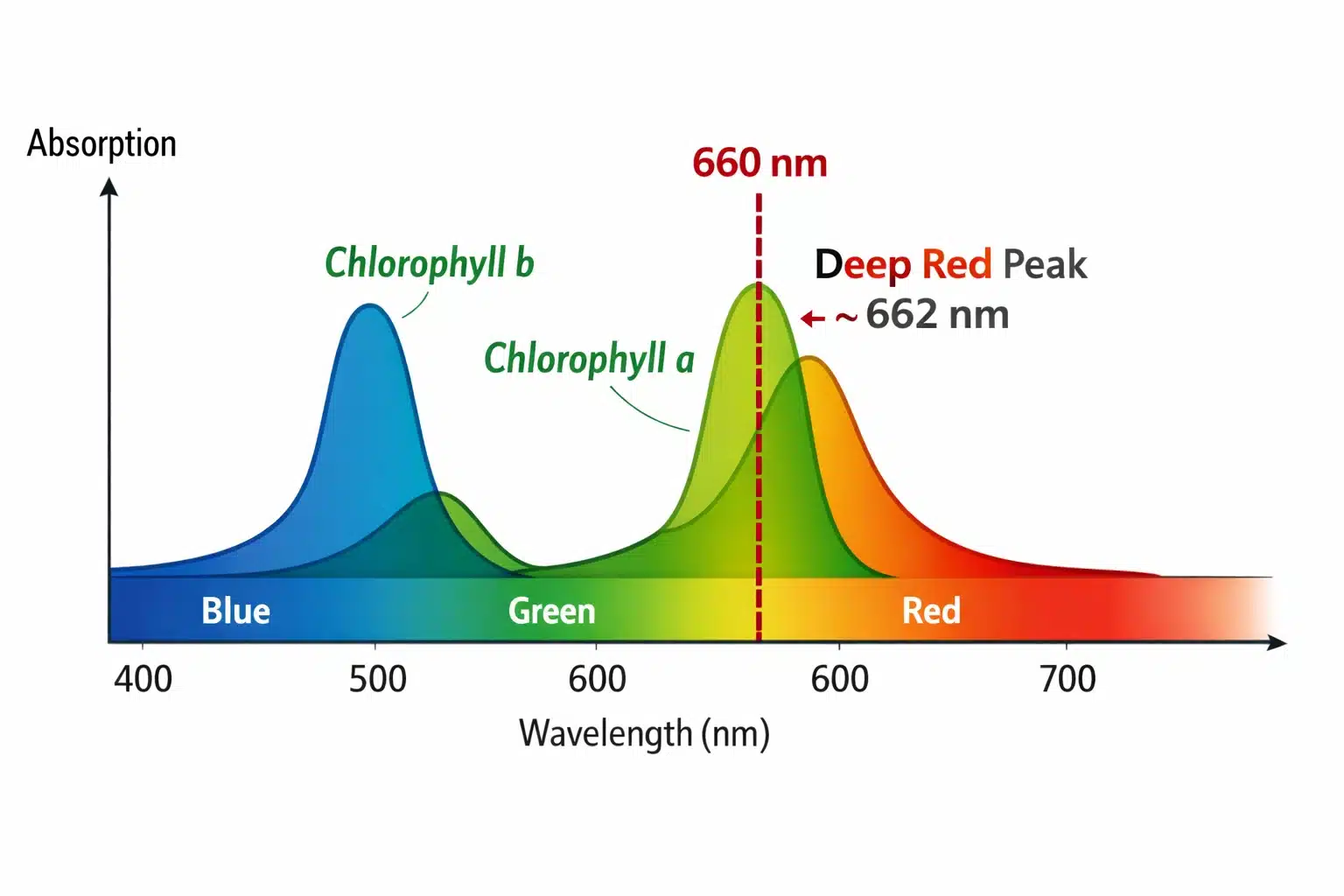
Figure 1:
Chlorophyll absorption spectrum highlighting the deep-red peak (~662 nm), with a reference line at 660 nm showing why this wavelength aligns so closely with maximum photosynthetic efficiency.
The **near-infrared** region around 850 nm plays a very different role from 660 nm deep red. At 850 nm, we are beyond visible light – this is an infrared wavelength invisible to the human eye. It lies in the domain of IR/NIR LEDs commonly used for sensing, imaging, and non-photosynthetic applications. One of the most important differences between 660 nm and 850 nm light is how they interact with materials like plant tissue and human tissue. Chlorophyll, for example, absorbs 660 nm strongly (as discussed) but absorbs very little at 850 nm. Healthy vegetation thus reflects most **near-infrared light** while absorbing red. This fact is exploited in multi-spectral sensing: instruments like NDVI sensors use a red channel (around 660–680 nm) and an NIR channel (~800–850 nm) to assess plant health. The classic NDVI (Normalized Difference Vegetation Index) is calculated from the difference between NIR and red reflectance – healthy leaves absorb red light heavily but reflect NIR, leading to a high NDVI value. In practice, an NDVI device might illuminate a crop canopy with a 660 nm LED and measure reflectance with a photodiode, comparing it to the reflectance of an 850 nm LED. According to case studies on NDVI-based chlorophyll estimation, NDVI sensors indeed pair a red and an NIR detector to estimate chlorophyll content by looking at transmitted or reflected red vs. NIR light. The red 660 nm band is chosen because it coincides with chlorophyll absorption, making the measurement sensitive to leaf chlorophyll levels, whereas the 850 nm band provides a baseline as it is mostly unaffected by chlorophyll (but sensitive to leaf structure and water content). In summary, in agricultural **sensing**, 660 nm and ~850 nm work as a complementary pair – one seeing how much red is “used” by the plant, the other seeing how much NIR is simply reflected back. (This is the principle behind many drone or satellite vegetation indices as well, where filters around 660 and 800–870 nm are common. In fact, NDVI is maximized when the red band is near the center of chlorophyll’s absorption, ~670 nm, which is why deep red LED sources are ideal for these sensors.)
In **biomedical sensing**, the 660 vs 850 nm combination is also prevalent. A great example is the pulse oximeter – a device that measures blood oxygen saturation noninvasively. Pulse oximeters shine two wavelengths of light through a thin body part (like a fingertip): one red around 660 nm and one infrared around 940 nm (close to 850 nm, just a bit longer). The reason for this choice is that oxygenated hemoglobin and deoxygenated hemoglobin absorb red and infrared light differently. Oxyhemoglobin absorbs more infrared and less red, whereas deoxyhemoglobin absorbs more red light. Thus, by comparing how much 660 nm red light versus 940 nm (IR) light is absorbed by the blood, the device can compute the oxygen saturation. In fact, a standard pulse oximeter uses a red LED (~660 nm) and an IR LED (~940 nm) for this measurement. The red light (660 nm) is absorbed strongly by deoxy-hemoglobin, and the infrared light is absorbed more by oxy-hemoglobin, so the ratio of absorption at these two wavelengths directly reflects the blood’s oxygenation level. While our focus here is on 850 nm (not 940), the principle is similar – these wavelengths fall in the near-IR where tissue is relatively transparent aside from blood. Some pulse oximeters and optical heart-rate sensors actually use 660 + 850 nm or 660 + 910 nm pairs, depending on the design, because 850 nm is another common LED available and still differentiates oxygenated blood reasonably well.
Beyond sensing, 660 nm and 850 nm are both popular in **photobiomodulation** and therapeutic illumination, but they have different penetration depths. Red light at 660 nm can penetrate skin and shallow tissue on the order of a few millimeters to a centimeter or more, depending on power and the tissue type. This makes it suitable for treating surface conditions (wound healing, skin health, etc.) – hence many “red light therapy” panels use 660 nm LEDs for skincare and anti-inflammatory purposes. Near-infrared light at 850 nm, on the other hand, penetrates even deeper – several centimeters into tissue – because longer wavelengths scatter less and certain tissue components (like water and hemoglobin) have lower absorption in the near-IR range. For instance, in low-level laser therapy studies, wavelengths around 810–850 nm have been shown to reach deeper layers (muscle, joints, even bone to some extent) whereas 660 nm tends to concentrate its effect in the superficial tissues. One study measuring 660 nm LED light penetration found that with sufficient irradiance (100 mW/cm2), red light could be detected at tissue depths of up to ~50 mm (5 cm) in cadaveric samples, though much higher power was required to go beyond 50 mm. In live tissue, the practical penetration of 660 nm for therapeutic effect is usually quoted around 5–10 mm (for skin and subcutaneous layers), whereas 850 nm can impact tissues perhaps 20–30 mm deep or more under ideal conditions. This is why many LED therapy devices actually incorporate both 660 nm **red LEDs** and ~850 nm **infrared LEDs** – the red targets the skin surface and shallow structures, while the NIR dives into “deep tissue” to benefit muscles and joints. In summary, 660 nm vs 850 nm is not a matter of which is “better” – they serve different roles: 660 nm excels at interacting with pigments like chlorophyll or hemoglobin (making it great for plant indices and blood oxygen sensors) and treating surface tissues, whereas 850 nm excels at propagating through materials (making it ideal for penetration into dense canopies or deep human tissues). (For more on the latter, see our upcoming article on the 850 nm LED.)
Spectral characteristics and output stability of 660 nm LEDs
Deep red 660 nm LEDs are often described as **quasi-monochromatic** sources. This means they emit a tightly clustered spectrum of wavelengths rather than a broad band. Unlike a white LED (which covers a wide range via phosphor) or a fluorescent lamp, a red LED will have most of its output concentrated around the specified wavelength. Typically, a 660 nm LED might have a spectral bandwidth (full width at half maximum) of about 20–30 nm. For instance, one datasheet might specify a peak at 660 nm with an FWHM of 25 nm, meaning the light is mostly between ~650 and ~675 nm. This narrow spectrum is beneficial for controlled experiments and applications: in plant science, using a 660 nm LED means you are delivering a known, specific red wavelength to the plants (useful for studying wavelength-specific effects). In sensing, using a narrow-band source like an LED avoids the need for additional optical filters – the LED by itself outputs primarily the desired wavelength (e.g. an optical sensor for chlorophyll fluorescence might use a 660 nm LED to excite chlorophyll a and know that little other light is present to confound measurements).
Another advantage of the LED’s narrow spectrum is consistency over time. The output **spectrum LED** profile of a 660 nm LED remains basically the same throughout its life – it doesn’t “drift” to completely different colors with age (though intensity will slowly decrease). That said, there are a few factors that can cause slight spectral shifts or intensity changes: temperature, current, and aging. As mentioned earlier, as an LED’s junction temperature rises, the peak wavelength shifts slightly to longer (redder) wavelengths. The shift is roughly 0.2–0.3 nm per °C for many red LEDs. In practical terms, if your LED heats up by 20–30 °C, the peak might move ~5–6 nm – generally not enough to affect plant growth or sensing noticeably. Nonetheless, precision systems account for this; for example, high-end optical instruments may include temperature control for the LEDs or calibration to correct for any drift in peak wavelength. High drive currents can also cause minor shifts and broader emission (due to self-heating and band-filling effects), so running a 660 nm LED significantly above its nominal current will warm it and potentially alter its output profile slightly.
In terms of **output stability** and lifetime, 660 nm LEDs today offer excellent performance. Most high-quality deep red LEDs are rated for very long lifetimes (50,000 hours or more to 70% of initial output, i.e., L70, under nominal conditions). The key to achieving this lifetime is managing heat – as with all LEDs, running cooler prolongs life and maintains intensity. At elevated temperatures, LED output can degrade faster and the emitted light can even drop in efficiency by around 10% as junction temperature goes from 25 °C to 85 °C due to thermal droop. For this reason, thermal design is crucial (we’ll discuss that more in the next section). In summary, the spectral output of a 660 nm LED is inherently stable and well-defined, with only minor variations due to environmental conditions. This makes deep red LEDs very reliable light sources for scenarios where a constant, known wavelength is needed (like consistent plant lighting or calibrated sensing). Users can generally trust that a 660 nm LED will continue to emit deep red light (not shifting into orange or IR unexpectedly) throughout its working life, as long as it is properly driven and cooled.
High-power 660 nm LED packages (SMD, COB, SMBB, EDC)
LEDs emitting at 660 nm come in a variety of package formats to suit different power levels and applications. For low-power indicator uses (like the tiny red LED on a device panel), one might find simple 5 mm through-hole packages or small SMD LEDs, including 660nm deep red options. However, for lighting and sensing in agriculture or medicine, we often need **high brightness** and high reliability – this is where advanced high-power packages are used. One common form is high-power **SMD LED** packages. These are surface-mount device packages (usually a ceramic or high-thermal-conductivity substrate) that can handle higher currents. Examples include 3535 or 5050 packages (named after their dimensions in mm). A “5050 SMD” package, for instance, is 5.0×5.0 mm and often contains multiple LED chips (it’s sometimes a 3-in-1 package for RGB LEDs, but can also host multiple red chips for more output). A single-color 660 nm **5050 SMD** might house two or four red diode emitters wired in series to handle higher voltage and spread heat. These SMD packages can be driven at 0.5W, 1W, or even 3W levels depending on design – a **3W 660nm** SMD LED typically would be one that can take around 700 mA at ~2.2 V forward voltage (≈1.5 W electrical, which with inefficiencies yields ~3W heat dissipation). Manufacturers mount these on metal-core PCBs to act as star or module LEDs that designers can then integrate onto larger boards or heatsinks.
For even greater output, **COB LED** packages, including those designed for deep red 660nm applications, are designed for demanding applications.Chip-on-Board) are popular. A COB module for deep red might integrate dozens of 660 nm LED chips directly onto a single substrate, creating effectively one large “chip” that emits very high radiance. For example, a 20 mm COB could have 100 small red LED dies arranged densely; when powered, the COB appears as one extremely bright red source. COBs are advantageous for achieving high power in a compact area – they simplify the optical design (only one light source to collimate or diffuse) and can reach high total flux (tens of watts of optical power) with proper cooling. Tech-LED offers deep red COB modules (see their COB (Chip-on-Board) lineup) which provide uniform deep red output ideal for larger grow lights or overhead lamps. The trade-off with COBs is that all that power is concentrated, so the heat flux is intense; excellent heat sinking is required right under the COB. Additionally, a single large source may need secondary optics to spread light across a growing area (unless multiple COBs are used). This contrasts with using many distributed SMD LEDs, which inherently cover an area without additional optics but involve more assembly.
Apart from generic SMD and COB, there are specialized package series optimized for high power and reliability. For instance, Tech-LED’s **High-Power SMBB** series (High-Power SMBB) and **High-Power EDC** series (High-Power EDC) are designed for demanding applications, particularly in the realm of 660nm deep red lighting. An SMBB package is typically a robust surface-mount LED with an enlarged thermal pad and perhaps a built-in micro lens or dome. These can often be driven at 1–3 A currents, providing a very intense 660 nm output from a single emitter. The EDC series might refer to a particular packaging style (for example, epoxy dome ceramic or similar) – these could be packages where the LED chip is mounted on a ceramic base with an epoxy or silicone dome lens to shape the beam. Such designs can handle high current and have **high thermal conductivity** paths for heat, so the LED junction stays cooler under load. Both SMBB and EDC packages are used in contexts like horticultural lighting bars, medical illumination devices, and machine vision systems, where you need bright, stable red light sources that can be surface-mounted onto circuit boards.
Finally, it’s worth mentioning **LED strip light** formats for 660 nm, since they are common in some grow setups and therapy devices. Flexible LED strips can be made using mid-power 660 nm SMD LEDs (often 5050 or smaller 3528 packages). For example, a deep red LED strip might have 120 LEDs per meter, each LED drawing 20 mA at ~2 V, giving a nice even glow of 660 nm along its length. These strips are useful for wrapping around plants or placing close to surfaces because they distribute many low-power LEDs to achieve uniform **illumination**. They won’t match the intensity of a COB or high-power SMBB LED, but for certain applications (like supplemental lighting or close-range therapy pads), the distributed approach avoids hotspots. In contrast, high-power modules like COBs or SMBBs will be used where you need intense light – for instance, a single COB above a plant canopy or an array of SMBB LEDs in a red light therapy lamp. Often, designers will combine approaches: use COBs for primary high-level lighting and fill in shadows with strips or small SMD clusters, or use an array of several SMBB/EDC LEDs spaced out to balance coverage and intensity. When selecting a 660 nm LED package, the checklist usually includes: required optical output (mW or µmol/s), area coverage needed, thermal management capacity, and integration method (surface mount vs. COB module vs. flexible strip). With the wide range of package options available – from **low power** indicator LEDs up to multi-chip high-power modules – there’s a deep red LED solution for virtually every scenario.
Thermal management and efficiency trade-offs in deep-red LEDs
Thermal considerations are critical when designing any high-power LED system, and deep red 660 nm LEDs are no exception. In fact, one of the few “Achilles heels” of 660 nm devices is their susceptibility to efficiency loss at high temperatures and currents – a phenomenon known as **droop**. As you drive an LED harder (increase the forward current), its internal quantum efficiency tends to decrease after a point. For red and far-red LEDs, current droop is often attributed to carrier leakage: at high current densities, some electrons escape the active region without generating photons. The result is that beyond a certain drive current, each additional milliamp produces proportionally less light (and more waste heat). Similarly, as the LED’s junction temperature rises, its output drops and its lifespan shortens. A typical deep red LED might be characterized at a junction temp of 25 °C, but in a real fixture the junction could run at 85 °C or higher. It’s noted that LED efficacy can decrease by around 10% or more when the junction goes from 25 °C to 85 °C, especially in 660nm LEDs.. This means if you don’t get rid of heat effectively, you’re literally losing light output and efficiency.
Good **thermal management** involves several practices: using packages with low thermal resistance (many high-power 660 nm LEDs are built on ceramic or have metal heat-sink pads), mounting them to metal-core PCBs or heat spreaders, and providing active or passive cooling (heat sinks, fans if needed). For example, an SMBB or COB LED will usually be mounted on an aluminum substrate with a thermal interface material to a heatsink. The goal is to keep the junction as cool as possible – ideally under ~60–70 °C during operation for best longevity and stability. Every degree of reduced junction temperature can meaningfully slow down lumen depreciation and prevent spectral shift. Most manufacturers will specify a maximum operating temperature (often 100 °C or so) and a thermal resistance (like °C/W) for the LED package. From these, a system designer calculates how big a heatsink or how much airflow is needed given the power dissipated (remember, if an LED is e.g. 45% efficient in converting electricity to light, the other 55% becomes heat). In deep red LEDs, the efficiency (radiant wall-plug efficiency) might be on the order of 50–70%, meaning roughly half the input power still turns to heat that must be dissipated, particularly in high power LED setups. **High thermal conductivity** materials (aluminum, copper, or even thermal ceramics) are thus used in LED boards and housings to wick heat away quickly.
Another trade-off to manage is how hard to drive each LED versus how many LEDs to use. You can get a certain total light output by driving a few LEDs at very high current, or by using more LEDs at lower current. Surprisingly, the latter is often more efficient. Running ten 660 nm LEDs at 50% of their max current each might yield more total output than running five LEDs at their absolute max, because LEDs are typically more efficient (lumens or photons per watt) at moderate currents. High current increases internal heating and droop. That’s why many horticultural fixtures use a large number of LED chips driven at partial power – it maximizes overall efficacy (µmol/J). The downside is higher component count and cost, but the efficiency gain and lower heat per LED can be worth it. As a designer, finding the right balance is key: you want enough **forward current** through each LED to justify the hardware, but not so much that you hit diminishing returns or overstress the device.
Electrical drivers also come into play. Efficient constant-current LED drivers (with 90–95% conversion efficiency) help minimize extra heat. A poor driver that wastes power will just add more heat to the system. Additionally, consider implementing thermal feedback or dimming: many high-power grow lights include a temperature sensor near the LEDs that can dim the output if the fixture overheats, protecting the LEDs from damage. In deep red systems where the human eye isn’t a reliable indicator of brightness (since our eyes are not very sensitive at 660 nm – red light can appear dim to us even when intensity is high), it’s especially important to design with proper electrical and thermal limits rather than “by eye.” Incorporating a photodiode for monitoring can be useful – for example, a silicon photodiode filtered for 660 nm could continuously measure the output of an LED array and feed a control loop that maintains stable intensity (useful in lab or horticulture settings for consistency, and as a QA measure to detect any LED degradation over time). In summary, maximizing the performance of 660 nm LEDs involves paying careful attention to heat and current: keep the LEDs cool, drive them within an efficient range, use enough emitters to distribute the load, and employ quality drivers. By doing so, you preserve the high photon efficacy that makes deep red LEDs so attractive in the first place, and you ensure a long operational life (often >50,000 hours) with minimal drops in output. Neglect thermal management, and even the best 660 nm LED will underperform – running hot, dimming out faster, or even failing prematurely.
Optical design: beam control, LED density, and uniform illumination
Designing an optical system with 660 nm LEDs requires thinking about how to deliver that deep red light uniformly and effectively to the target – be it plant leaves, sensor photodiodes, or human tissue. One aspect is **beam control**. High-power LED packages often come with a primary optic (for example, a built-in dome lens that gives a Lambertian ~120° spread). Depending on the application, you might want to narrow this beam or diffuse it further with a 660nm LED strip light. For instance, in a greenhouse overhead light, you may want a wide distribution to cover plants evenly. In a medical diagnostic device, you might want to focus the LED light to a small spot or a specific path. Secondary optics like lens arrays, reflectors, or diffusers are commonly employed with deep red 660nm LEDs to shape the output. If you need a concentrated beam – say to penetrate deeper into tissue or to project a spot on a sensor target – you can use collimating lenses that take the LED’s output and focus it to e.g. a 20° beam. Conversely, if you need uniform illumination across an area (like an even wash over a plant canopy or therapy treatment area), you might use diffusers or simply position multiple LEDs in an array to overlap their outputs.
The concept of **LED density** ties in here. This refers to how closely packed the LEDs are in an array or fixture. A high LED density (many LEDs in a small area, like a COB or tightly clustered module) results in effectively one bright source that may need to be spread out optically. A low LED density (LEDs spaced out across a panel or strip) naturally covers area more uniformly with minimal optics. Early-generation LED grow lights often used dense clusters of red and blue LEDs with focusing lenses, which sometimes led to spotty lighting – some areas got intense light, others were darker. Modern designs have trended towards spreading LEDs over the whole fixture to ensure overlapping coverage. Research in horticultural lighting has shown that less-focused photon distribution yields more uniform canopy lighting without reducing efficacy. In fact, many fixtures forego narrow lenses entirely now, relying on a high count of wide-angle LEDs to get even mixing. Using **optical covers** that scatter light is another strategy: a diffuse glass or polycarbonate cover can mix the output of red LEDs so that by the time it reaches plants, it’s very uniform. The trade-off is a slight loss of efficiency (a diffuser might absorb 8–10% of the light at 660nm), but the benefit is no hot-spots and better light penetration into the canopy (because light coming from different angles can reach lower leaves). Improved uniformity often outweighs that small efficiency hit, since plants grow better under consistent lighting than under a few super-intense beams with dark gaps between.
When arranging 660 nm LEDs for uniform illumination, consider using a **red led strip** or grid approach. For example, rather than one 50 W COB in the center of a grow light, an alternative is an array of, say, 50 pcs of 1 W LEDs spread over the panel. The total output can be the same, but the distribution is inherently uniform. Similarly, in a multispectral imaging setup (e.g. for produce sorting or medical imaging), you might ring several red LEDs around the camera lens to evenly bathe the subject in 660 nm light from all sides, avoiding shadows. The **led density** and placement should also account for distance: if the target is far (meters away), a tighter beam or higher density source might be needed to project sufficient intensity. If the target is close (a few centimeters), a looser spacing or even a **5050 smd** LED strip might suffice to cover it. For deep red light therapy devices that wrap around a body part, flexible arrays of many small LEDs ensure the red light hits uniformly from all angles – this is more effective for something like an LED therapy pad for a joint, compared to a single spotlight LED that would only illuminate one spot.
Another optical concern is mixing with other wavelengths. In a typical horticultural lamp, you have mostly 660 nm red but also some blue and maybe far-red or white. Ensuring these different LEDs mix to create a blended spectrum at the plant’s surface is important. Techniques include alternating the positions of different colored LEDs on the board, using diffuse secondary optics as noted, or using **3 in 1** multichip LEDs (for example, tri-die packages that contain a red, a blue, and a green or far-red chip in one package – though for high power, discrete LEDs are more common than multi-color packages). If using discrete LEDs, placing them in a repeating pattern and at the right density will minimize any striping or color imbalance (e.g., you wouldn’t want red and blue to form separate patches of colored light – they should overlap to produce a purplish overall illumination that plants receive). As an extreme example, some LED grow bars are designed with alternating red and blue LEDs so closely spaced that to the naked eye the light looks pinkish-white, indicating good color mixing.
In summary, the optical design for 660 nm LED deployment boils down to: achieving the required intensity at the target and doing so uniformly. If intense, focused light is needed (like in a **light therapy LED** for a small treatment spot or a sensor that requires a narrow beam), one might opt for collimated high-power LEDs or clustered modules with lenses. If broad, even coverage is the goal (like illuminating a 2×4 ft grow tray or a large tissue area), one would distribute many deep red LEDs across that area or use diffusive optics to spread the light. The deep red wavelength itself doesn’t pose special challenges optically (it behaves like any visible light in lenses and reflectors, although some materials like certain plastics might absorb red slightly). It’s more about geometry and intensity management. And thanks to the variety of package types – from tiny SMDs to large COBs – designers have the flexibility to create the beam profiles they need. Whether you need a *high brightness* spotlight or a gentle, uniform glow of 660 nm, the right combination of LED package and optics will make it possible.
Using 660 nm LEDs in agricultural and biomedical sensing systems
The applications of 660 nm deep red LEDs extend beyond illumination – they are also integral to **sensing systems** in agriculture and biomedicine. Let’s consider a few scenarios. In precision agriculture, growers and researchers use active optical sensors to monitor crop health in real time. A common design is a handheld or tractor-mounted unit that emits red light onto plant leaves and measures the reflected light with a detector. As discussed earlier, pairing a 660 nm LED with an NIR LED (e.g. 850 nm) allows calculation of vegetation indices like NDVI, which correlates with chlorophyll content and plant stress. The 660 nm LED provides the “probe” signal that plants strongly absorb, and a calibrated photodiode measures how much of that red is reflected back. By also measuring the reflectance of the NIR LED (which plants don’t absorb much), the device can compensate for factors like leaf angle and ambient light. For example, a sensor might log that a crop’s leaves reflect only 10% of the 660 nm light (meaning 90% was absorbed by chlorophyll) but reflect 50% of the 850 nm light. From these readings, one can infer the plants are dense and healthy. Companies produce such sensors (e.g. Greenseeker, Crop Circle) which often include an array of deep red LEDs and matching photodiodes. Here, 660 nm LEDs are valued for their stability and known output – the sensor’s accuracy relies on the LED consistently emitting the same intensity and wavelength each measurement. Some systems include a reference photodiode next to the LED to monitor its output and correct for any drift (another role for photodiodes in monitoring/QA). In essence, 660 nm LEDs act as a controlled light source for “active sensing” of plant properties, enabling on-the-go decisions about fertilizer, irrigation, or disease treatment based on the light signals returned by the crop.
In **biomedical sensing**, 660 nm appears in various devices. We’ve covered pulse oximetry where it’s used to sense blood oxygenation in vivo. Another example is **wearable electronics**: some fitness bands and smartwatches use red (and infrared) LEDs to estimate blood oxygen (SpO₂) and sometimes blood flow or heart rate at rest. While green LEDs (around 525 nm) are often used for heart rate due to strong pulse signals at the skin surface, red/IR LEDs are used for deeper readings and for people with darker skin where green light penetration is limited. Additionally, medical diagnostic instruments may use 660 nm LEDs for spectroscopy or fluorescence. For instance, certain point-of-care analyzers shine 660 nm through a sample to detect changes in color of a reagent (if the test chemistry produces a dye that absorbs at 660). In microbiology, 660 nm LEDs can be used as a controlled light source to measure bacterial growth in culture via optical density at 660 (OD660 is a common proxy for cell density in suspension). These are all examples where the *sensing* isn’t of the LED’s environment per se, but the LED provides the probing light for an optical measurement.
On the **biomedical treatment** side (which is not sensing but still a system use), arrays of 660 nm LEDs are widely used in phototherapy devices. These can be considered systems with a feedback aspect if they incorporate sensors. For example, a red light therapy bed or face mask might have dozens or hundreds of 660 nm LEDs to deliver therapeutic light for skin health, anti-inflammation, or collagen stimulation. While delivering light, some advanced versions might include temperature sensors or even light sensors to ensure the dose is correct. Typically though, they operate open-loop. Nonetheless, designers choose 660 nm here because of its known interactions with cellular chromophores like cytochrome c oxidase in mitochondria – much as in plants, red light stimulates biological processes in human cells (this field is called photobiomodulation or **red light therapy**). 660 nm is considered ideal for skin-deep treatments (wound healing, scar reduction, acne, etc.) because it penetrates a few millimeters and is absorbed by mitochondria-rich cells, leading to increased ATP production and modulation of healing responses. Many commercial **660nm red light therapy** devices advertise this wavelength for these reasons. For deeper tissue concerns (muscle aches, joint pain), they often include near-infrared (~850 nm) as well, for reasons we discussed. It’s common to see therapy panels with a mix of 660 and 850 LED sources (sometimes switchable or combined), leveraging both wavelengths’ benefits.
One interesting crossover application is **biosensing for agriculture**: using 660 nm LEDs in combination with photodiodes to detect pigments or chemical signals. For example, a device might shine 660 nm on fruit or leaves to detect fluorescence from chlorophyll or other compounds as a freshness or stress indicator. Another might use a 660 nm LED in water quality instruments to detect algae (since algae have chlorophyll that fluoresces red when excited by 660 nm). Even in animal farming, 660 nm LEDs have been used in sensors to detect blood or subtle cues (though 940 nm is more common for penetrating flesh in veterinary oximeters, etc.). In all these cases, the integration of LED and photodiode detectors forms the crux of an optical sensing system. Because 660 nm is a relatively safe, non-ionizing, and specific wavelength, it’s very suitable for continuous use in sensors that come into contact with living subjects, whether leaves or skin. There’s no UV to worry about (no sunburn or DNA damage risk), and it’s not so infrared that it would cause thermal injury; it’s a “just right” wavelength for gentle probing of biological materials.
To sum up, 660 nm LEDs are not just lights – they’re *tools* in smart systems. In agriculture, they allow real-time monitoring of plant health (enabling precision farming that can improve yields and resource efficiency). In medicine and biotech, they enable noninvasive measurements and also treatments that harness light to stimulate biological responses. When designing such systems, one will pair the LED with appropriate sensors (like pairing with a photodiode that has sensitivity at 660 nm or a spectrometer), and one will consider factors such as ambient light (might need to modulate the LED and use lock-in detection to avoid sunlight interference in field sensors), power consumption (battery-operated field sensors will pulse the LED rather than run continuously to save energy), and safety (driving the LED at safe levels for eye exposure if the device could be looked into, for instance, some standards limit how much 660 nm power can be emitted continuously in a consumer device). Many of these sensing applications also require calibration – e.g., calibrating the LED output and photodiode response using known references – to ensure that the numbers (NDVI, SpO₂, etc.) are accurate. A stable, high-quality 660 nm LED simplifies that calibration since its output will be consistent over time and across temperature, within the limits we described earlier. In the end, from **horticulture** to healthcare, the presence of a little red LED shining at 660 nm often means there’s some clever measurement or beneficial therapy happening, capitalizing on this wavelength’s unique intersection with biology.
Electrical design: drivers, forward current, and power consumption
Driving a 660 nm LED (or an array of them) requires careful electrical design to ensure efficiency, stability, and longevity. One key parameter is the LED’s **forward voltage** (Vf). Deep red 660 nm LEDs typically have a lower forward voltage than higher-energy colors like blue or UV. A single 660 nm diode might have a forward voltage around 2.0–2.4 V at its nominal current (compare that to ~3.0–3.4 V for a white or blue LED). This means that for a given supply voltage, you can place more red LEDs in series than you could blue LEDs. For example, on a 24 V DC rail, one could string perhaps 10 red LEDs in series (10 × ~2.2 V ≈ 22 V) but maybe only 7 or 8 blue LEDs. Why does this matter? Many LED driver designs use a series string with a constant current – so understanding Vf helps in configuring series vs parallel connections. When working with high-power LEDs, constant current drivers are the norm. A driver might be set to provide, say, 700 mA; if you have a series string of 5 reds, it will drop whatever voltage necessary (maybe ~11 V) to maintain that 700 mA through all LEDs. If you have 10 in series, it will output ~22 V at 700 mA. The driver choice depends on how many LEDs you need to power and at what current. Fortunately, because red LEDs have relatively low forward voltage, they are quite efficient with respect to driver overhead – less voltage needs to be dropped or regulated as waste heat in linear drivers (if those are used), and in switching drivers, the conversion tends to be efficient as well across the typical range.
**Power consumption** of a 660 nm LED system is directly tied to how many LEDs and what drive current. For a given light output requirement, one should aim to use the least power possible (for efficiency) but also consider cost and complexity. Let’s say we need 1000 µmol/s of deep red photons for a particular grow light. If each 660 nm LED can produce 0.5 µmol/s at 150 mA (just illustrative numbers), we’d need 2000 such LEDs at that current – which is a huge number of diodes, but each using little power (~0.33 W each, total ~660 W). Alternatively, we could run fewer LEDs at higher current: if an LED can produce 1.0 µmol/s at 700 mA, then 1000 of them at that current could do it (each ~1 W, total ~1000 W). The first approach uses more LEDs at lower power per LED, the second uses fewer at higher power. The efficiency might differ; often the larger number of lightly driven LEDs would actually use less total power for the same photons (due to higher efficacy at lower current). But then you have more LEDs consuming some baseline power each (and more wiring, etc.). The point is, there is a system optimization to be done. Many modern systems opt for a sweet spot: e.g., drive LEDs at about 50–70% of their max rating, where they are near peak efficiency, and use enough of them to reach the target output with some headroom.
Driver electronics for 660 nm LEDs are typically constant current sources, as mentioned, because LED brightness is governed by current. You can implement these as simple resistor limiters for very low-power setups (like a small red indicator on 5 V might just use a resistor). But for high-power arrays, active drivers (buck or boost converters, or linear regulators in some cases) are used to maintain stable current even if input voltage or LED Vf changes with temperature. For example, a horticultural lamp running off a 48 V supply might use a dedicated LED driver IC that can source 1 A through 18 series-connected red LEDs. The driver will adjust its output voltage as needed to keep 1 A constant. This ensures uniform light output and avoids thermal runaway (LEDs conduct more current if they get hotter, which could lead to a destructive spiral if not current-limited).
Another aspect is dimming and control. Many LED drivers support PWM dimming or analog dimming inputs. With 660 nm LEDs, PWM dimming (pulsing the LED on/off faster than the eye can see) is often used in applications like greenhouses to simulate dawn/dusk cycles or in research to provide specific light dosing. PWM frequency should be high enough to avoid any flicker affecting machine vision if cameras are involved (for instance, if using a camera to record plant fluorescence under a modulated LED, you’d sync or set the PWM beyond the camera’s shutter effects). The electronics should also handle any **low energy** modes gracefully – e.g., if dimmed very low, some drivers might cut out; good design avoids that by having a proper dimming range. Additionally, if combining with other colors, multi-channel drivers might be used to separately control red, blue, far-red channels to tweak spectra. Tech-LED’s high-power modules (like SMBB or EDC) might each require their own channel on a driver if they are high current. Fortunately, LED driver tech has come a long way; you can get multi-channel constant current drivers that simplify building e.g. a 660 nm + 730 nm lamp with independent control of each.
One must also consider safety and compliance. A large array of 660 nm LEDs can be very bright (in terms of photon flux) yet not appear so to our eyes. This can be dangerous because one might stare into it thinking it’s not too bright, but in reality it’s delivering a lot of energy to the eyes (even if it’s deep red). While 660 nm is not as hazardous as UV or blue (which can cause photochemical eye damage), very intense red light can still cause discomfort or temporary after-images, and extremely high powers could pose retinal risks due to heating. Thus, any “led lamp” intended for therapy or human use should have appropriate diffusers or exposure guidelines (e.g., keep a certain distance, don’t stare directly for long periods). Electrical safety is also a factor – high-power LED systems often run at elevated voltages or currents, so ensuring proper insulation, fusing, and compliance with regulations (UL, CE, etc.) is crucial.
To summarize the electrical design considerations: **forward current** is the main lever controlling 660 nm LED output, so a quality constant-current driver sized for the intended current and number of LEDs is needed. The forward voltage of deep red LEDs is low (~2.2 V), which influences how you arrange them in series/parallel and what driver topology (buck vs boost) you need. Pay attention to driver efficiency and thermal dissipation – a driver that is 90% efficient means 10% of your power is heating the driver rather than making light, which in a 200 W fixture is 20 W of heat to manage just in the driver. Choose drivers with high efficiency and good power factor if plugging into mains. Consider dimming interfaces if dynamic control is desired (0–10 V analog dimming, PWM, or even digital protocols for smart grow lights). Also consider redundancy: in mission-critical systems (some plant growth chambers, for example), you might design parallel strings such that if one LED fails open, others still continue to work, or use current balance chips for parallel strings. **Power consumption** of the total system will be the sum of LED electrical power plus driver overhead; aiming for high photon efficacy (µmol/J or mW/W) at the design stage can guide decisions on how many LEDs and what current to use. In practice, one might achieve over 3.5 µmol/J at the fixture level with 660 nm-rich LED designs today – which translates to significant energy savings compared to older lighting tech or less optimized spectra. Achieving that requires aligning the electrical design (drivers, currents) with the LED characteristics so that each component operates in its optimal range.
Selection checklist and next steps
When choosing and implementing a 660 nm LED solution, keep the following checklist in mind:
- Wavelength & Spectrum: Confirm the LED’s dominant wavelength (~660 nm) and spectral width. Ensure it aligns with your application (e.g., chlorophyll peak for plants, or specific absorption band for a sensor).
- Optical Output: Determine the radiant flux or photon flux needed. Select LED packages (and quantity) that can deliver the required output with some margin. Decide between fewer high-power LEDs vs. more low-power LEDs based on efficiency and uniformity needs.
- Packaging: Choose the appropriate package type – SMD LED (for modular builds and easy PCB mounting), COB (for very high output from a single source), or specialized packages like SMBB/EDC for robust high-current use. Consider mounting and integration (PCB layout, connectors) for each type.
- Thermal Management: Design for heat dissipation. Use metal-core PCBs or heat sinks as needed. Check thermal resistance of LED packages and use thermal interface materials. Aim to keep junction temperatures low for longevity and consistent output (e.g., below 85 °C). If possible, measure LED temperature in prototype and ensure it’s within spec at full power.
- Driver and Power for high power LED systems can be quite complex. Select a suitable constant current driver or LED power supply. Match its output current and voltage range to your LED string configuration. Look for drivers with high efficiency and dimming capability if needed. Ensure total power consumption meets your efficiency targets (especially important in energy-intensive grows or battery-powered devices).
- Optics and Light Distribution: Plan how you will deliver the light. If uniform coverage is required, decide LED spacing or diffuser use to avoid hotspots. If a focused beam is required, select lenses or reflectors. Remember that deep red light is less visible to humans – use instruments to verify illumination patterns and intensities.
- Integration with Sensors: If your system involves sensing (photodiodes, cameras, etc.), ensure they are properly filtered and calibrated for 660 nm. Manage ambient light – you may need optical filters or synchronous detection if the environment has other light. If using photodiodes for feedback, choose ones with good sensitivity at 660 nm.
- Reliability and Lifespan: Check the LED’s ratings (lifetime, moisture sensitivity, etc.). Use conformal coatings or encapsulants if the environment is humid (to protect LED bonds). Consider a maintenance plan – since 660 nm LEDs last long, your system might never need replacement LEDs, but designing for easy swap (sockets, modules) can be a plus.
- Safety and Compliance: Ensure any human-use device complies with safety guidelines (limit direct eye exposure, include warnings or shielding if needed, even though 660 nm is generally eye-safe at typical intensities). For mains-powered systems, use certified drivers or get approvals as required (UL, CE). Electromagnetic interference from drivers (if using switching supplies) should also be checked.
With these considerations addressed, you’re well on your way to deploying a successful deep red LED solution. The next steps might involve prototyping a single module or array and testing it under real conditions – for a grow light, that could mean growing some test plants and measuring their response; for a sensor, comparing its readings against known standards or lab instruments. Fine-tuning things like the red:blue ratio for plants, or the drive current for optimal LED efficiency, can be done iteratively. Be sure to utilize the resources available: datasheets of LEDs (which provide detailed performance curves), application notes from driver manufacturers, and relevant literature (plant biology papers, photomedicine studies) to inform your design choices. By leveraging the unique strengths of the 660 nm wavelength and solid engineering practices, you can create a system that is both highly effective and efficient.
FAQ's:
What is 660nm deep red light and how does it compare to 660 nm led chips?
660nm deep red light refers to light with a wavelength centered at about 660 nm, commonly produced by led 660nm red chips and high power leds. Compared to other leds, a 660nm led (including 3w 660nm and 3w smd variants) emits in the deep red portion of the spectrum led, optimized for red light therapy and horticulture applications like flowering and fruiting. Its high brightness and specific wavelength range make it more effective for stimulating photosynthesis and cellular responses than lower-energy or broad-spectrum leds.
Can a 3w 660nm high power led be used for red light therapy and deep tissue treatment?
Yes, a 3w high power 660nm led can be used in red light therapy protocols. Light 660nm penetrates tissue moderately well and, when combined with near infrared light or infrared 850nm sources (a 3 in 1 approach), can target superficial and deeper tissues. For deep tissue treatment, pairing 660nm with 850nm led or near-infrared light improves penetration. Power consumption and thermal management, such as high thermal conductivity heatsinks, are important for safe, effective operation.
How does a led red strip or ir led strip differ from a traditional led lamp for horticulture?
Led strip light and ir led strip products (including red led strip and 5050 smd types) are flexible and often lower cost, useful for supplemental lighting. Traditional led lamps or cob led fixtures usually offer higher power and focused spectrum control. For horticulture, red 660nm and far red leds are critical for flowering and fruiting, while spectrum led solutions (including blue and infrared 850nm) are used to balance growth. High power led fixtures provide more uniform intensity for larger canopies compared to low power strips.
What roles do far red and near-infrared light (850nm led) play alongside 660nm red light?
Far red and near-infrared light, such as infrared 850nm and other nir wavelengths, complement 660 nm deep red by influencing different plant responses and tissue effects. Far red shifts phytochrome balance to encourage stem elongation and flowering, while infrared 850nm led improves deep tissue effects in therapy. A combined light therapy led system or grow light with spectrum led design (3 in 1 or multi-channel) often includes 660nm for chlorophyll absorption and 850nm for penetration and additional photobiomodulation benefits.
Are 660nm red light therapy devices safe and what about low power vs high power options?
660nm red light therapy devices are generally safe when used per guidelines. Low power devices provide gentler stimulation suitable for home use and prolonged sessions, while high power or 3w 660nm units deliver stronger irradiance for shorter treatments. High brightness and high power led units require adequate cooling (high thermal conductivity materials) and careful dosing to avoid overheating or excessive energy exposure. Consult device specs for power consumption and recommended treatment times.
How do 3w smd and 3w high power cob led configurations affect performance for growers?
3w smd and 3w high power cob led configurations differ in light distribution and thermal characteristics. 3w smd leds and 5050 smd arrays provide modular, versatile layouts and are common in red led strip products. COB led and high power led designs concentrate many leds into a single emitter for higher intensity and efficiency, beneficial for flowering and fruiting stages in horticulture. Choice depends on desired coverage, spectrum (deep red 660nm, far red), and cooling solutions.
What is the importance of wavelength range and spectrum led selection for plant flowering and fruiting?
Wavelength range and spectrum led selection are crucial for optimizing flowering and fruiting. Light 660nm targets chlorophyll and flowering signals, while deeper red and far red adjust photomorphogenesis. A well-designed spectrum led array mixes 660nm deep red, blue, and sometimes infrared 850nm to balance vegetative growth and reproductive stages. Tailoring the spectrum and intensity (high brightness vs low power) enables growers to manipulate flowering times and improve yields.
Can low energy 660nm LEDs be integrated into multi-purpose devices like a 3 in 1 led grow light or red light therapy lamp?
Yes, low energy 660nm leds are frequently integrated into 3 in 1 devices combining 660nm deep red, far red, and near-infrared light for both horticulture and therapeutic use. These multi-spectrum solutions allow simultaneous benefits: enhanced flowering and fruiting for plants and combined red/infrared photobiomodulation for tissue health. Designers must balance led chip choices (e.g., 660nm led 3w vs low power smd), power consumption, and heat dissipation to maintain longevity and performance.