Near-infrared (NIR) and short-wave infrared (SWIR) are adjacent, invisible bands of the infrared spectrum, and the practical difference between them comes down to two things: wavelength and the detector each one requires. NIR spans roughly 700–1000 nm and is read by low-cost silicon (Si) sensors, which makes it the default for night vision, biometrics, pulse…
Tech-Led Blog
-
-
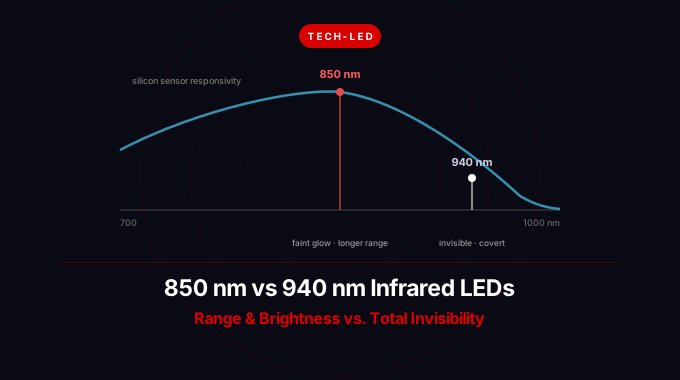
The choice between an 850 nm and a 940 nm infrared LED comes down to one trade-off: brightness and range versus total invisibility. Silicon camera sensors are roughly twice as responsive at 850 nm as at 940 nm, so an 850 nm illuminator produces a brighter image and 30–50% longer effective range at equal power…
-
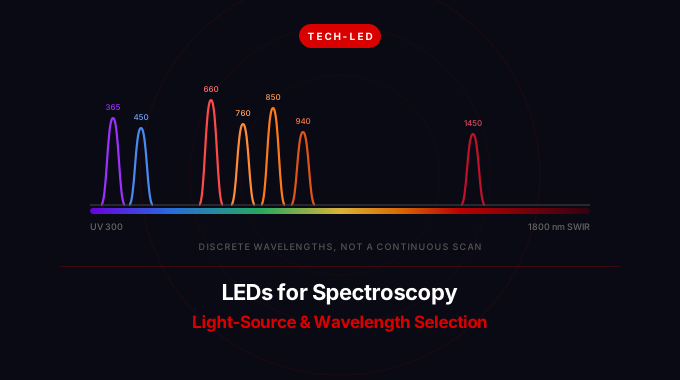
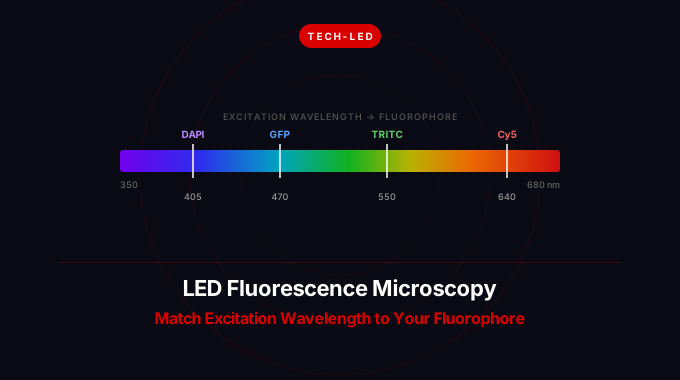
The light source in a fluorescence microscope has one job: deliver a band of excitation light that overlaps the absorption peak of the fluorophore you are imaging, then get out of the way so the longer-wavelength emission can be detected. Choosing the LED is therefore a wavelength-matching problem. DAPI excites near 358 nm (a 365…
-
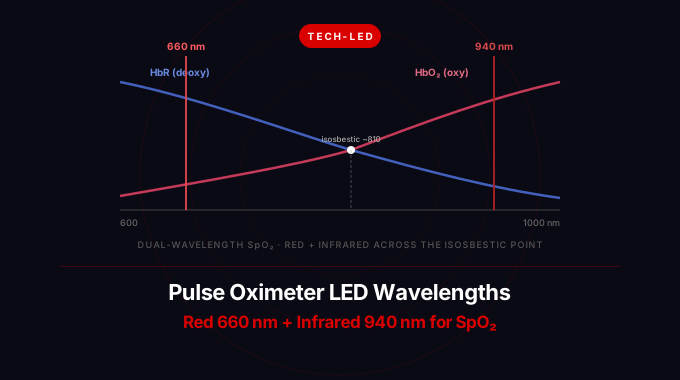
A pulse oximeter measures blood oxygen saturation (SpO₂) by shining two wavelengths of light through perfused tissue and comparing how much each is absorbed. The standard pairing is a red LED at ~660 nm and a near-infrared LED at ~940 nm, chosen because oxygenated hemoglobin (HbO₂) and deoxygenated hemoglobin (HbR) absorb red and infrared light…
-
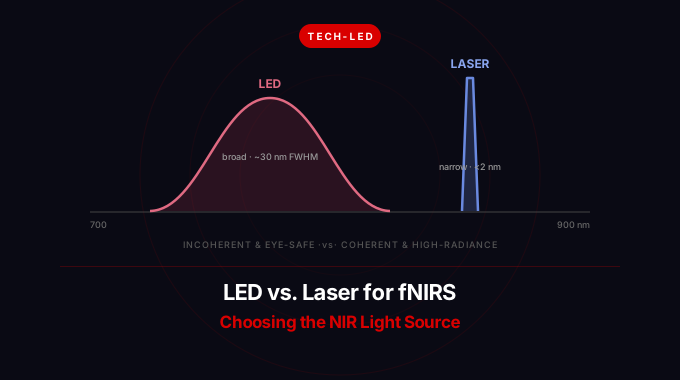
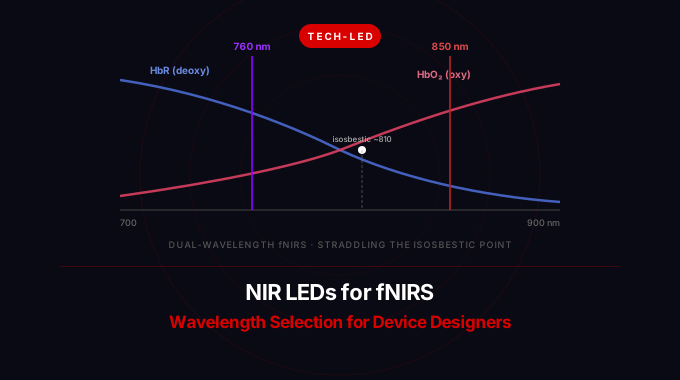
Functional near-infrared spectroscopy (fNIRS) measures brain activity by shining near-infrared light through the scalp and skull and detecting how much is absorbed by oxygenated and deoxygenated hemoglobin in the cortex. Building an fNIRS device requires at least two NIR wavelengths that straddle the ~810 nm hemoglobin isosbestic point — most commonly a pairing around 760…
-
Industrial UV LEDs span 200-420 nm across three sub-bands: UV-C (200-280 nm) for germicidal and water-disinfection applications including surface disinfection and water purification, UV-B (280-315 nm) for narrow medical and specialty curing uses, and UV-A (315-400 nm) for industrial curing of inks, coatings, and adhesives, plus fluorescence excitation and optical inspection. Selection depends on three…
-
For technical buyers, lead time is never just a date on a quote. It is the visible result of a broader supply chain that includes component sourcing, manufacturing capacity, logistics, forecasting, and how well a supplier manages disruption. This article explains how LED buyers can think about availability, procurement planning, and sourcing risk in a…
-
Choosing an OEM LED supplier is not the same as buying standard lighting from a catalog. Engineering teams need a partner that can support design constraints, integration risk, lifecycle planning, compliance, and long-term supply continuity, not just deliver a competitive quote from light manufacturers. This guide explains what OEM buyers should look for when evaluating…
-
Choosing between a domestic and international LED supplier is rarely just a pricing decision. For OEM teams, procurement managers, contractors, and technical buyers, the better option depends on lead time, support, logistics, documentation, and how much supply-chain risk a project can tolerate. This article explains how to compare sourcing models so buyers can weigh cost,…
-
Not every LED product that looks good on paper will perform well in the real world. For B2B buyers, engineers, OEM teams, and procurement leads, evaluating LED quality means looking beyond basic lighting claims and asking whether the product is built, tested, documented, and supported in a way that reduces risk over time. This article…
-
Choosing the right LED supplier is not just about price, lead time, or who answers your email fastest. The best buying decisions come from asking the right questions before a quote becomes a commitment, especially when the lighting application affects performance, maintenance, compliance, and long-term supply continuity. This guide gives buyers a practical framework for…
-
If you are sourcing LEDs for industrial equipment, custom electronics, OEM development, or research systems, choosing between an LED distributor and an LED manufacturer is not just a procurement detail. It can affect technical guidance, component availability, supply flexibility, lead times, and long-term support. These sourcing decisions also sit inside a broader component-supply ecosystem shaped…
-
If you are looking for an LED supplier for industrial equipment, research systems, custom instrumentation, or OEM development, the challenge is rarely just finding a part number. The real challenge is finding a sourcing partner that can help match wavelength, package style, power, voltage, reliability, and long-term availability to the exact demands of your application….
-
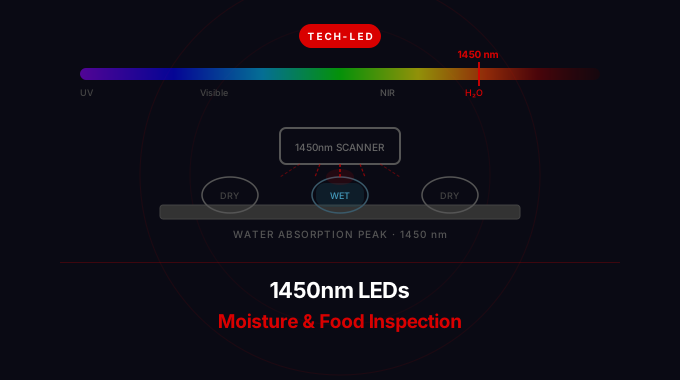
Short-wave infrared inspection at 1450 nm is especially useful when moisture-sensitive contrast matters. In food processing, agricultural handling, and industrial quality control, a 1450 nm LED can help reveal differences that are difficult to see under visible light or more conventional IR illumination. That makes this wavelength particularly relevant for teams working with SWIR sensor…
-
1750 nm LEDs sit at the deeper end of the SWIR spectrum, where industrial imaging, sensing, and advanced inspection systems begin to move beyond general-purpose infrared illumination and into more specialized optical work. At this wavelength, system designers are often thinking less about ordinary viewing and more about detector compatibility, spectroscopy-adjacent workflows, and the kind…
-
A 1650 nm LED sits in an especially useful part of the SWIR range for industrial sorting, material detection, and optical inspection. In recycling lines, manufacturing environments, and automated classification systems, this wavelength can help reveal differences that are difficult to detect under visible light alone. That makes it highly relevant when the goal is…
-
A 1550 nm LED sits in a strategically important part of the SWIR spectrum for sensing, imaging, and industrial inspection. This wavelength is often associated with eye-safer system design, detector compatibility, and specialized optical tasks where standard visible or shorter-wave IR illumination is not the best fit. For engineers evaluating industrial sensing systems, 1550 nm…
-
Short-wave infrared (SWIR) LEDs around 1200 nm represent a pivotal transition point between traditional infrared and the deeper SWIR region. This article explores what makes the 1200 nm wavelength special, how photodiode detectors behave at this crossover, and why engineers often choose LED emitters over lasers at 1200 nm. We delve into the semiconductor technology behind 1200nm LEDs,…
-
Summary: This article explores 1050 nm LED technology and why it matters for short-range SWIR (short-wave infrared) systems. We cover how 1050nm sits at the edge of the near-infrared spectrum, bridging into SWIR, and explain its unique advantages for low-noise IR illumination. You’ll learn how these high-power infrared LEDs differ from common 850nm or 940nm…
-
Infrared illumination at the 850 nm wavelength has become the backbone of modern night vision and surveillance lighting. This near-infrared light provides high radiant energy that silicon-based camera sensors can detect easily, while remaining almost invisible to the naked eye. By operating just beyond the visible spectrum, an 850 nm IR LED offers a powerful…
-
Infrared LEDs at the 940 nm wavelength emit near-infrared light that is invisible to the human eye, making them ideal for gesture recognition and proximity sensing applications where illumination must be covert. Unlike shorter-wavelength IR emitters (e.g. 850 nm) that produce a faint red glow, a 940 nm LED is completely invisible to the naked…
-
780 nm is a near-infrared wavelength sitting right at the edge of the visible spectrum – essentially invisible to the human eye but easily detected by common silicon sensors. This makes a 780 nm LED an ideal light source for optical sensing systems – it yields strong detector response without producing distracting visible light. By pairing a…
-
Deep red 660 nm LED emitters have become essential components in both advanced agricultural lighting and biomedical systems. At a wavelength of 660 nanometers – the heart of the red light spectrum – these LEDs align with peak chlorophyll absorption to maximize photosynthetic light for plants, while also offering an optimal balance of optical penetration and…
-
630 nm red LEDs have emerged as critical components in modern biometric sensors, offering a precise light source for measuring physiological signals beneath the skin. This particular wavelength is ideal for penetrating human tissue to illuminate blood vessels while still being selectively absorbed by key biomolecules like hemoglobin. The result is a balanced interplay of…
-
520 nm green LEDs are crucial in industrial vision systems and agricultural sensors. In machine vision, this green wavelength aligns with peak camera sensitivity and helps produce balanced white-light illumination for accurate imaging. In agricultural applications, green light is strongly reflected by plant foliage, providing a means for canopy imaging and photosynthesis detection proxies like…
-
In industrial inspection and machine vision systems, high-power 450nm LED sources have become a key element for providing intense blue illumination. This “royal blue” wavelength sits at the cusp of the visible spectrum between violet and green, offering high-energy photons for enhanced contrast without veering into ultraviolet UV light. These high power LEDs provide intense…
-
405 nm LED technology sits at the border of visible violet and ultraviolet light (UV-A), effectively functioning as an ultraviolet LED in the UV-A range, making it a unique member of the UV & Near-UV LEDs (235–420 nm) category. This near-ultraviolet wavelength offers distinct advantages for industrial optical systems. From fluorescence microscopy and machine vision…
-
In the UV curing world, 365 nm is widely recognized as the standard UV-A LED curing wavelength. This specific LED wavelength lies in the long-wave ultraviolet range, delivering “invisible” UV light that triggers photochemical reactions without stray visible glare. From curing inks and coatings to bonding adhesives and hardening 3D printing resins, 365nm UV LEDs…
-
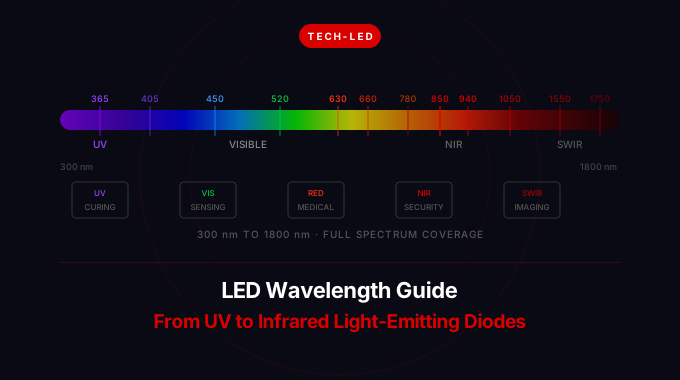
Wavelength is a defining characteristic of any LED light. It determines the LED’s color (or invisibility in ultraviolet and infrared bands) and influences its efficiency and best applications. By selecting the right LED wavelength – from UV curing at 365 nm to SWIR imaging beyond 1500 nm – engineers can optimize performance for tasks ranging…
-
If you’ve browsed the Tech-LED / Marubeni catalog, you’ve likely seen part numbers like SMBB850DS1-100S-02Z-I and wondered what each segment means. This guide shows you how to decode Marubeni LED part numbers – so engineers and purchasing teams can understand package type, wavelength, chip configuration, and options at a glance. Anatomy of a Marubeni LED…
-
LEDs (light-emitting diodes) are used across nearly every industry — general and architectural lighting, displays and smartphones, automotive, machine vision and industrial inspection, horticulture, medical and dental devices, UV curing and sterilization, infrared sensing and night vision, and optical data communication. The major types of LED are defined by the wavelength they emit, which is…
-
Near-infrared (NIR) light therapy, a subset of photobiomodulation (PBM), represents a cutting-edge, non-invasive therapeutic modality that harnesses specific wavelengths of light to elicit profound biological effects at the cellular level. Unlike visible light, NIR penetrates deeper into tissues, making it a powerful tool for addressing a wide array of health concerns, from muscle recovery to…
-
Infrared (IR) LED light therapy, a rapidly evolving modality within the field of photobiomodulation (PBM), harnesses specific wavelengths of light to elicit therapeutic effects at the cellular level. This non-invasive approach has garnered significant attention for its potential in regenerative medicine, pain management, and dermatological applications. For optoelectronic engineers and integrators, a thorough understanding of…
-
1. Introduction to Infrared LEDs Defining IR LEDs: Invisible Light, Wavelengths, and Basic Function Infrared Light-Emitting Diodes (IR LEDs) are specialized semiconductor devices engineered to emit infrared (IR) radiation. This form of electromagnetic radiation possesses wavelengths longer than those of visible light, typically spanning a range from 700 nanometers (nm) to 1 millimeter (mm). A…
-
TLDR: Quick Overview of IR LEDs Infrared (IR) LEDs are semiconductor devices that convert electricity into invisible infrared light. This occurs through electroluminescence, where electrons and holes recombine in a direct bandgap material like Gallium Arsenide (GaAs), releasing energy as photons. Unlike visible LEDs, IR LEDs emit longer wavelengths (typically >700 nm), making them imperceptible to the…
-
In the rapidly evolving world of optoelectronics, near-infrared (NIR) LEDs, particularly those utilizing perovskite materials, are gaining attention in the field of optoelectronics. have emerged as critical components across a myriad of applications, from security systems and industrial automation to medical diagnostics and smart agriculture. But a fundamental question often arises for engineers and integrators:…
-
An IR LED (infrared light-emitting diode) is a diode that emits infrared light — invisible radiation with wavelengths typically between 700 nm and 1000 nm, most often 850 nm or 940 nm. Unlike a normal (visible) LED, its output can't be seen by the human eye, yet it is easily detected by cameras, photodiodes, and…
-
This light wasn’t from a bulb or laser but from an array of 850 nm near-infrared LEDs providing illumination invisible to the human eye. In simple terms, Near-infrared (NIR) LEDs are essential light sources in various applications. are light-emitting diodes engineered to emit photons just beyond the visible spectrum. Though we can’t see their beam,…
-
In the quest for The development of sustainable tech is crucial for a sustainable future., adopting a circular economy mindset can greatly reduce waste and resource use. Near-infrared (NIR) LEDs are a prime example: they deliver high efficiency and extremely long lifespans, meaning fewer replacements and less discarded hardware. In fact, as LED lighting produces…
-
Visible vs IR Emission in LEDs Contrary to common assumptions, standard LED lighting emits virtually no near-infrared (NIR) light. By design, LEDs produce light in a narrow visible band (roughly 400–700 nm) rather than across the infrared spectrum. In fact, engineers and lighting experts emphasize that standard white LEDs generate essentially no IR in the beam….
-
In many industries, near-infrared (NIR) LEDs are transforming how machines illuminate and sense. These LEDs emit invisible light (700–1000 nm) and are extremely efficient, contributing to sustainability. For example, LED manufacturers notes their NIR LED designs *"minimize energy use and carbon footprint."* In practice, switching to NIR LED lighting and sensing can dramatically cut power…
-
Think energy-efficient lighting is only about visible LEDs? Think again. Near-infrared (NIR) LEDs are quietly transforming how we save power and design greener electronics. These invisible light sources – emitting just beyond the red end of the spectrum – are key enablers for modern smart devices and eco-friendly systems. In fact, as detailed in our…
-
Multiple near-infrared LEDs on a test board. The 850 nm LED (left) faintly emits a red glow, while several 940 nm LEDs appear dark to the human eye. Near-infrared LED technology has emerged as a powerful successor to legacy infrared illumination methods. But how do the costs stack up when considering the power supply for NIR LEDs?…
-
In today’s security and sensing landscape, near-infrared (NIR) LEDs play a crucial role in everything from surveillance cameras to industrial sensors. Selecting the right NIR LED for your business needs can significantly impact the performance and reliability of your systems. In this comprehensive guide, we’ll walk through the key factors to consider – from identifying…
-
Infrared Illuminators for Night Vision Security Cameras: NIR LED Integration Guide for OEM Designers
An infrared illuminator is a near-infrared (NIR) light source — typically built from arrays of 850 nm or 940 nm LEDs — that floods a scene with invisible light so cameras can see in the dark while remaining undetectable to human observers. For security camera integrators and OEM designers, the IR illuminator is the component…
-
Near-infrared LEDs in medical devices are quietly transforming patient care, from high-tech hospital equipment to everyday health monitors. These invisible wavelengths of light give medical designers new ways to sense and heal the human body without invasive procedures. As detailed in our Near-Infrared (NIR) LED Guide, a near-IR LED (also called an infrared diode) emits…
-
Current Use of NIR LEDs in Industry Near-infrared (NIR) LEDs have already become workhorses in industrial settings. They serve as invisible illuminators and sensors in machine vision systems, production line monitors, and automation sensors. For example, factories employ IR LED spotlights and ring lights to enable machine vision cameras to inspect products for defects without…
-
What Is a Near-Infrared LED? A near-infrared (NIR) LED is a light-emitting diode that outputs invisible infrared light typically in the 700 nm to 1000 nm wavelength range, just beyond the deep red portion of the visible spectrum. Like any LED, it’s a semiconductor device: when forward-biased, electrons and holes recombine to emit photons of light. The…
-
The field of LED and optoelectronic technology is rapidly evolving, bringing with it a growing set of specialized terms that can be difficult to navigate. Tech-LED.com specializes in advanced LED solutions for applications such as medical diagnostics, industrial sensing, security, machine vision, and scientific research. Our products include infrared (IR), near-infrared (NIR), short-wave infrared (SWIR),…
-
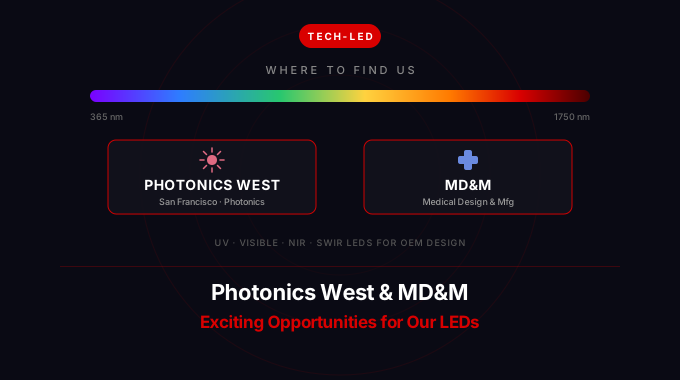
Photonics West: A Successful Showcase of Our LEDs With 10 years of experience as a Sales Manager at Marubeni, I can honestly say that Photonics West was one of the most thrilling events I've had the opportunity to be a part of. It wasn’t just about showcasing our wide wavelength range LEDs, stretching from 365nm…
-
Marubeni America Corporation is pleased to announce that we will begin shipping samples of our "epitex F Series" LED chip, which operate in the SWIR range of 1050nm to 1900nm and feature a low-profile, compact design. The sample shipments are set to start in August 2024 (see Figure 1 and Table 1). We are excited…
-
What is SWIR, and how can you benefit from high-performance SWIR LEDs? How does SWIR LED work? This article will cover the basics of SWIR. We will analyze the diverse range of new opportunities that SWIR LEDs can offer. Read on to learn about the most common uses of SWIR LEDs. The article will analyze…
-
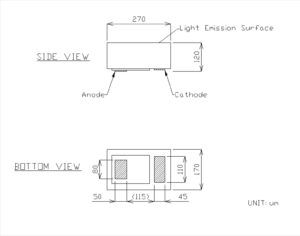
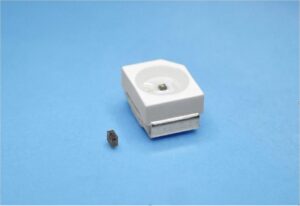
New developed product announcement An Ultra-compact SWIR LED Package with a Footprint of 0.6 x 0.3 mm Adopts the world's first SWIR LED chip utilizing a flip-chip structure with InP materials*1 Marubeni America Corporation (hereinafter “MAC”) is pleased to announce that it has developed an ultra-compact LED package with a footprint of 0.6 x 0.3…
-
Introduction about Mass Production of high power 1100nm LEDs Revolutionizing the SWIR Spectrum Marubeni America Corporation (hereinafter referred to as "MAC") has proudly announced the commencement of mass production for the "1100GD" product line, a groundbreaking 1100nm LED that delivers double the light output in the SWIR range, starting June 2024. This innovative product leverages...
-
The evolution of Light Emitting Diode (LED) technology has revolutionized numerous industries by providing energy-efficient, durable, and versatile lighting solutions. LEDs operate across a broad spectrum of wavelengths—from ultraviolet (UV) through visible light to infrared (IR)—each offering unique properties that are harnessed for specialized applications. Below is a list of industrial applications associated with various…
-
LEDs appear across medical devices in three broad roles, each defined by wavelength. In phototherapy, red (~630–660 nm) and near-infrared (~850 nm) light drive photobiomodulation for pain relief, circulation, and skin treatment. In biomedical sensing, red and infrared LEDs (660 + 940 nm) measure blood oxygen in pulse oximeters, and paired NIR wavelengths (~760 +…
-
A solar simulator reproduces sunlight — its spectrum, intensity, and uniformity — so photovoltaic cells and materials can be tested under controlled, repeatable conditions. An LED solar simulator does this by combining many LED wavelengths into a tunable array that approximates the standard AM1.5G reference spectrum across roughly 300–1200 nm (and out to the SWIR…
-
Optical sorters separate materials at speed by reading a light signal and firing an air jet or ejector at items that don't match. The LED light source is what makes the distinction possible, and the wavelength is chosen by what you're sorting on: visible light for color (ripe vs. unripe, product vs. foreign matter), SWIR…
-
Machine vision lighting is the practice of selecting an LED light source — its wavelength and its geometry — to maximize the contrast a camera needs to detect a feature reliably. The wavelength is matched to the material and the defect: UV (365–405 nm) to excite fluorescence and reveal surface flaws, visible (450–660 nm) for…
-
Surveillance imaging in the dark relies on infrared LED illuminators — light the camera can see but the human eye cannot. The wavelength sets the trade-off: 850 nm gives the brightest image and longest range because silicon sensors are most responsive there (at the cost of a faint visible glow), 940 nm is completely invisible…
-
In an optical sensor, an LED is the emitter and a photodiode is the detector; the sensor measures how a target changes the light passing between them. The wavelength is chosen so the light interacts with the thing being measured: NIR (940 nm) for invisible proximity and gesture sensing, a specific absorption line (e.g. 4.26…
-
LEDs play two distinct roles in smart agriculture, and both are wavelength-driven. As sensing emitters, they measure crop and soil condition: red (~660 nm) plus NIR (~800 nm) for vegetation indices like NDVI and chlorophyll/stress assessment, SWIR (~1450 nm) for soil and crop moisture, and UV (365–405 nm) to excite the fluorescence that flags early…
-
LEDs (Light Emitting Diodes) have become a cornerstone technology in industrial applications, offering precision, energy efficiency, and adaptability. Tech-LED provides specialized products designed to meet the technical demands of various industries. What Are Industrial LED Applications? Industrial LED applications involve the use of LED technology to enhance performance, improve efficiency, and achieve specific operational goals….
-
This year, we were thrilled to be part of MD&M 2024 for the first time, an event uniting pioneers, experts, and enthusiasts in the medical device and manufacturing industry. Our exhibition booth offered attendees a unique opportunity to explore our latest product offerings, showcasing avant-garde sensing LED technologies. Throughout MD&M 2024, we cultivated connections with…
-
In recent years, technological advancements have paved the way for groundbreaking innovations in the field of medical devices. One such revolution is the integration of Extreme Tiny Chip-Scale Package (CSP) LED technology into medical devices. This tiny yet powerful lighting solution is reshaping healthcare, offering numerous benefits in terms of efficiency, precision, and patient care….
-
SWIR LED technology is a type of light-emitting diode that operates in the shortwave infrared (SWIR) spectrum. The full form of SWIR is "Shortwave Infrared." It is a type of LED that operates in the wavelength range of 900 nm to 1700 nm, which is different from traditional LED technology that operates in the visible…
-
Industrial SWIR (short wave infrared) LED lighting operates in the 1050-1750 nm band, beyond the silicon detector cutoff at roughly 1100 nm. SWIR LEDs enable imaging, sensing, and machine vision applications that silicon-based cameras and photodetectors cannot see: through-fog and through-silicon-wafers imaging at 1050-1200 nm (including silicon wafer inspection), moisture detection at 1450 nm, eye-safe…
-
A walk through the lighting section of any hardware store, and you may be dazzled by not only the sparkling fixtures but also the sheer number of options with which you are presented. A few of your choices include incandescent, fluorescent and LED lights. One of the most energy-efficient general lighting technologies – light-emitting diodes,…