Tech-led.com


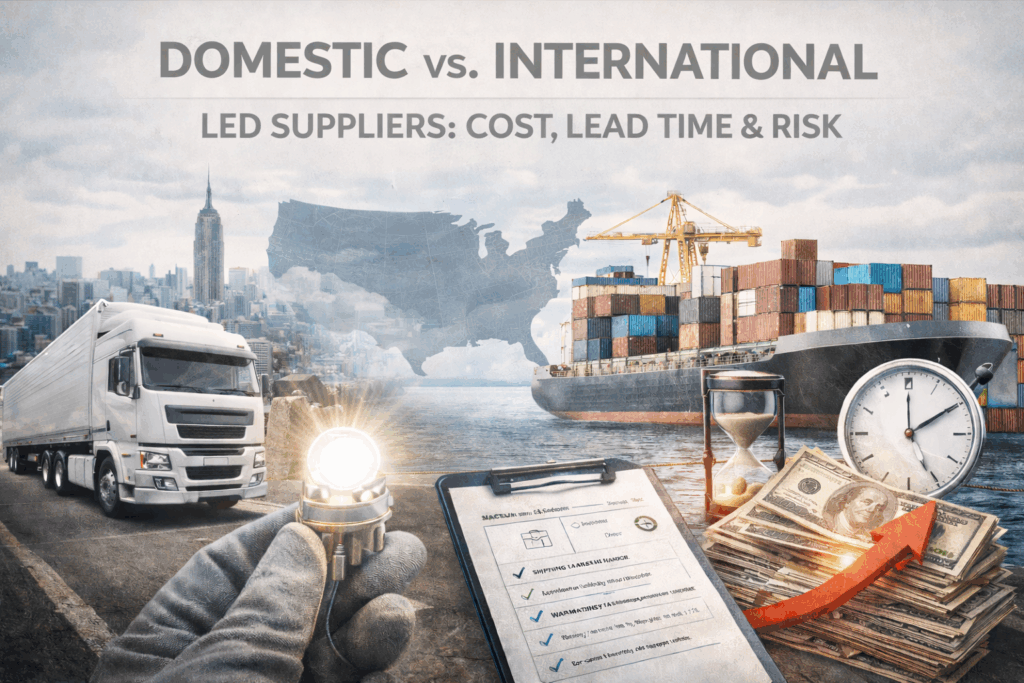
Summary: Domestic LED suppliers usually win on communication, sample turnaround, and schedule flexibility; international suppliers can win on unit cost, manufacturing scale, and access to specialized parts. The right choice depends on landed cost (freight, duties, buffer stock, delay exposure) rather than quoted price, and on how much lead-time variance the program can absorb. For optoelectronic components such as UV, near-infrared, and SWIR emitters and photodiodes, the factory and the support channel are often in different countries, so the useful comparison is who holds stock near you, who answers application questions on radiometric specs and binning, and who is accountable for change notices. This article compares cost, lead time, risk, technical support, and documentation across both sourcing models.
Choosing between a domestic and international LED supplier is rarely just a pricing decision. For OEM teams, procurement managers, contractors, and technical buyers, the better option depends on lead time, support, logistics, documentation, and how much supply-chain risk a project can tolerate. This article explains how to compare sourcing models so buyers can weigh cost, service, and resilience instead of chasing the lowest quote in isolation.
That comparison matters because modern LED lighting markets are global, but project consequences are local. A delayed shipment, weak documentation package, or poorly managed product change can affect installation schedules, maintenance planning, and long-term confidence in the supply path. If your team is evaluating led lighting solutions for a real-world application, this guide will help you compare domestic vs international options with clearer eyes.
Why is the sourcing model as important as the product itself?
When buyers compare suppliers, they often begin with the product, the price, and the lead time. That is reasonable, but it is incomplete. The sourcing model behind the quote influences communication, logistics, technical access, and what happens if something changes after approval. For a lighting project, the wrong source can create more risk than a slightly higher cost from the right partner.
This is especially true in commercial and industrial environments where reliability, documentation, and product support matter as much as the initial transaction. Whether the buy involves a fixture, a driver, a custom module, or a specialized diode-based assembly, the question is not only where the goods come from. It is how the supplier relationship performs under pressure.
What usually distinguishes domestic and international LED suppliers?
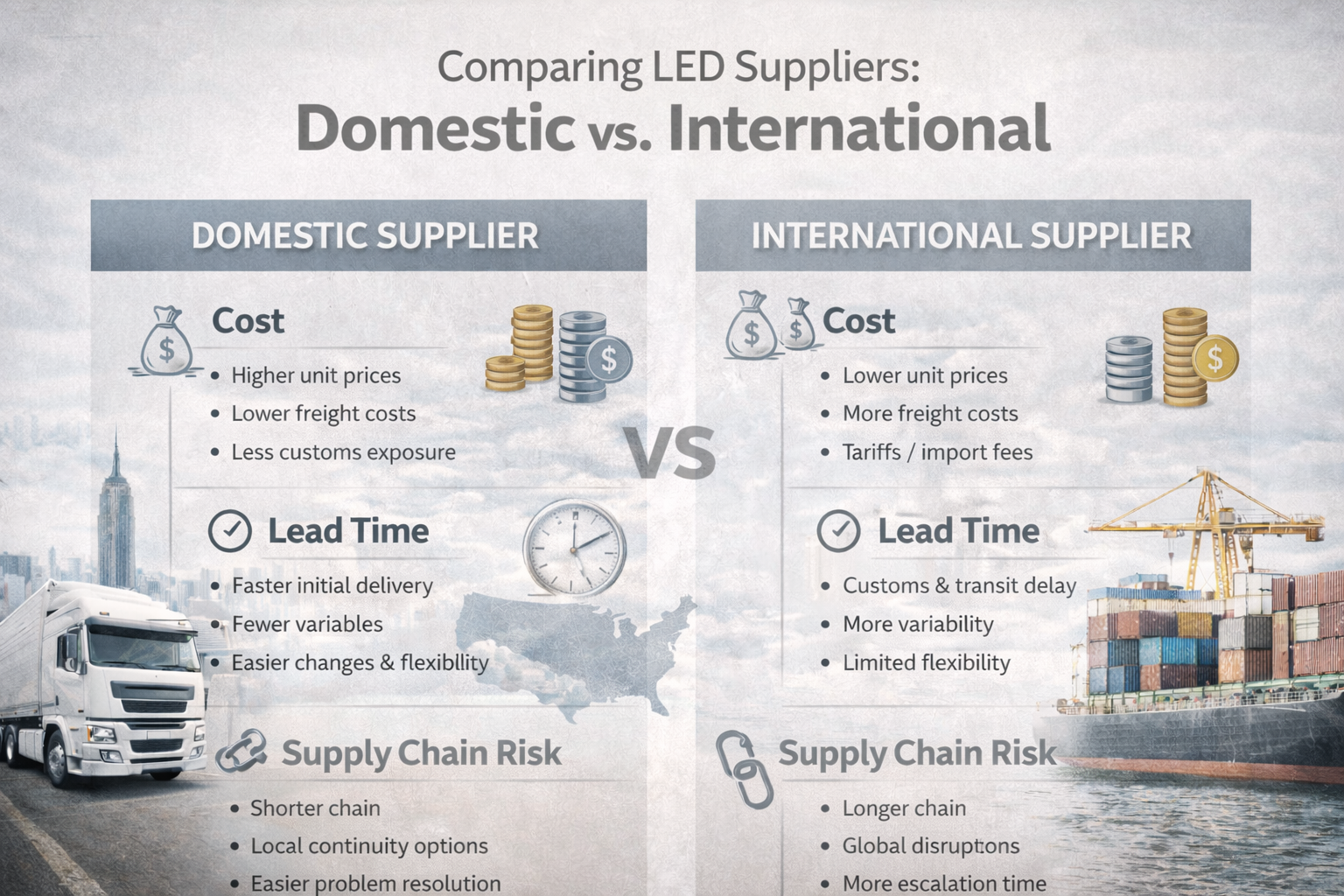
A domestic source usually offers closer communication, easier time-zone alignment, and simpler coordination around shipping, warranty questions, and revisions. An international manufacturer or distributor may offer lower unit cost, broader manufacturing scale, or access to a wider variety of lighting products and new products, but those benefits can come with tradeoffs around logistics complexity and response speed.
For buyers evaluating light emitting diodes or integrated led fixtures, that distinction matters because sourcing is not just about where a catalog is based. It also affects how technical issues are handled, how fast samples move, how customs or import steps are managed, and how quickly the team can react if project needs change.
How should buyers compare cost beyond the quoted price?
Cost comparison should start with the quote, but it should not end there. A lower unit price from an overseas supplier may look attractive until buyers account for freight, customs exposure, buffer inventory, communication overhead, and the cost of delays. A domestic supplier may charge more up front but create savings through easier support, faster decisions, and lower disruption risk.
This matters because the real cost of a sourcing decision includes more than the component or module itself. If a delayed led strip light holds up a job, or a revision issue creates downtime, the apparent savings can disappear quickly. That is why serious buyer analysis looks at total impact, not just the line-item price.
What happens to lead time when sourcing internationally?
International sourcing can work well when demand is stable and planning is disciplined, but it usually introduces more variables. Shipping windows, customs clearance, consolidation delays, port issues, and broader market disruptions can all extend LED lead time. That does not mean international sourcing is bad. It means buyers need to treat time as a risk factor, not a promise printed on a quote.
Domestic sourcing often offers an advantage when a project needs speed, flexibility, or the ability to adjust late in the process. For a contractor managing installation timing, or for an OEM dealing with a fast-moving production schedule, the shorter path can be more valuable than the cheapest nominal lead time on paper.
How do risk and resilience differ between domestic and global supply chains?
Domestic sourcing can reduce risk by shortening the chain between decision and delivery. That may improve visibility around inventory, simplify problem escalation, and reduce exposure to border delays or sudden logistics shifts. It can also make change management easier when a lighting technology specification, voltage requirement, or packaging plan changes midstream.
International sourcing may still be the right choice when scale, manufacturing depth, or a specialized capability outweigh those risks. But buyers should ask how the supplier handles contingency planning, alternate runs, revision notices, and continuity. Supply-chain resilience is not about choosing one geography blindly. It is about understanding where the weak points are before they become expensive.
When does domestic sourcing make the most sense?
Domestic sourcing is often strongest when speed, clarity, and support are central to the purchase. If the application involves commercial lighting, custom integration, frequent communication, or a need for tighter coordination across approval, sampling, and rollout, a local or regional source may offer a better operating model. That can be especially true when the buyer values fast answers more than maximum unit-cost compression.
It also makes sense when a project depends on strong documentation, local accountability, or easier service coordination. For buyers handling led lighting projects with multiple stakeholders, shorter communication loops can reduce friction and support better decisions throughout the process.
When does international sourcing make more sense?
International sourcing can be the better choice when a buyer has stable forecasts, stronger internal procurement discipline, and a clear reason to optimize around manufacturing scale or specialized capability. In some cases, an international manufacturer may offer access to specific high-performance components, custom builds, or cost structures that are difficult to match domestically.
This can matter in programs involving large volumes, specialized electronics, or a narrow technical requirement. The key is not to assume that international always means cheaper or domestic always means safer. The better choice depends on the application, the schedule, and how much uncertainty the team can absorb.
How should technical support factor into the decision?
Technical support is one of the clearest differences between sourcing paths. Buyers should ask who answers application questions, who owns revisions, and how quickly the team can respond if something in the field does not match expectations. A good supplier should be able to discuss driver pairing, power supplies, cct targets, cri expectations, wattage, and compatibility with the intended fixture or control path.
This is especially important for projects involving LED strips, LED bulbs, downlights, display systems, linear modules, or custom assemblies. A domestic authorized distributor may offer stronger front-end technical coordination, while an overseas manufacturer may provide deep factory insight but slower communication. The right model depends on what kind of support the project really needs.
What about quality, documentation, and accountability?
Accountability is easier to talk about than to prove. Buyers should ask how quality is documented, how revisions are tracked, and what happens if received product does not match the approved sample. This matters whether the item is a simple LED light, an accessory, a bar assembly, or a more complex integrated system. Good sourcing requires documentation discipline as much as production capability.
For technical teams, the best quality decision often comes from asking whether the supplier can support the entire path from approval to field use. That includes test data, packaging control, sample consistency, warranty handling, and escalation. High-quality support is not just about saying the product is premium. It is about showing how accountability works in practice.
How do domestic and international options affect commercial planning?
The sourcing choice can influence planning for inventory, rollout timing, maintenance, and customer expectations. A domestic path may support leaner inventory and more flexible replenishment. An international path may require larger safety stock, more conservative scheduling, and earlier forecasts to protect against disruption. Those planning implications matter just as much as the invoice cost.
For teams serving residential, commercial, automotive, or industrial channels, the supply model should match the pace of the business. If your markets require quick adjustments, local responsiveness can be valuable. If your demand is stable and forecastable, global manufacturing of LEDs may be a better fit for your project. Either way, buyers should connect sourcing strategy to actual commercial behavior rather than choose by habit.
What questions should buyers ask before choosing one sourcing path?
Start with the basics: what is the real lead time, what risks exist in the chain, what happens if the product changes, and who owns technical escalation? Then move deeper: what level of innovation or customization is required, how important is local communication, and how much flexibility does the project need if forecasts shift? Those answers usually reveal whether the sourcing model fits the job.
It is also smart to ask how the supplier thinks about sustainability, manufacturing location, backup plans, and knowledge base resources for ongoing support. A serious partner should be able to explain not only what it sells, but how it helps customers reduce uncertainty and make a better sourcing choice.
How can buyers make the final domestic vs international decision?
The best final decision is usually the one that balances cost with execution risk. For some teams, that means choosing a domestic source for speed, communication, and lower disruption exposure. For others, it means working internationally because the volume, technical need, or available manufacturing capability justifies the extra complexity. Either path can work if the tradeoffs are understood upfront.
In practice, the strongest buyers compare light performance, support model, logistics risk, and long-term reliability together. They do not assume the best quality comes automatically from one geography, and they do not assume the cheapest quote is the most efficient choice. They evaluate the full sourcing picture and choose the partner that best fits the project.
Applying the comparison to optoelectronic components
Most of the sourcing literature on this question is written for finished lighting products. Wavelength-specific emitters and detectors add a few considerations that make the support channel matter more than the country of manufacture.
Specifications have to survive every handoff. An infrared, SWIR, or UV emitter is bought on radiometric numbers: peak wavelength and tolerance, spectral width, radiant flux or radiant intensity at a named drive current, and often a pulsed current rating. Each intermediary between your engineer and the factory is a chance for a bin code, option suffix, or test condition to be dropped. Whatever the geography, insist on the complete part number with every option code on the purchase order and the same test conditions on the datasheet you approved.
Incoming inspection cannot be done by eye. A visible LED can be checked by powering it up. An 850 nm, 940 nm, SWIR, or UV part cannot; verification needs a spectrometer or calibrated radiometer, or it relies on the supplier's lot test data. That makes documentation and accountability part of the purchase, and it favors a supplier who can answer a test-data question in your working day.
Prototype speed depends on the sample loop. Emitter selection often takes several rounds of samples at different wavelengths, lens options, or packages. A supplier with a local point of contact and stock close to your lab usually shortens that loop more than a lower unit price saves.
Many programs combine both models. It is common to prototype through a domestic catalog supplier and then move production volume to a contracted or direct supply arrangement once the design and forecast are stable. The comparison is not either or; it is about which model fits each phase.
| Question to ask any LED supplier | Why it matters for optoelectronic parts |
|---|---|
| Is the quoted quantity in stock, and where is it held? | Separates shelf lead time from production lead time and freight exposure |
| Who answers application questions, and in which time zone? | Radiometric specs, binning, and detector pairing need engineering answers, not order status |
| Which test conditions and lot data ship with each order? | IR, SWIR, and UV parts cannot be verified visually at incoming inspection |
| How are product changes and discontinuations notified, and how far ahead? | Determines whether a change is a planned requalification or a line stoppage |
| Can samples at alternate wavelengths or packages ship quickly? | Emitter selection usually takes more than one round of samples |
| What is the landed cost including freight, duties, and buffer stock? | A lower unit price can be outweighed by the inventory needed to cover variance |
Tech-LED is the online catalog for Marubeni America Corporation's LED business unit, which gives buyers in the United States a domestic point of contact for technical and commercial questions on Marubeni LED components. The catalog covers UV LEDs, IR and NIR LEDs, SWIR LEDs, and photodiodes, and the product search filters stocked parts by peak wavelength across packages. For the broader supplier evaluation checklist, see the global LED supplier guide for industrial and research applications. To compare a domestic quote against an existing international source, contact Tech-LED with the part number or requirement, annual volume, and target delivery date.
FAQ
Is it cheaper to buy LED components from an international supplier?
Often on unit price, not always on landed cost. Add freight, duties, customs brokerage, the extra safety stock needed to cover longer and more variable transit, the engineering time spent across time zones, and the cost of a late build if a shipment slips. For low and medium volumes of specialized optoelectronic parts, those items can erase the unit-price gap. At high, stable volumes the international price advantage is more likely to hold.
Are domestic LED suppliers faster than international suppliers?
For parts held in domestic stock, usually yes, because the shipment avoids international freight and customs clearance. For parts that must be produced, the production time is the same wherever the order is placed, and the domestic advantage narrows to shorter communication loops and quicker problem escalation. Ask any supplier to separate stock availability from production lead time so the comparison is like for like.
How do I compare a domestic and an international LED supplier quote?
Normalize both quotes to the same part, the same option codes, the same test conditions, and the same delivered quantity and date. Then compare landed cost, the stock versus production split of the lead time, documentation and lot test data included, change-notification terms, and who provides application support. Only after those are equal is the unit price a fair comparison.
Can a domestic LED supplier provide parts manufactured overseas?
Yes, and for LED components this is the normal case, since a domestic supplier is often the local stocking, sales, and support channel for parts produced elsewhere. The practical questions are whether the domestic supplier holds stock, whether it provides traceable documentation back to the manufacturer, and whether it can escalate technical and quality questions to the factory on your behalf.
Key takeaways
- Domestic and international LED suppliers solve different problems, and the right choice depends on project priorities.
- Total cost should include logistics, delays, support load, and risk, not just quoted price.
- Domestic sourcing is often stronger for speed, communication, and flexibility.
- International sourcing can be valuable for scale, specialized manufacturing, and certain cost structures.
- Technical support, documentation, and accountability should carry real weight in the decision.
- The best sourcing choice balances lead time, resilience, and application fit, not just headline savings.
- A disciplined comparison helps buyers choose with more confidence and less avoidable risk.