Tech-led.com


Summary: This article explores 1050 nm LED technology and why it matters for short-range SWIR (short-wave infrared) systems. We cover how 1050nm sits at the edge of the near-infrared spectrum, bridging into SWIR, and explain its unique advantages for low-noise IR illumination. You’ll learn how these high-power infrared LEDs differ from common 850nm or 940nm emitters, why their broad spectrum and low coherence make them ideal compared to lasers, and how they enable new imaging, spectroscopy, and sensing applications. Engineers and optical designers will gain insight into using 1050nm light sources for imaging deeper into biological tissues, achieving minimal speckle in machine vision, and building energy-efficient SWIR systems worth integrating into industrial and medical designs.
For the broader SWIR LED context, how 1050 nm fits within the 1050-1750 nm SWIR band, multispectral system design, and wavelength selection across the full SWIR range, see our SWIR LED Lighting Guide.
What Makes 1050nm an Important Wavelength at the NIR–SWIR Boundary?
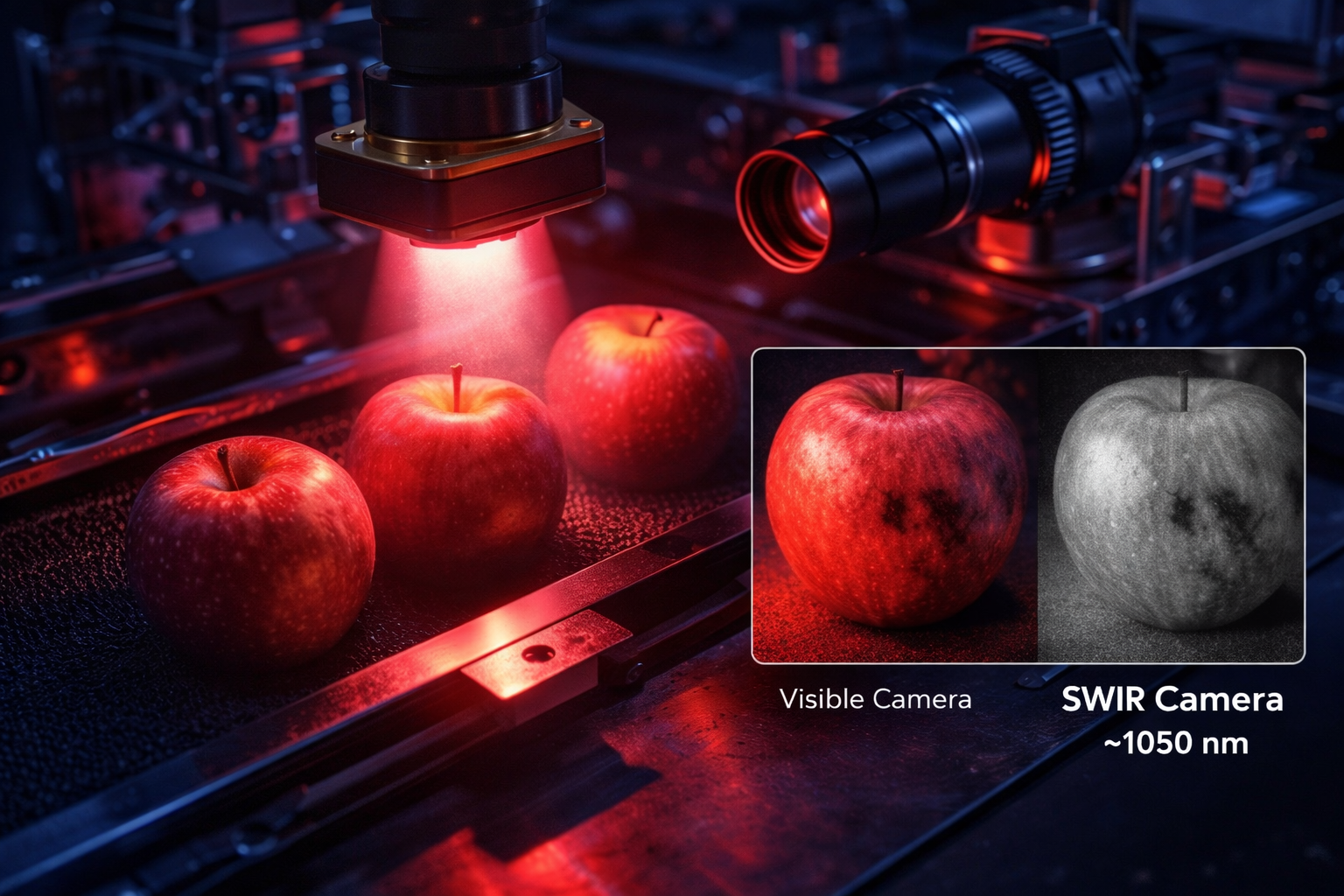
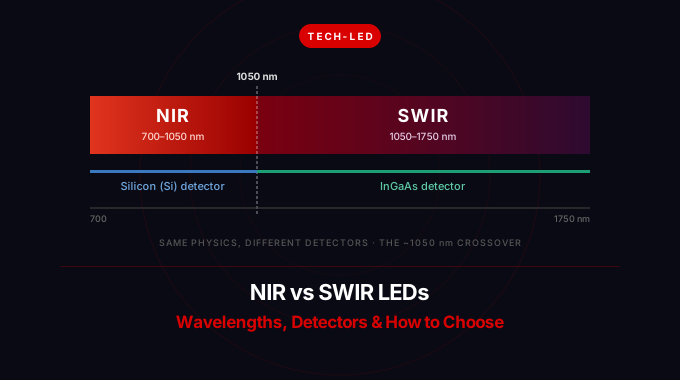
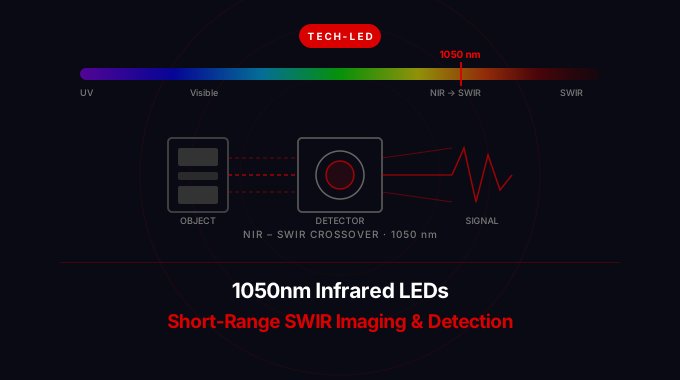
1050nm sits at a pivotal transition between the near-infrared (NIR) and short-wave infrared. In fact, 1050 nm is often considered the upper limit of extended NIR and the beginning of SWIR. This matters because detector technologies change around this point. Silicon-based photodiodes and camera sensors, which work well in the visible and NIR, rapidly lose sensitivity as the wavelength approaches ~1.1 μm. The bandgap of silicon corresponds to about 1100 nm, meaning photons beyond this have insufficient energy to be detected – effectively, silicon becomes transparent to 1050nm light. As a result, specialized SWIR sensors (typically indium gallium arsenide, InGaAs) are used to capture 1050nm and longer wavelengths. InGaAs detectors excel from roughly 900 nm up to 1700 nm with high quantum efficiency, covering the full SWIR range that silicon cannot. This makes 1050nm a key “bridge” wavelength – it’s just low enough that certain silicon-based devices can still respond (though weakly), and just high enough to be squarely in the range of high-sensitivity SWIR InGaAs sensors.
Because 1050nm straddles the NIR/SWIR boundary, it offers unique advantages. It lies in a spectral “sweet spot” where many materials become more transparent, particularly in the near infrared region. For instance, silicon wafers, glass, and even water vapor that are opaque or highly scattering at visible wavelengths start to transmit at SWIR wavelengths. This enables specialized imaging tasks – a classic example is silicon wafer inspection, which is only feasible with high power illumination in the SWIR band since silicon is. transparent above its band-edge. In summary, 1050nm LED sources allow engineers to leverage SWIR-like imaging characteristics (like seeing through silicon or fog) while still working with relatively compact sensors and optics, thanks to their high power output. It’s the gateway to SWIR performance in a convenient near-infrared package.
How Does a 1050nm LED Compare to 850nm, 940nm, and 980nm IR LEDs?
The 1050nm LED differs from more common IR LED wavelengths (such as 850nm, 940nm, or 980nm) in several important ways. Firstly, 850nm and 940nm LEDs fall squarely in the traditional NIR range. An infrared 850nm LED is widely used in night vision cameras and remote controls – it emits just beyond visible red and can still be detected by silicon-based cameras or photodiodes. By contrast, a 1050nm LED outputs light deeper into the infrared, largely invisible to silicon sensors unless they are specifically enhanced for NIR. In practical terms, this means standard security or machine vision cameras (which often use 850nm illuminators) might not see 1050nm without special sensors. The 980nm wavelength is closer to 1050nm but still within reach of some silicon devices; however, 980nm is historically associated with IR laser diodes (for example in telecom or as pump lasers) more than with LEDs. A 1050nm source firmly enters the SWIR LED category, often requiring InGaAs-based photodetectors for optimum detection.
Another difference is in emission characteristics and power. 850nm and 940nm LEDs are mature technologies with very high radiant output and efficiency, commonly available in high-power packages. At 1050nm, LED chips typically have slightly lower radiative efficiency (partly due to the material bandgap). However, modern 1050nm LED designs can still provide strong output power – often several tens of milliwatts of radiant flux at drive currents of a few hundred mA. For example, driving a high-power 1050nm LED at 600 mA might produce a radiant intensity comparable to some 940nm emitters, but with the benefit of the longer wavelength’s special properties. Another distinction is visibility and imaging effects: 850nm LEDs emit a faint red glow visible to the human eye, whereas 940nm and 1050nm are completely invisible. This can be important in covert or non-disruptive illumination. Additionally, longer wavelengths like 1050nm experience less Rayleigh scattering, so in imaging applications they tend to produce less haze and scatter in air or tissue (contributing to that “deep tissue penetration” effect discussed later). In summary, compared to 850nm and 940nm, a 1050nm LED trades a bit of efficiency for extended reach into SWIR, requiring suitable sensors but offering capabilities (like seeing through certain materials or achieving minimal scattering) that shorter IR LEDs cannot.
Where Are LEDs Preferred Over Lasers for Infrared Lighting?
High power LEDs and lasers are both used as infrared light sources, but they have very different emission properties. A laser emits a narrow, coherent beam with a very pure wavelength, whereas an LED emits a broader spectrum of light and is incoherent. For many short-range illumination purposes – whether in IR lighting for cameras or sensors – LEDs are often preferred over lasers because of their low coherence and the consequent reduction in speckle and interference. Speckle is a granular noise pattern that occurs when coherent laser light reflects off a rough surface. It can seriously degrade image quality in machine vision or any imaging system. LED illumination, by contrast, is inherently low-noise in this regard: one study found that LED-based images had over ten times lower speckle contrast compared to images illuminated by coherent laser diodes. In other words, an LED provides a much more uniform, speckle-free illumination field than a laser, which is critical for high-quality imaging.
Beyond speckle, LEDs have other advantages in infrared illumination. They have a broader emission bandwidth (typically 20–50 nm wide for a 1050nm LED, versus <1 nm for a laser), which means they have a much shorter coherence length. This low temporal coherence prevents interference fringes and multi-path interference effects in optical setups. In practical terms, using an LED for IR illumination yields more even lighting and stable intensity, whereas using a laser system might require additional optics (diffusers, beam shapers) or mechanical vibration to mitigate speckle noise. LEDs also tend to be safer and simpler: a 1050nm LED diode can be driven like any other LED with a current source, without the high collimation or cooling needs that high-power lasers demand. For short ranges – say a few centimeters to a few meters – an LED can flood an area with sufficient infrared light without the tight beam of a laser. This makes alignment easier and reduces hot spots. The trade-off is that LEDs typically cannot match the raw distance range of lasers (which can focus light over kilometers), but for short-range detection and imaging, the LED’s simplicity and low-coherence output are a winning combination. Engineers often choose LEDs when they need illumination that is high-power but diffuse, ensuring low-noise images and avoiding the complexities of laser safety classification and speckle reduction hardware.
What Are the Advantages of 1050nm LED Illumination in Imaging and Machine Vision Systems?
Using 1050nm LEDs for illumination brings specific advantages to imaging and machine vision systems. One key benefit is the ability to work in the SWIR regime at short range. Many industrial machine vision or automation systems currently rely on 850nm or 940nm NIR lighting. By moving to 1050nm, these systems can leverage the unique optical interactions of SWIR light. For example, some materials that are opaque at 850nm become translucent at 1050nm, allowing vision systems to inspect subsurface features or through certain enclosures. In quality control, a 1050nm illumination source could reveal hidden defects in silicon, glass, or plastic that shorter wavelengths would not penetrate. Additionally, 1050nm is far enough from the visible spectrum that it won’t interfere with human operators or visible-light cameras – it can operate truly invisibly in the background of a production line.
Another advantage is the low-noise, high-contrast imaging enabled by this wavelength. As discussed, low-noise IR illumination using an LED avoids speckle and provides even lighting. In a practical vision system, this translates to higher image quality and more reliable detection algorithms, especially when utilizing high power sources. For instance, a SWIR imaging camera illuminated with a 1050nm LED array can achieve high contrast on objects that might otherwise blend in under visible or 850nm lighting. Textures or markings that are camouflaged at shorter wavelengths might “pop” when viewed in SWIR due to differences in material reflectance. Short-range 1050nm LED illumination is also useful in industrial and agricultural settings – for example, moisture inspection: water has distinct absorption beyond 1000 nm, so a 1050nm lighting system can highlight moisture content in products on a conveyor. Because this wavelength experiences less scattering, the images often have better clarity with minimal scattering haze (a kind of minimal scattering benefit in air or tissue). All these factors make 1050nm LEDs valuable for machine vision, robotics, and any imaging system where seeing through materials or enhancing contrast is needed at close distances.
How Do Optical Sensors Detect 1050nm IR Light?
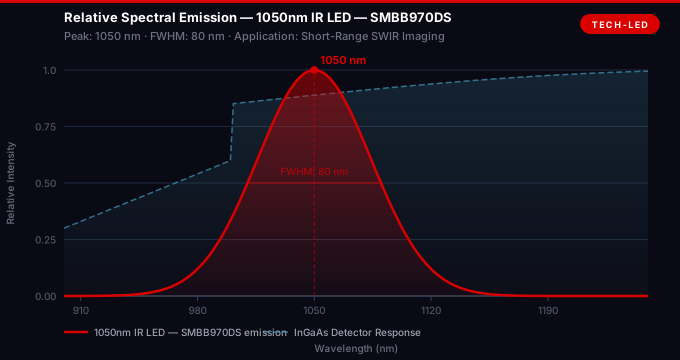
Detecting 1050nm light requires matching your sensor technology to the wavelength. As mentioned, silicon-based photodiodes and CMOS camera sensors have an upper sensitivity limit around 1000–1100 nm. A standard silicon sensor’s responsivity drops off sharply approaching 1050nm. A detector responsivity analysis shows that beyond about 1 μm, silicon’s quantum efficiency is near zero due to its bandgap. Therefore, for robust detection of 1050nm near infrared light, InGaAs photodiodes or cameras are the go-to solution. InGaAs (indium gallium arsenide) sensors are specifically engineered for the SWIR range. They typically cover wavelengths from ~900 nm up to 1700 nm (and specialized variants can extend to 2200 nm). These sensors maintain high sensitivity at 1050nm – often with quantum efficiency well above 70% in that region – meaning they convert a large fraction of incoming 1050nm photons into an electrical signal.
There are also emerging detector technologies that can straddle the NIR/SWIR boundary. For example, “extended” silicon detectors (like deep depletion CCDs or black silicon photodiodes) aim to slightly extend silicon’s range past 1000 nm, but their performance at 1050 nm is still limited compared to InGaAs. Some modern CMOS image sensors (such as Sony’s SenSWIR series) actually integrate both silicon and InGaAs layers to be sensitive from visible light up to 1300 nm or more. These hybrid sensors are designed for “broadband” or dual-band imaging, capturing 1050nm light alongside visible wavelengths. In specialized applications like fiber optic communications at 1060 nm, you might also find InGaAs avalanche photodiodes or other optical detectors that are optimized for that specific line. In summary, to detect 1050nm IR light, one typically uses InGaAs-based sensors or other SWIR-compatible detector technology. It’s important to check the sensor’s spectral responsivity specification – an engineer designing a system must ensure the detector choice aligns with the 1050nm emission. Using a 1050nm LED without an appropriate detector would be like having a light source with no “eyes” to see it.
Why Do 1050nm LEDs Enable Deeper Penetration for Medical Imaging?
One of the most exciting aspects of 1050nm light is its ability to penetrate deeper into biological tissues with lower scattering and absorption. Biomedical engineers categorize 1050–1100 nm as the beginning of the “NIR-II” window (also called the second near-infrared window). In this regime, light encounters reduced scattering in tissue compared to visible or shorter NIR wavelengths, which means it can travel farther into the body. Simultaneously, the absorption of light by blood and water is relatively low around 1050 nm – in fact, studies show that tissues containing blood and water have some of the lowest background absorption in the ~1050–1150 nm wavelength range. This combination of low scattering and modest absorption is the recipe for deep penetration and high contrast in non-invasive imaging.
Because of these properties, 1050nm illumination has been adopted in medical imaging modalities. A prime example is optical coherence tomography (OCT). Early OCT systems often used ~800–850 nm light, but newer swept-source OCT systems use ~1050 nm light to achieve greater imaging depth in the eye and other tissues. The longer wavelength yields less signal attenuation, allowing visualization of deeper layers (for instance, seeing deeper into the choroid layer of the retina). Researchers have noted that 1050nm OCT provides “improved image penetration” in retinal imaging, revealing structures that 840nm light might miss. Beyond ophthalmology, 1050nm LEDs (or SLEDs – superluminescent diodes – which are like broadband LED sources) are being explored for imaging thick tissues and even whole-body small animal imaging. The goal is deep tissue penetration without resorting to invasive methods – for example, illuminating a tissue with 1050nm light can allow fluorescent or photoacoustic imaging several centimeters below the surface, where shorter wavelengths could not reach. In summary, 1050nm sits in a biological transparency window: it goes further into tissue with less scattering, enabling clearer, deeper views for medical imaging and diagnostics. It opens the door to new non-invasive imaging techniques, from better OCT scans to novel fluorescence or photoacoustic imaging of biological tissues.
Can 1050nm LEDs Be Used for Spectroscopy and Fiber-Optic Sensing?
Yes, 1050nm LEDs can be very useful in spectroscopy and sensing applications, especially for short-range or integrated sensor setups. In spectroscopy, a broad LED source at 1050nm can serve as an illumination for measuring how materials absorb or reflect light in that spectral region. For instance, certain molecular overtone and combination bands occur in the 1000–1100 nm range, so a 1050nm source can probe chemical features that aren’t accessible with visible light. One example is water content measurement: water has a known absorption feature around 970 nm and again past 1150 nm. Operating around 1050nm allows a sensor to avoid the strong water peak at 970 while still being sensitive to moisture via adjacent bands, making it ideal for manufacturing applications. This can be exploited in agricultural or food processing sensors (to monitor freshness or dryness) and in environmental sensing.
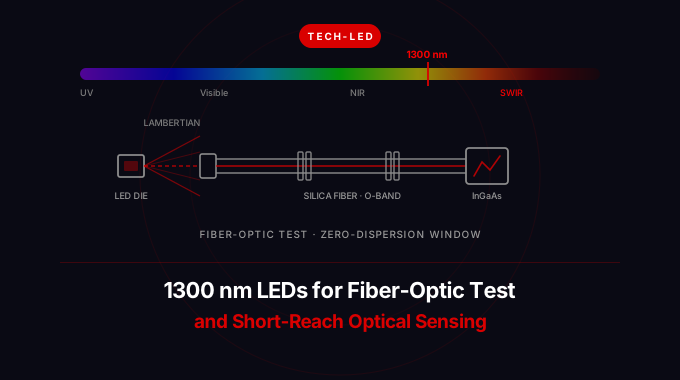
In fiber optic sensing, 1050nm is also significant. Many fiber-optic sensor systems and interferometers (like fiber Bragg grating sensors or optical coherence domain reflectometers) can be designed for ~1 micron operation. A broadband LED light source around 1050 nm provides low-coherence light that can be coupled into standard telecom-grade fiber (since fiber typically has low loss in the 1000–1300 nm window). Compared to using a 850nm LED, a 1050nm LED in fiber systems experiences less attenuation over distance in silica fibers and can also take advantage of fiber amplifiers (like Yb-doped fiber amplifiers) if needed. Additionally, 1050nm is far from the common telecom bands (1310 nm and 1550 nm), so a 1050nm fiber sensor won’t interfere with communication signals, which is a plus in aerospace applications or infrastructure monitoring where both data links and sensors might co-exist. Overall, whether it’s analyzing materials via spectroscopy or building a custom sensor, a 1050nm LED offers a stable, relatively narrowband (compared to incandescent) but incoherent source in the SWIR range. Its use cases span from industrial process monitoring (moisture, plastic identification, chemical concentrations) to scientific instrumentation, utilizing high power LEDs for enhanced performance. Engineers just need to ensure their detector or spectrometer is designed for SWIR – for example, using suitable photodiodes or gratings – to fully capitalize on a 1050nm LED’s output.
What Packaging and Optics Are Used in High-Power 1050nm LED Designs?
Designing a high-power 1050nm LED for practical use involves careful attention to packaging and optics. These LEDs are often built on specialized LED chip structures (for example, InGaAsP semiconductor layers) and are packaged to handle the thermal load. High-power infrared LEDs typically use metal or ceramic packages that can dissipate heat efficiently – you might see 1050nm emitters in TO-18 can packages with integrated lenses, or in surface-mount (SMD) ceramic packages. The packaging not only provides heat sinking but also mechanical stability and alignment for any optics. Many high power 1050nm LEDs include a built-in lens or window for optimized light delivery. A molded lens can help collimate or focus the output, which is useful because in many applications you want to direct the infrared light onto a target area. Some packages use a flat window for wide-angle illumination, whereas others have a dome or integrated lens to narrow the beam. The choice of lens affects the radiant intensity (power per area) and the beam divergence. For example, an SMD LED with a narrow lens might have a ±10° beam and higher intensity, while a broad-emitting LED might cover 120° without any secondary optics.
Optical considerations are crucial since 1050nm is beyond the visible – you must use materials and coatings that are transparent in the SWIR range for any external optics. Standard glass lenses usually transmit 1050nm well (since it’s just on the edge of where glass starts absorbing). Anti-reflective coatings on lenses can be optimized for ~1000–1100 nm to maximize throughput. If coupling the LED into a fiber optic system or an optics assembly, precise alignment is needed because LED light is not as inherently directional as a laser. Sometimes an array of 1050nm LEDs is used (an LED collection or cluster) to boost overall output – in such cases, each die might be packaged together under one window for combined emission. Another aspect of packaging is driver integration: high-power LEDs often are mounted on star boards or modules that make it easier for engineers to attach to heat sinks and connect to current drivers. Because 1050nm LEDs generate heat at high drive currents, the package usually must be mounted to a heat sink or metal core PCB for continuous operation. In summary, the packaging of 1050nm LEDs tends to be compact yet robust – using ceramic substrates, metal leads, and infrared-transparent lenses – all configured to deliver stable, high-power output in the SWIR wavelength range.
How to Optimize 1050nm LED Output and Efficiency in Applications?
When incorporating a 1050nm LED into a system, there are several design considerations to ensure you get the best output and efficiency. First, driving conditions: these diodes should be driven with a stable current source, typically in the hundreds of milliamps for high-power types. Manufacturers often specify a test current (for instance, 500 mA or 600mA) at which the LED’s radiant flux and forward voltage are characterized. Running at this rated current will give the advertised output power, but be mindful of heat. Using lower duty cycles or pulsed driving can allow higher peak currents without overheating, which is useful if you need brief bursts of intense IR illumination (as might be the case in pulsed spectroscopy or range-finding).
Thermal management is key to both output and lifespan. Keeping the LED junction cool will maintain higher radiant efficiency (since excessive heat can roll off the output and shift the wavelength). Mount the LED on a good heat sink and consider airflow if necessary. Also, pay attention to the electrical configuration and power supply – to avoid intensity ripple or noise in sensitive imaging, a low-noise driver is recommended so that the LED’s emission is steady. In terms of efficiency, 1050nm LEDs are generally quite energy-efficient for their spectral region, but you can maximize system efficiency by collecting and delivering their high power light effectively. This might involve using reflective optics or light pipes to direct more of the LED’s output onto the target. If the application doesn’t require a wide beam, using secondary optics (like an IR-transmissive condenser lens) can greatly increase the usable intensity. Conversely, if you need a wide, uniform illumination, diffusers that work at near-infrared can help spread the beam without absorbing too much light (diffusers should be chosen for low loss at 1050 nm). Finally, consider the environment: if the application is outdoors or in a harsh setting, ensure the LED and its optics are protected by appropriate enclosures or filters (some systems use an IR-pass filter window to cover the LED, which passes 1050 nm but blocks shorter wavelengths and environmental contaminants). By addressing drive conditions, thermal design, optical coupling, and environmental protection, you can fully leverage a 1050nm LED’s capabilities. The result will be an energy-efficient IR illumination system that reliably delivers the needed radiant power for your application, whether it’s a sensor, a camera, or a spectroscopy instrument. And as always, check the LED’s datasheet for key specifications – such as radiant flux, peak wavelength, bandwidth, and rise/fall times – to ensure they meet your system requirements.
- 1050nm LEDs sit at the crossroads of NIR and SWIR. At this wavelength, silicon sensors stop responding, and InGaAs SWIR detectors take over, enabling unique imaging capabilities just beyond the NIR range.
- Compared to 850nm/940nm IR emitters, 1050nm LEDs reach deeper. They allow seeing through materials (like silicon or plastics) and achieve less scattering, at the cost of needing appropriate SWIR detectors and slightly lower efficiency than shorter IR LEDs.
- LEDs provide low-noise, speckle-free infrared illumination. Unlike laser beams, incoherent LED light at 1050nm produces minimal speckle and interference, which is crucial for high-quality imaging and sensing at short range.
- 1050nm penetrates biological tissue more effectively. This wavelength falls in an optical window with reduced scattering and absorption, enabling deeper, clearer views in medical imaging (e.g. OCT and other non-invasive diagnostics benefit greatly from the use of high power near infrared light sources.
- Engineers can integrate high power 1050nm LEDs into diverse systems for improved efficiency. From spectroscopy setups to machine vision and fiber-optic sensors, these high-power infrared LEDs open new possibilities – provided that proper sensors, optics, and thermal designs are in place to maximize their performance.
What is an IR LED chip and how does it relate to a 1050 nm LED?
An IR LED chip is the semiconductor die that generates infrared light when current passes through it; a 1050 nm LED uses a chip engineered to emit near-infrared (NIR) radiation centered around 1050 nm. The chip design, materials, and packaging determine output power, spectral peak, and efficiency. For applications needing specific wavelength options or tight spectral control, the chip specification is a critical factor when selecting a 1050 nm LED.
Can a high power LED deliver sufficient output at 1050 nm for industrial use?
Yes, a high power LED configured for 1050 nm can provide the radiant flux required for many industrial tasks such as inspection, sensing, and illumination in SWIR-sensitive detectors. High power LEDs are built to handle greater current and thermal load; their specification sheets typically list radiant intensity, forward voltage, and thermal resistance. Proper heat sinking and driver choice are essential to maintain energy-efficient operation and long lifetime.
How does a SWIR LED differ from a typical diode and is 1050 nm considered SWIR?
SWIR LEDs cover the short-wave infrared band roughly from 900 nm to 1700 nm; a 1050 nm LED falls within this SWIR range and differs from lower-NIR diodes primarily in semiconductor materials and optical packaging. Compared with visible diodes, SWIR devices emphasize different radiation characteristics, detector compatibility, and transmission through certain materials. When specifying a diode for SWIR use, check wavelength options, spectral width, and detector matching.
What fiber and lens considerations are important when coupling a 1050 nm LED light source?
Efficient coupling of a 1050 nm LED into fiber or through an optical lens system requires matching numerical aperture, spot size, and lens coatings suitable for NIR/SWIR wavelengths. Specialty fibers and AR coatings optimized for 1050 nm reduce loss. Lens materials should transmit in the NIR/SWIR band; using lenses designed for visible light can introduce absorption and increased radiation loss. For fiber-coupled modules, the led collection geometry and alignment tolerance specified by the supplier are key.
How do led collection and lens geometry affect energy-efficient performance at 1050 nm?
LED collection optics and lens geometry shape output beam uniformity and coupling efficiency, directly affecting energy-efficient performance. Well-designed collection lenses minimize stray radiation and maximize the fraction of emitted photons directed to the target or into fiber, reducing required drive current. For high power led modules at 1050 nm, optics that optimize etendue and reduce thermal load help maintain long-term efficiency.
What specifications should I check when choosing a 1050 nm LED from a supplier?
Key specifications include peak wavelength (centered at 1050 nm), spectral bandwidth (FWHM), radiant flux or power, forward voltage and current, thermal resistance, beam angle, and lifetime rating. Also review environmental ratings, recommended heat-sinking, and available wavelength options (e.g., comparisons with 730nm or UV ranges if multi-wavelength systems are used). Suppliers should provide measurement conditions and radiation pattern data to ensure proper system integration.
Is 1050 nm considered NIR and are there safety concerns with infrared radiation?
Yes, 1050 nm is in the near-infrared (NIR) and SWIR bands. While it is invisible to the human eye, it can still pose eye and skin exposure risks because corneal and retinal absorption differ from visible light. Safety standards for laser and LED radiation apply; always follow recommended exposure limits, labeling, and use protective measures when working with high power led modules. Check supplier safety documentation for emission classification and safe operating practices.
Can manufacturers offer wavelength options like 730nm, UV, or multiple wavelengths alongside a 1050 nm LED for multispectral systems?
Many manufacturers and suppliers provide a range of wavelength options, including 730nm, 1050 nm, and UV bands, enabling multispectral light sources. Combining wavelengths in a single module or system often requires careful optical design to manage differences in beam divergence, led chip characteristics, and spectral filtering. For applications such as imaging or sensing, integrated multi-wavelength assemblies with proper drivers and thermal management can deliver flexible, energy-efficient solutions.
Putting 1050 nm in Context
This article is part of our broader exploration of how LED wavelength selection impacts optical system performance from UV through infrared. While 1050 nm LEDs sit at the critical boundary between near-infrared and SWIR, engineers often evaluate them alongside more established NIR options such as 850 nm LEDs and 940 nm LEDs, which remain dominant in silicon-based imaging and sensing systems. Understanding how these adjacent wavelengths differ in detector compatibility, scattering behavior, and illumination characteristics helps designers choose the most effective infrared light source for machine vision, spectroscopy, and SWIR-compatible applications.