The light source in a fluorescence microscope has one job: deliver a band of excitation light that overlaps the absorption peak of the fluorophore you are imaging, then get out of the way so the longer-wavelength emission can be detected. Choosing the LED is therefore a wavelength-matching problem. DAPI excites near 358 nm (a 365…
Tech-Led Blog
UV LEDs
-
-
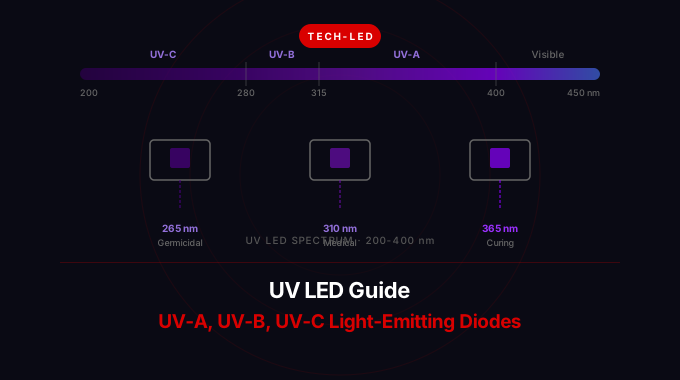
Industrial UV LEDs span 200-420 nm across three sub-bands: UV-C (200-280 nm) for germicidal and water-disinfection applications including surface disinfection and water purification, UV-B (280-315 nm) for narrow medical and specialty curing uses, and UV-A (315-400 nm) for industrial curing of inks, coatings, and adhesives, plus fluorescence excitation and optical inspection. Selection depends on three…
-
Industrial UV LEDs span 200-420 nm across three sub-bands: UV-C (200-280 nm) for germicidal and water-disinfection applications including surface disinfection and water purification, UV-B (280-315 nm) for narrow medical and specialty curing uses, and UV-A (315-400 nm) for industrial curing of inks, coatings, and adhesives, plus fluorescence excitation and optical inspection. Selection depends on three…
-
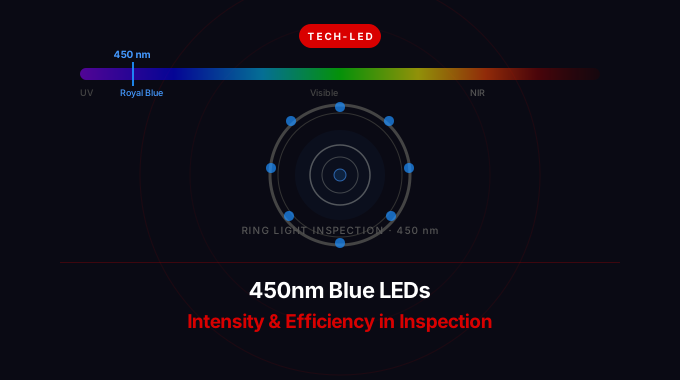
In industrial inspection and machine vision systems, high-power 450nm LED sources have become a key element for providing intense blue illumination. This “royal blue” wavelength sits at the cusp of the visible spectrum between violet and green, offering high-energy photons for enhanced contrast without veering into ultraviolet UV light. These high power LEDs provide intense…
-
405 nm LED technology sits at the border of visible violet and ultraviolet light (UV-A), effectively functioning as an ultraviolet LED in the UV-A range, making it a unique member of the UV & Near-UV LEDs (235–420 nm) category. This near-ultraviolet wavelength offers distinct advantages for industrial optical systems. From fluorescence microscopy and machine vision…