Tech-led.com


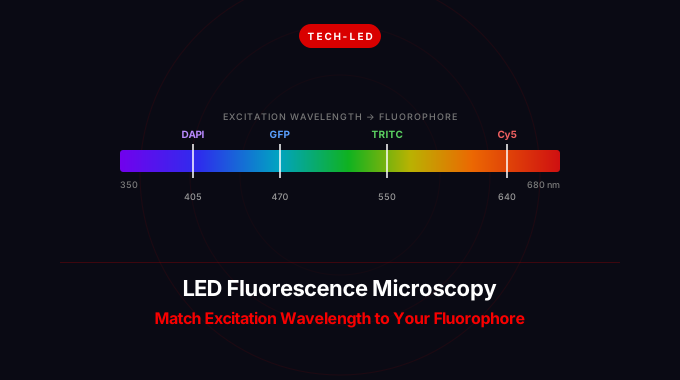
The light source in a fluorescence microscope has one job: deliver a band of excitation light that overlaps the absorption peak of the fluorophore you are imaging, then get out of the way so the longer-wavelength emission can be detected. Choosing the LED is therefore a wavelength-matching problem. DAPI excites near 358 nm (a 365 nm or 405 nm LED), GFP/FITC near 488–495 nm (a 470 nm LED), TRITC/Cy3 near 547 nm (a ~530–550 nm source), and Cy5 near 649 nm (a ~630–640 nm LED). A modern multi-channel system combines several of these LED wavelengths behind a set of filter cubes so one microscope can image multiple stains. This guide covers how to match the LED to the fluorophore, how LEDs compare to mercury arc lamps and lasers, the filter-cube fundamentals that make it work, and the component wavelengths to specify.
| Fluorophore (common) | Excitation peak | Emission peak | LED excitation line |
|---|---|---|---|
| DAPI, Hoechst | ~358 nm | ~461 nm | 365 nm or 405 nm |
| CFP | ~436 nm | ~480 nm | ~430–440 nm |
| GFP, FITC, Alexa 488 | ~488–495 nm | ~510–519 nm | 470 nm |
| YFP | ~514 nm | ~527 nm | ~505–520 nm |
| TRITC, Cy3, Alexa 555 | ~547–555 nm | ~565–572 nm | ~520–550 nm |
| Texas Red, mCherry | ~587–595 nm | ~610–620 nm | ~590 nm |
| Cy5, Alexa 647 | ~649 nm | ~670 nm | ~630–650 nm |
Why excitation wavelength is the first decision
Fluorescence works by Stokes shift: a fluorophore absorbs a photon at a shorter wavelength, loses a little energy, and re-emits at a longer wavelength. The excitation source must put as much power as possible into the fluorophore's absorption band while the detection path isolates the weaker, red-shifted emission. If the LED wavelength sits off the absorption peak, excitation efficiency falls and you pay for it in signal-to-noise, longer exposures, more photobleaching, dimmer images.
This is why an LED's peak wavelength and spectral bandwidth (FWHM) matter more for microscopy than raw output. A 470 nm LED with a 20–30 nm FWHM lands neatly inside GFP's absorption band; a source that is too broad spills energy outside the band (wasted, and harder to filter out), while one centered on the wrong line under-excites the dye. Reference excitation/emission spectra, for example, Nikon's MicroscopyU or a fluorophore spectra viewer, are the starting point for matching a dye to an LED line.
LED vs. mercury arc vs. laser as the excitation source
For decades, fluorescence microscopes used mercury or metal-halide arc lamps: bright, but broadband with uneven spectral peaks, hot, mercury-containing, with a warm-up cycle and a ~200–2,000 hour bulb life that drifts as it ages. LEDs have displaced them in most new instruments, and lasers occupy the high-end confocal niche.
| Factor | LED engine | Mercury / metal-halide arc | Laser |
|---|---|---|---|
| Spectral output | Narrow band per channel (~20–30 nm), wavelength-selectable | Broad, with fixed mercury peaks (365, 405, 436, 546 nm) | Single line, <1 nm |
| Per-channel control | Independent, instant on/off, dimmable | Whole-spectrum on; needs filter wheel to select | Per-laser |
| Stability | High; constant-current drive | Drifts as bulb ages | High |
| Lifetime | 20,000–50,000 h | ~200–2,000 h (bulb) | Varies |
| Mercury content | None | Yes (disposal regulated) | None |
| Best fit | Widefield / epifluorescence, multi-channel imaging | Legacy systems | Confocal, TIRF, high-resolution |
The decisive LED advantages for widefield and epifluorescence are per-channel switching (each wavelength turns on only when its fluorophore is imaged, cutting photobleaching) and stability (constant output for quantitative measurements). Commercial LED illuminators from CoolLED, Lumencor, Excelitas (X-Cite), and Thorlabs package multiple wavelengths into one engine, but the underlying selection problem is the same one an OEM faces when building illumination from discrete LED emitters.
Filter cubes: how the wavelengths stay separated
A fluorescence microscope keeps excitation and emission light apart with a filter cube containing three elements:
- Excitation filter, a bandpass that trims the LED to a clean band matched to the fluorophore's absorption (e.g. 470/40 nm for GFP).
- Dichroic mirror (beamsplitter), reflects the excitation wavelength onto the sample but transmits the longer emission wavelength toward the detector.
- Emission filter, a bandpass that passes only the fluorophore's emission and blocks scattered excitation light.
Because the LED is already narrow-band, it makes the excitation filter's job easier and reduces out-of-band light that would otherwise leak through as background. For multi-channel systems, each fluorophore gets its own cube (or a multi-band cube), and the matching LED channel is switched on for that cube. Matching the LED line to both the fluorophore and the filter set is the core integration task.
Designing multi-channel LED illumination
Most fluorescence work is multi-color, a nuclear stain plus one or more labeled targets, so an instrument typically needs several excitation lines. A common four-channel palette covers most routine immunofluorescence:
| Channel | LED line | Typical fluorophores |
|---|---|---|
| UV / violet | 365–405 nm | DAPI, Hoechst |
| Blue | 470 nm | GFP, FITC, Alexa 488 |
| Green | 520–550 nm | TRITC, Cy3, Alexa 555 |
| Red | 630–640 nm | Cy5, Alexa 647 |
The LEDs are combined optically (dichroic mirrors or a light guide) into a common path and switched electronically. Key component-level requirements:
- Peak-wavelength accuracy and tight binning so every unit excites at the intended line.
- Radiant power sufficient to saturate the fluorophore's absorption at the sample plane without excessive heat.
- Fast switching / modulation for low-photobleaching sequential imaging and for synchronizing with a camera.
- Thermal and output stability, junction temperature shifts both output and peak wavelength, so constant-current drive and heat-sinking are essential for quantitative work.
- Detector match, pair the system with a sensitive silicon detector or sCMOS camera responsive across the emission bands.
For the full wavelength map from UV to infrared, see the LED Wavelength Guide; for the near-UV violet channel specifically, the 405 nm LED guide covers DAPI excitation, silicon-detector compatibility, and optics in depth, and the UV LED Guide covers the 365 nm option.
Marubeni LEDs for fluorescence excitation
Tech-led distributes Marubeni's LED portfolio across the wavelengths fluorescence excitation needs, from near-UV through visible to red, in surface-mount and high-power packages suited to microscope illumination modules and OEM fluorescence instruments:
- 365 nm UV-A LEDs, deep-UV excitation for DAPI/Hoechst
- 405 nm violet LEDs, DAPI and near-UV fluorophores, silicon-detector friendly
- 450 nm blue LEDs, the blue channel for GFP/FITC-class dyes
- 520 nm green LEDs, green excitation for TRITC/Cy3
- 630 nm red LEDs, red excitation for Cy5-class far-red dyes
Wavelength-pair selection, tight binning, radiant-power budgeting at the sample plane, and the switching and thermal-stability needs of a multi-channel engine are exactly the kind of spec-stage decisions worth confirming with an applications engineer. For component recommendations, datasheets, and samples, see the UV/visible LED product range or contact Tech-led engineering.
Frequently asked questions
What wavelength LED is used for fluorescence microscopy?
It depends entirely on the fluorophore. The LED excitation line must overlap the dye's absorption peak: ~365–405 nm for DAPI, ~470 nm for GFP/FITC, ~520–550 nm for TRITC/Cy3, and ~630–650 nm for Cy5. Most microscopes use several LED channels so one instrument can image multiple stains.
What LED excites GFP?
Green fluorescent protein absorbs most strongly near 488 nm, so a 470 nm blue LED (with a ~470/40 nm excitation filter) is the standard widefield choice. It sits inside GFP's absorption band and is well separated from GFP's ~510 nm emission, which the emission filter passes to the detector.
What LED wavelength excites DAPI?
DAPI's excitation peak is around 358 nm. A 365 nm UV LED matches it most closely, but a 405 nm violet LED is widely used because it still excites DAPI efficiently while being far easier to detect with standard silicon cameras and easier to handle optically. The choice is a trade-off between excitation efficiency (365 nm) and detector/optics convenience (405 nm).
Are LEDs better than mercury lamps for fluorescence microscopy?
For most widefield and epifluorescence work, yes. LEDs offer independent per-channel on/off and dimming (which reduces photobleaching), stable mercury-free output for quantitative imaging, 20,000–50,000 hour lifetimes, instant on with no warm-up, and no toxic-disposal requirement. Mercury and metal-halide arc lamps remain in legacy systems, and lasers are preferred for confocal and TIRF.
Why does fluorescence microscopy need filters if the LED is already narrow-band?
Even a narrow LED emits some out-of-band light, and the fluorophore's emission must be separated from the much stronger excitation light. The filter cube, excitation filter, dichroic mirror, and emission filter, cleans up the LED band, directs it to the sample, and passes only the red-shifted emission to the detector. The narrow LED makes the excitation filter's job easier and lowers background.
Can one LED cover multiple fluorophores?
A single LED line can excite fluorophores with overlapping absorption bands (for example, FITC and Alexa 488 both work under 470 nm), but dyes with widely separated excitation peaks need different LED channels. Multi-color imaging therefore uses a multi-channel LED engine with one line per channel, switched in sequence.
What spectral bandwidth (FWHM) should a fluorescence-excitation LED have?
Narrow is generally better: a ~20–30 nm FWHM concentrates power in the absorption band and minimizes out-of-band light the excitation filter must reject. The LED's peak should be centered on, or just below, the fluorophore's excitation maximum, and tight wavelength binning keeps multiple units consistent.
What about far-red and near-infrared dyes?
Far-red dyes like Cy5 (~649 nm) use ~630–640 nm red LEDs, and near-infrared labels such as Cy7 (~750 nm) move into the NIR, where dedicated infrared emitters apply. Red and NIR channels reduce autofluorescence and tissue absorption, which is why far-red imaging is growing in live-cell and deep-tissue work.
Related guides
- 405 nm Violet (UV-A) LED for Fluorescence and Optical Detection, deep dive on the violet excitation channel
- Industrial UV LED Guide, UV-A/B/C bands and the 365 nm option
- 450 nm Blue LEDs, the blue excitation channel
- LED Wavelength Guide: From UV to Infrared, the full spectrum map
Building a fluorescence microscope or OEM fluorescence instrument? Contact Tech-led engineering for excitation-LED wavelength recommendations, datasheets, and samples across the UV-to-red range.