Tech-led.com


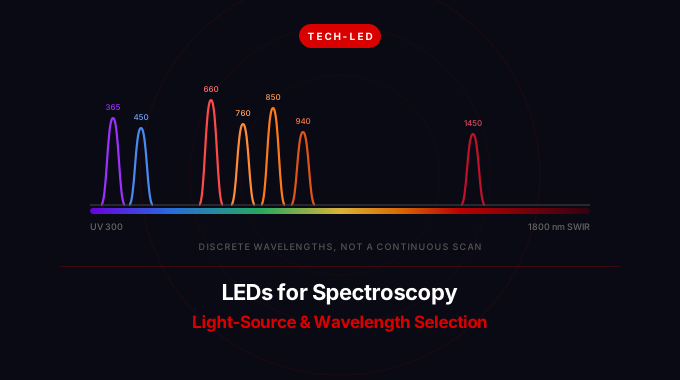
LEDs have become a practical light source for a wide range of spectroscopy and spectral-sensing instruments, from near-infrared tissue spectroscopy and multispectral imaging to absorbance measurement, fluorescence excitation, colorimetry, and photobiomodulation. LED light sources are compact, stable, electrically simple, long-lived, and available across the ultraviolet (UV), visible, near-infrared (NIR), and short-wave infrared (SWIR) bands. For instruments that probe a set of discrete wavelengths rather than a full continuous spectrum, LEDs are often the most efficient and lowest-cost choice. This guide covers when LEDs make sense for spectroscopy, the specifications that matter, how to choose wavelengths, how to pair an LED with a detector or spectrometer, and how spectroscopy is also used to characterize LED light itself.
Why LEDs for spectroscopy
Classic spectroscopy uses a broadband lamp (tungsten-halogen, incandescent, deuterium, or xenon) and a dispersive element, a grating or prism, to spread the spectrum across a detector. That approach is powerful but bulky, power-hungry, and expensive. Many modern instruments instead use the inverse strategy: illuminate the sample with one or more narrow, well-defined wavelengths from LEDs and measure the response. This is where LED light sources excel.
An LED emits a relatively narrow band of light, typically tens of nanometers wide, with a roughly Gaussian spectral distribution, centered on a chosen peak. By selecting the right set of LEDs, a designer can interrogate exactly the absorption or emission features that matter and skip the cost, size, and power of a full monochromator. The result is a smaller, lower-cost, more rugged instrument well suited to portable, wearable, in-line, and high-channel-count designs.
LEDs are a strong fit when your measurement:
- targets specific spectral features at a few wavelengths rather than a full continuous scan;
- needs a compact, low-cost, or portable form factor;
- benefits from fast switching, LEDs modulate at kHz–MHz rates for lock-in detection and background-noise rejection;
- requires long lifetime and stable output with minimal warm-up.
Full continuous-spectrum work, high-resolution identification of unknown materials, or resolving fine spectral structure, still favors a broadband lamp plus a spectrometer, or a tunable laser. LEDs shine for targeted, multi-wavelength measurement and monitoring.
What spectroscopy needs from an LED light source
Four LED specifications drive measurement quality:
Peak (center) wavelength. The center of the emission band must align with the spectral feature you are measuring. Many spectroscopy applications are wavelength-specific to within a few nanometers, so center-wavelength accuracy and bin tolerance matter. Peak wavelength also drifts slightly with drive current and temperature, which must be controlled or characterized.
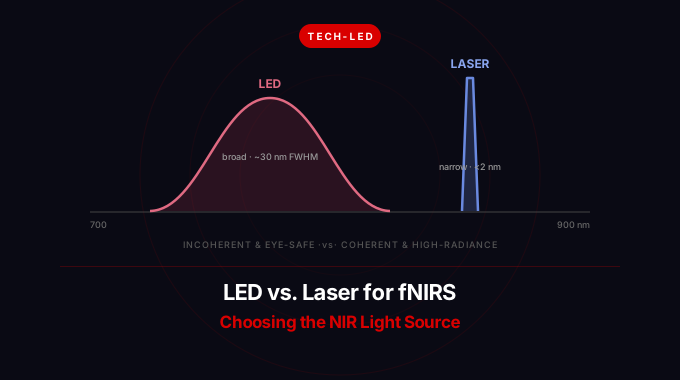
Spectral width (FWHM) and bandwidth. An LED emits a band, not a line, usually 20–40 nm full-width at half-maximum in the visible/NIR. A narrowband emitter gives cleaner, more selective measurements; a broader bandwidth can blur closely spaced features. Where the math depends on the source spectral distribution, for example, relating absorption to analyte concentration through the Beer–Lambert law, use the LED's measured emission curve rather than assuming a single wavelength.
Optical power and irradiance. Enough radiant output must reach the sample and return to the detector for an adequate signal-to-noise ratio. Applications often specify a target irradiance (e.g., tens of mW/cm² at the sample); higher power also supports longer path lengths or larger source–detector separations.
Stability. Output should be stable over time and temperature, because spectroscopy compares intensities. Constant-current drive, thermal management, and, where needed, optical feedback keep the reading honest across a measurement.
| Source | Spectrum | Best for | Trade-offs |
|---|---|---|---|
| LED | Narrow band (~20–40 nm) at a chosen peak | Targeted multi-wavelength measurement; portable, low-cost, fast-switching systems | Not a single line; limited to available peak wavelengths |
| Broadband lamp + spectrometer | Full continuous spectrum (tungsten, halogen, incandescent, xenon) | High-resolution identification, unknown-sample scanning | Bulky, power-hungry, costly; warm-up and lifetime limits |
| Laser / laser diode | Sub-nanometer line | Maximum spectral purity, fiber-optic coupling, long range | Expensive; eye-safety hazard class; speckle; narrow availability |
LED vs. lamp vs. laser
Source
Spectrum
Best for
Trade-offs
LED
Narrow band (~20–40 nm) at a chosen peak
Targeted multi-wavelength measurement; portable, low-cost, fast-switching systems
Not a single line; limited to available peak wavelengths
Broadband lamp + spectrometer
Full continuous spectrum (tungsten, halogen, incandescent, xenon)
High-resolution identification, unknown-sample scanning
Bulky, power-hungry, costly; warm-up and lifetime limits
Laser / laser diode
Sub-nanometer line
Maximum spectral purity, fiber-optic coupling, long range
Expensive; eye-safety hazard class; speckle; narrow availability
For most discrete-wavelength instruments, LEDs land in the sweet spot between a lamp's bulk and a laser's cost and safety burden. Where a broad spectrum is genuinely required, a lamp is still the right call; where a single wavelength with maximum purity is required, a laser wins.
Choosing wavelengths across the spectrum
Spectroscopy spans the full optical range, UV-Vis, NIR, and SWIR, and the right band depends on what you are measuring:
- UV (UV-A/B/C, ~250–400 nm), fluorescence excitation, protein and nucleic-acid absorbance, photochemistry, and UV-activated processes (for example, narrow-band UVB around 305–315 nm for vitamin-D activation).
- Visible (~400–700 nm), colorimetry and colorimetric assays, absorbance of pigments and dyes, reflectance, and photobiomodulation. A blue LED (~450 nm) is common for fluorescence excitation; red around 630–660 nm for therapy and absorbance.
- Near-infrared (NIR, ~700–1050 nm), tissue and biomedical spectroscopy, functional near-infrared spectroscopy (fNIRS), pulse oximetry, and reflectance measurement, where common NIR LED sets include 750, 760, 800, 850, and 940 nm.
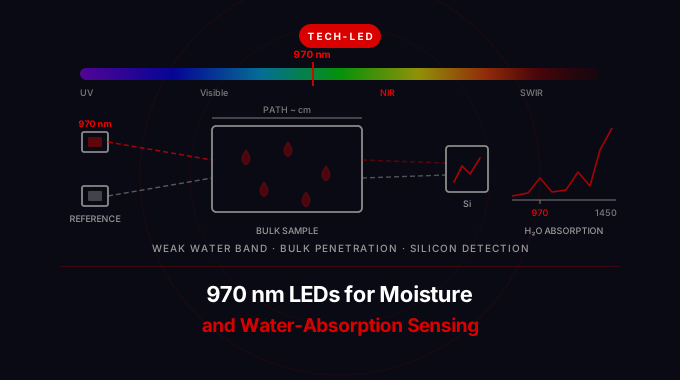
- Short-wave infrared (SWIR, ~1050–1750 nm), moisture and water-content measurement, food and material composition, and multispectral imaging of features invisible in the visible band.
Because biological and chemical absorption features are spread across several of these bands, many designs need multiple wavelengths at once, discrete single-color LEDs, an RGB LED, or a custom multi-wavelength package.
Pairing LEDs with photodiodes and spectrometers
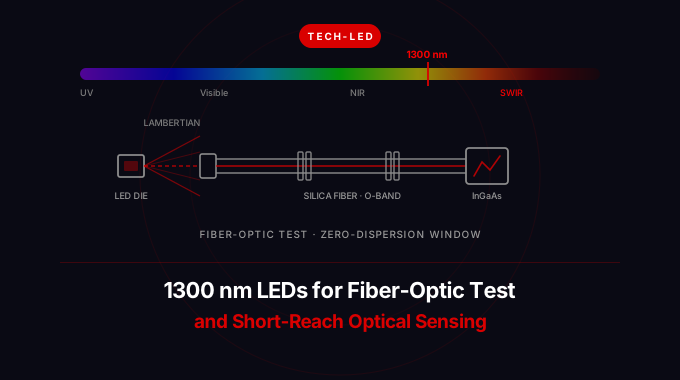
An LED light source is only half the instrument; the detector and optics complete it. For a fixed-wavelength LED design, the detector is usually a photodiode (silicon for UV–NIR up to ~1000 nm, InGaAs for SWIR), simple, fast, and low-cost, and a natural match to an LED's discrete output. Where you still need to resolve a spectrum, a compact spectrometer module (often a fixed grating over a CCD or photodiode array) measures across a wider spectral range at a defined resolution.
Practical pairing considerations:
- Coupling and optics, a lens, optical filter, light guide, or optical fibers route the LED output to the sample and the returning light to the detector, and isolate the band of interest; integrating-sphere and fiber-optic accessories help with diffuse or weak signals.
- Detector sensitivity and range, match the photodiode or spectrometer's spectral response to your LED wavelengths.
- Calibration, calibrate intensity and (for a spectrometer) wavelength so results are repeatable; a dark reading sets the background-noise floor.
- Modulation and lock-in, switching the LED and detecting synchronously rejects ambient light and improves the detection limit.
Because LEDs switch instantly and need no warm-up, they pair well with low-cost photodiode front-ends for high-channel-count and continuous-monitoring sensors.
Multispectral imaging and multi-wavelength designs
A recurring requirement is a system that illuminates a sample with several wavelengths, in sequence or from one compact source, for multispectral imaging, multi-parameter sensing, or differential absorption. Building this from discrete packages means tight mechanical alignment and a large footprint.
A multi-wavelength package solves this. Marubeni Tech-LED's COB 8-in-1 package integrates up to eight independently driven emitters, chosen freely from a wide UV-through-SWIR wavelength list, in a single 2.2 × 2.9 mm footprint. For a multispectral or multi-band spectroscopy instrument, that collapses an array of separate LEDs into one component with a common optical origin, simplifying the optics, mounting, calibration, and integration.
Using spectroscopy to characterize LED light
Spectroscopy and LEDs intersect from the other direction too: a spectrometer is the standard tool for measuring an LED's own light. Whether you are qualifying an emitter for a design or verifying a production batch, a spectral measurement gives you the peak wavelength, the FWHM and full spectral distribution, and the radiant or luminous output.
For white LEDs and lighting, those same spectral data yield the lighting metrics that matter: correlated color temperature (CCT), the color-rendering index (CRI), chromaticity and hue, and how a white LED's phosphor coating produces a broad spectrum compared with an incandescent or halogen bulb. This spectral analysis is how engineers confirm that an LED light source or luminaire meets its color, illumination, and quality targets, and it is why "LED spectroscopy" is as much about characterizing LEDs as it is about using them.
Key LED specifications for a spectroscopy instrument
When selecting LEDs for a spectroscopy or spectral-sensing design, pin down these parameters:
- Peak / center wavelength and bin tolerance, how tightly the peak must be held, and over what temperature range.
- FWHM, bandwidth, and spectral shape, narrow enough for your selectivity, with a known LED emission curve and spectral range.
- Radiant power / irradiance at the sample, derived from path length, geometry, and detector sensitivity.
- Drive and modulation, constant-current drive, and switching speed for lock-in or time-multiplexed detection.
- Thermal behavior, wavelength and output drift versus junction temperature, and the heatsinking needed to stay in spec.
- Package, optics, and mounting, emitter size, viewing angle, and whether a single multi-wavelength package (versus discrete parts) better fits the optical design.
Marubeni LEDs for spectroscopy
Marubeni Tech-LED supplies LEDs spanning roughly 365 nm (UV) through 1750 nm (SWIR), including the visible and NIR wavelengths most spectroscopy systems rely on. You can browse the catalog by wavelength to match specific peaks, choose individual emitters in SMD, SMBB, COB, and through-hole packages, or specify and customize a multi-wavelength 8-in-1 package for multispectral designs. For tight peak-wavelength bins, custom wavelength combinations, or guidance on FWHM and optical power for your measurement, contact us with your target wavelengths, irradiance, and geometry.
Frequently asked questions
Can you use LEDs for spectroscopy?
Yes. LEDs are widely used in spectroscopy and spectral sensing, especially for instruments that measure a set of discrete wavelengths rather than a full continuous spectrum. They are compact, stable, fast-switching, low-cost, and available across UV, visible, NIR, and SWIR, which makes them well suited to portable and multi-channel designs.
LED vs. laser for spectroscopy, which is better?
It depends on the measurement. Lasers give sub-nanometer spectral purity and couple efficiently into optical fibers, which matters for high-resolution or long-path work, but they are costly and carry eye-safety constraints. LEDs offer a narrowband (but not single-line) output at far lower cost and complexity, and are the better choice for targeted multi-wavelength, portable, and high-channel-count instruments.
What wavelength LED do I need for my spectroscopy application?
Match the LED center wavelength to the absorption or emission feature you are measuring. UV suits fluorescence excitation and protein/nucleic-acid absorbance, visible suits colorimetry and pigments, NIR suits tissue and reflectance spectroscopy, and SWIR suits moisture and material composition. Many designs need several wavelengths across these bands.
How does an LED's spectral width (FWHM) affect spectroscopy?
A typical LED emits a 20–40 nm band rather than a single line, so closely spaced features can blur, and any calculation based on the source spectrum should use the LED's measured emission curve. A narrower FWHM improves selectivity; where high resolution is essential, a laser may be required.
What detector pairs with an LED spectroscopy light source?
For a fixed-wavelength LED, a photodiode (silicon for UV–NIR, InGaAs for SWIR) is the simplest, lowest-cost match. Where you need to resolve a spectrum, a compact spectrometer module, a grating over a CCD or photodiode array, measures across a spectral range at a defined resolution. Match the detector's sensitivity to your LED wavelengths and calibrate for repeatable results.
Can one LED package provide multiple spectroscopy wavelengths?
Yes. A multi-wavelength package such as a COB 8-in-1 integrates several independently driven emitters at different wavelengths in one small footprint, which is ideal for multispectral imaging and multi-parameter spectral sensing because all the wavelengths share a common optical origin.
How is spectroscopy used to characterize LED light?
A spectrometer measures an LED's peak wavelength, FWHM, and full spectral distribution, and for white LEDs derives lighting metrics such as color temperature and color-rendering index (CRI). This spectral analysis qualifies emitters during design and verifies output in production.
Why is wavelength stability important in spectroscopy?
Spectroscopy compares light intensities, so any drift in source wavelength or output during a measurement becomes error. LED peak and output shift with drive current and temperature, so constant-current drive and thermal management, and, where needed, characterization or feedback, keep results repeatable.
Related guides
- NIR LEDs for fNIRS: Wavelength Selection and Component Guidance
- Choosing an LED for Fluorescence Microscopy: Matching Excitation Wavelength to Your Fluorophore
- Pulse Oximeter LED Wavelengths: Red and Infrared for SpO₂ Sensor Design
- Near-Infrared (NIR) LED Guide
{ "@context": "https://schema.org", "@type": "FAQPage", "mainEntity": [ { "@type": "Question", "name": "Can you use LEDs for spectroscopy?", "acceptedAnswer": { "@type": "Answer", "text": "Yes. LEDs are widely used in spectroscopy and spectral sensing, especially for instruments that measure a set of discrete wavelengths rather than a full continuous spectrum. They are compact, stable, fast-switching, low-cost, and available across UV, visible, NIR, and SWIR, which makes them well suited to portable and multi-channel designs." } }, { "@type": "Question", "name": "LED vs. laser for spectroscopy, which is better?", "acceptedAnswer": { "@type": "Answer", "text": "It depends on the measurement. Lasers give sub-nanometer spectral purity and couple efficiently into optical fibers, which matters for high-resolution or long-path work, but they are costly and carry eye-safety constraints. LEDs offer a narrowband (but not single-line) output at far lower cost and complexity, and are the better choice for targeted multi-wavelength, portable, and high-channel-count instruments." } }, { "@type": "Question", "name": "What wavelength LED do I need for my spectroscopy application?", "acceptedAnswer": { "@type": "Answer", "text": "Match the LED center wavelength to the absorption or emission feature you are measuring. UV suits fluorescence excitation and protein/nucleic-acid absorbance, visible suits colorimetry and pigments, NIR suits tissue and reflectance spectroscopy, and SWIR suits moisture and material composition. Many designs need several wavelengths across these bands." } }, { "@type": "Question", "name": "How does an LED's spectral width (FWHM) affect spectroscopy?", "acceptedAnswer": { "@type": "Answer", "text": "A typical LED emits a 20–40 nm band rather than a single line, so closely spaced features can blur, and any calculation based on the source spectrum should use the LED's measured emission curve. A narrower FWHM improves selectivity; where high resolution is essential, a laser may be required." } }, { "@type": "Question", "name": "What detector pairs with an LED spectroscopy light source?", "acceptedAnswer": { "@type": "Answer", "text": "For a fixed-wavelength LED, a photodiode (silicon for UV–NIR, InGaAs for SWIR) is the simplest, lowest-cost match. Where you need to resolve a spectrum, a compact spectrometer module, a grating over a CCD or photodiode array, measures across a spectral range at a defined resolution. Match the detector's sensitivity to your LED wavelengths and calibrate for repeatable results." } }, { "@type": "Question", "name": "Can one LED package provide multiple spectroscopy wavelengths?", "acceptedAnswer": { "@type": "Answer", "text": "Yes. A multi-wavelength package such as a COB 8-in-1 integrates several independently driven emitters at different wavelengths in one small footprint, which is ideal for multispectral imaging and multi-parameter spectral sensing because all the wavelengths share a common optical origin." } }, { "@type": "Question", "name": "How is spectroscopy used to characterize LED light?", "acceptedAnswer": { "@type": "Answer", "text": "A spectrometer measures an LED's peak wavelength, FWHM, and full spectral distribution, and for white LEDs derives lighting metrics such as color temperature and color-rendering index (CRI). This spectral analysis qualifies emitters during design and verifies output in production." } }, { "@type": "Question", "name": "Why is wavelength stability important in spectroscopy?", "acceptedAnswer": { "@type": "Answer", "text": "Spectroscopy compares light intensities, so any drift in source wavelength or output during a measurement becomes error. LED peak and output shift with drive current and temperature, so constant-current drive and thermal management, and, where needed, characterization or feedback, keep results repeatable." } } ] }