Tech-led.com


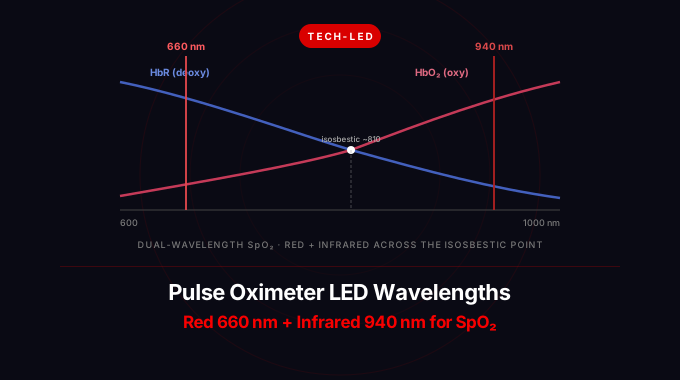
A pulse oximeter measures blood oxygen saturation (SpO₂) by shining two wavelengths of light through perfused tissue and comparing how much each is absorbed. The standard pairing is a red LED at ~660 nm and a near-infrared LED at ~940 nm, chosen because oxygenated hemoglobin (HbO₂) and deoxygenated hemoglobin (HbR) absorb red and infrared light differently: at 660 nm, HbR absorbs more than HbO₂, while at 940 nm, HbO₂ absorbs more than HbR. The two wavelengths straddle the hemoglobin isosbestic point near 810 nm, and the device computes SpO₂ from the ratio of ratios of the pulsatile signal at each wavelength. For the OEM engineer specifying the light source, the decisions are the wavelength pair, the optical geometry (transmissive vs. reflective), radiant power, spectral and thermal stability, and the photodiode match.
| LED channel | Typical wavelength | What it senses | Why this wavelength |
|---|---|---|---|
| Red | 660 nm | Deoxyhemoglobin (HbR) absorbs strongly here | Large HbR/HbO₂ absorption difference; mature, efficient AlGaInP red LEDs |
| Infrared | 940 nm | Oxyhemoglobin (HbO₂) absorbs more here | Sits above the isosbestic point with low water absorption; clean HbO₂ contrast |
How pulse oximetry works, and why wavelength choice matters
Pulse oximetry is a non-invasive optical measurement of arterial oxygen saturation. Light from the LEDs passes through tissue (a fingertip, earlobe, or, in wearables, the skin at the wrist) and a photodiode measures the transmitted or back-scattered intensity. Only the pulsatile (AC) component of that signal, the part that varies with each arterial pulse, carries information about arterial blood; the steady (DC) component represents tissue, venous blood, and other constant absorbers. By isolating the AC component at two wavelengths, the device measures arterial oxygenation specifically.
The light source determines whether that measurement is accurate. Because the SpO₂ calculation depends on the known absorption of hemoglobin at each wavelength, an emitter that sits off its target wavelength, or that drifts with temperature, feeds error directly into the oxygen reading. That is why wavelength selection and spectral stability are the first decisions in pulse oximeter light-source design, the same way they are in adjacent dual-wavelength techniques like functional near-infrared spectroscopy (fNIRS).
The two-wavelength principle and the ratio of ratios
Oxyhemoglobin and deoxyhemoglobin have different absorption spectra that cross at the isosbestic point near 800–810 nm, where both absorb light equally. Below that point (in the red), HbR absorbs more strongly; above it (in the near-infrared), HbO₂ absorbs more. To solve for oxygen saturation you need two wavelengths on opposite sides of the isosbestic point, one red, one infrared, giving two independent absorbance measurements.
The device combines them using a ratio of ratios, conventionally written R:
R = (AC₆₆₀ / DC₆₆₀) ÷ (AC₉₄₀ / DC₉₄₀)
Normalizing each wavelength's pulsatile (AC) signal by its own baseline (DC) cancels out tissue thickness, skin pigmentation, and LED intensity differences, leaving a value that depends almost entirely on arterial oxygenation. An empirical calibration curve, derived by manufacturers from controlled-desaturation studies on human volunteers, maps R to SpO₂. A well-known anchor on that curve is that R ≈ 1.0 corresponds to roughly 85% SpO₂; lower R values map to higher saturation. The calibration is built into the device firmware, which is why the exact LED wavelengths must match the wavelengths the calibration assumes. The underlying physics is the modified Beer-Lambert law, the same relationship used across tissue spectroscopy. (Wikipedia's pulse oximetry overview covers the 660/940 nm convention and the ratiometric principle.)
Why 660 nm and 940 nm specifically
Several wavelength pairs could straddle the isosbestic point, but 660 nm + 940 nm became the de facto standard for good physical reasons:
- Red at 660 nm maximizes HbR contrast. Around 660 nm the gap between deoxy- and oxyhemoglobin absorption is large, so the red channel responds sharply to changes in saturation. A nearby alternative, 630 nm red, is used in some designs, but 660 nm gives a more favorable absorption ratio and is the calibration reference for most commercial oximeters. See the 660 nm deep-red LED page for component detail.
- Infrared at 940 nm sits cleanly above the isosbestic point. At 940 nm, HbO₂ absorbs more than HbR, water absorption is still low, and high-efficiency GaAs near-infrared LEDs are mature. An 850 nm IR LED also lies above the isosbestic point and is used in some sensors and in camera-based and vein-visualization systems, but 940 nm is the textbook pulse-oximetry pairing for its stronger oxy/deoxy separation.
- Both wavelengths are eye-safe and easy to drive. Red and NIR LEDs at oximetry power levels are inexpensive, run on simple constant-current drive, and are small enough for finger clips and wrist wearables alike.
Designs needing additional robustness sometimes add a third wavelength (for example a green channel for motion-tolerant heart rate, discussed below), but the red + IR pair is what makes the SpO₂ measurement itself possible.
Transmissive vs. reflective geometry, and why wearables add green
How the LED and photodiode are arranged determines where the sensor can be placed and how strong the signal is.
| Geometry | LED / detector layout | Best sites | Typical use |
|---|---|---|---|
| Transmissive | LED on one side, photodiode directly opposite | Fingertip, earlobe, toe, infant foot | Clinical finger-clip and earlobe oximeters |
| Reflective (PPG) | LED and photodiode side-by-side on the same surface | Wrist, forehead, chest | Smartwatches, fitness bands, patch monitors |
Transmissive sensors send light straight through a thin, well-perfused site and give the cleanest pulsatile signal. Reflective photoplethysmography (PPG) lets the sensor sit on thicker body parts by reading back-scattered light, at the cost of a weaker signal and more motion sensitivity.
This is also why wrist wearables use a green LED (~520–530 nm) for heart rate but still need red and infrared for SpO₂. Hemoglobin absorbs green light very strongly, producing a large pulsatile signal that is excellent for counting beats, but green light penetrates only a fraction of a millimeter and cannot resolve oxygenation. Measuring SpO₂ requires the red/IR pair that brackets the isosbestic point. Many modern wearables therefore carry 520 nm green, red, and infrared emitters in one optical sensor module, green for robust heart rate, red + IR for blood-oxygen saturation.
Key LED specifications for pulse oximeter design
When specifying the emitters, the parameters that drive measurement quality:
| Specification | Why it matters for SpO₂ | Typical target |
|---|---|---|
| Peak wavelength accuracy | The calibration curve assumes specific wavelengths; an off-target emitter biases SpO₂ | ±5–10 nm, with tight binning |
| Spectral bandwidth (FWHM) | Hemoglobin absorption varies across the band; narrower emission reduces error | 20–40 nm typical for LEDs |
| Radiant power / intensity | Must penetrate tissue and return a detectable AC signal while staying within skin-exposure limits | Application-dependent; pulsed drive raises peak output |
| Temporal stability | Output drift becomes noise in the pulsatile signal | High; constant-current drive |
| Thermal wavelength stability | Peak wavelength redshifts with junction temperature (~0.1–0.2 nm/°C for red/NIR), moving the channel off the calibrated point | Low drift; heat-sinking + duty cycling |
| Matched red/IR output | Red and IR AC signals should be comparable in magnitude to use the detector's dynamic range | Balance drive currents per channel |
| Package footprint | Finger clips and dense wearable modules need compact emitters | SMD / multi-chip packages |
Thermal stability matters most in wearables, where an emitter held against warm skin heats up and drifts. A study of LED spectral shift with temperature measured a 660 nm LED's peak moving several nanometers across a 0–50 °C range, enough to perturb the assumed hemoglobin absorption, which is why constant-current drive, heat-sinking, and tight wavelength binning are standard practice.
Photodiode pairing and LED drive
A pulse oximeter is a source-detector system: the red and IR LEDs and a single photodiode share one optical path. The detector must be sensitive at both wavelengths. Silicon photodiodes respond well from roughly 600 nm to 1000 nm with peak responsivity near 850–900 nm, covering 660 nm and 940 nm in one device, which is why a single silicon detector reads both channels.
Because one detector sees both wavelengths, the LEDs are time-multiplexed: the red LED flashes, then the infrared, then both switch off so the photodiode can measure ambient light for subtraction. This cycle repeats hundreds of times per second, and firmware demultiplexes the red, IR, and dark samples to recover each channel's AC and DC components. The LED driver must deliver stable, repeatable current pulses, since any drive instability appears directly as measurement noise. For component cross-reference, see LED optical sensors and the broader Near-Infrared (NIR) LED Guide.
Accuracy, skin tone, and standards
Pulse oximeter accuracy has come under renewed regulatory scrutiny because skin pigmentation can bias readings. Melanin absorbs more strongly in the red than in the infrared, which can shift the ratio of ratios and cause some devices to overestimate true oxygen saturation in people with darker skin. The U.S. FDA's pulse oximeters resource page documents these accuracy limitations, and in January 2025 the agency issued draft guidance on non-clinical and clinical performance testing recommending validation across a representative range of skin tones. For device designers, this elevates the importance of wavelength accuracy, balanced red/IR output, and robust calibration, the factors most sensitive to the light source.
Pulse oximeter equipment is governed by ISO 80601-2-61 (basic safety and essential performance of pulse oximeter equipment), alongside the general medical-electrical standard IEC 60601-1 and the photobiological safety standard IEC 62471 for the optical emissions. Building the LED subsystem to these standards, and documenting the emitter's spectral and safety characteristics, is part of any device's regulatory pathway, a point covered further in how NIR LEDs are used in medical devices.
Marubeni LEDs for pulse oximetry and SpO₂ sensors
Tech-led distributes Marubeni's red and near-infrared LED portfolio, which covers the wavelengths a pulse oximeter or SpO₂ sensor needs, including emitters in the ~660 nm red and ~940 nm infrared bands that form the standard dual-wavelength pairing, in surface-mount packages suited to finger-clip and wearable optical modules. Relevant wavelength background:
- 660 nm deep-red LEDs, the standard red oximetry wavelength
- 940 nm infrared LEDs, the standard infrared oximetry wavelength
- 630 nm red LEDs for biometric and optical sensors, the alternative red wavelength and deeper sensor-design reference
- 520 nm green LEDs, for the heart-rate (PPG) channel in wearables
Wavelength pairing, tight binning, balanced red/IR output, and the footprint and thermal-stability needs of optical sensor modules are exactly the kind of spec-stage decisions worth confirming with an applications engineer. For component recommendations, datasheets, and samples, see the IR/NIR LED product range or contact Tech-led engineering.
Frequently asked questions
What wavelengths do pulse oximeters use?
Standard pulse oximeters use two wavelengths: a red LED at ~660 nm and a near-infrared LED at ~940 nm. The two are chosen because oxygenated and deoxygenated hemoglobin absorb red and infrared light differently, and because the pair straddles the hemoglobin isosbestic point near 810 nm. Some designs substitute nearby wavelengths (e.g. 630 nm red, or 850–905 nm infrared), but 660 nm + 940 nm is the convention most calibration curves assume.
Why do pulse oximeters use two wavelengths?
Because oxygen saturation is the ratio of oxyhemoglobin to total hemoglobin, and the two forms of hemoglobin have different absorption spectra that cross at the isosbestic point. One wavelength can't separate them. Using one wavelength below the isosbestic point (red, HbR-dominant) and one above it (infrared, HbO₂-dominant) gives two independent measurements, letting the device solve for saturation via the ratio of ratios.
What is the ratio of ratios (R) in pulse oximetry?
It is the value the device computes to derive SpO₂: R = (AC/DC at 660 nm) ÷ (AC/DC at 940 nm). Each wavelength's pulsatile (AC) signal is normalized by its own steady (DC) baseline, which cancels out tissue thickness, pigmentation, and LED brightness. An empirical calibration curve then maps R to oxygen saturation, for example, R ≈ 1.0 corresponds to roughly 85% SpO₂.
Why 660 nm and 940 nm rather than other wavelengths?
At 660 nm the absorption difference between deoxy- and oxyhemoglobin is large, so the red channel is highly sensitive to saturation changes. At 940 nm, oxyhemoglobin absorbs more than deoxyhemoglobin, water absorption is still low, and efficient infrared LEDs are readily available. Together they bracket the isosbestic point and match the wavelengths device calibrations are built around.
Can you measure SpO₂ with a single wavelength?
No. A single wavelength yields one absorbance value, which cannot separate oxy- from deoxyhemoglobin. You can measure heart rate from a single wavelength (this is how green-LED wrist sensors count beats), but blood-oxygen saturation requires at least two wavelengths on opposite sides of the isosbestic point.
Why do fitness trackers use a green LED instead of red and infrared?
Green light (~520–530 nm) is absorbed very strongly by hemoglobin, producing a large, motion-tolerant pulsatile signal that is ideal for heart rate. But green penetrates only a fraction of a millimeter and cannot resolve oxygenation. Devices that also report SpO₂ add red and infrared LEDs alongside the green one, green for heart rate, red + IR for blood oxygen.
Should a pulse oximeter use transmissive or reflective geometry?
Transmissive sensors (LED and photodiode on opposite sides of a fingertip or earlobe) give the cleanest signal and are standard for clinical finger clips. Reflective sensors (LED and photodiode side-by-side) read back-scattered light and are used where the device sits on thicker tissue, the wrist, forehead, or chest, as in smartwatches and patch monitors, at the cost of a weaker, more motion-sensitive signal.
Does skin tone affect pulse oximeter accuracy?
It can. Melanin absorbs more in the red than the infrared, which can bias the ratio of ratios and cause some devices to overestimate true oxygen saturation on darker skin. The FDA has issued safety communications and pursued updated validation guidance on this. Designers mitigate it through accurate wavelength selection, balanced red/IR output, and calibration validated across a representative range of skin tones.
What photodiode pairs with pulse oximeter LEDs?
A silicon photodiode is the usual choice, because it responds across roughly 600–1000 nm, covering both the 660 nm red and 940 nm infrared channels in a single detector with peak sensitivity near 850–900 nm. The red and infrared LEDs are time-multiplexed so one detector can read both channels in sequence, with a dark interval for ambient-light subtraction.
What standards govern pulse oximeter design?
The primary standard is ISO 80601-2-61 for the basic safety and essential performance of pulse oximeter equipment, layered on the general IEC 60601-1 medical-electrical standard. The LED emissions themselves are assessed for photobiological safety under IEC 62471. Compliance documentation typically requires characterizing the emitters' spectral output and confirming exposure limits.
Related guides
- 630 nm Red LEDs for Biometric and Optical Sensor Applications, deeper PPG/sensor component reference
- 660 nm Deep-Red LEDs, the standard red oximetry wavelength
- 940 nm Infrared LEDs, the standard infrared oximetry wavelength
- NIR LEDs for fNIRS, the sibling dual-wavelength brain-imaging technique
- How Near-Infrared LEDs Are Revolutionizing Medical Devices, broader biomedical NIR LED context
Designing a pulse oximeter or SpO₂ sensor and selecting the LEDs? Contact Tech-led engineering for red and near-infrared wavelength-pair recommendations, datasheets, and samples.