Tech-led.com


Infrared illumination at the 850 nm wavelength has become the backbone of modern night vision and surveillance lighting. This near-infrared light provides high radiant energy that silicon-based camera sensors can detect easily, while remaining almost invisible to the naked eye. By operating just beyond the visible spectrum, an 850 nm IR LED offers a powerful light source for security cameras with only a faint red glow visible to humans. Engineers and system integrators often rely on 850 nm LEDs because they balance camera sensitivity with covert operation. Understanding why 850 nm infrared is so widely used – and how it differs from 940 nm IR – is essential for designing effective, discreet night vision systems.
What is the 850 nm infrared wavelength and why is it used in night vision?
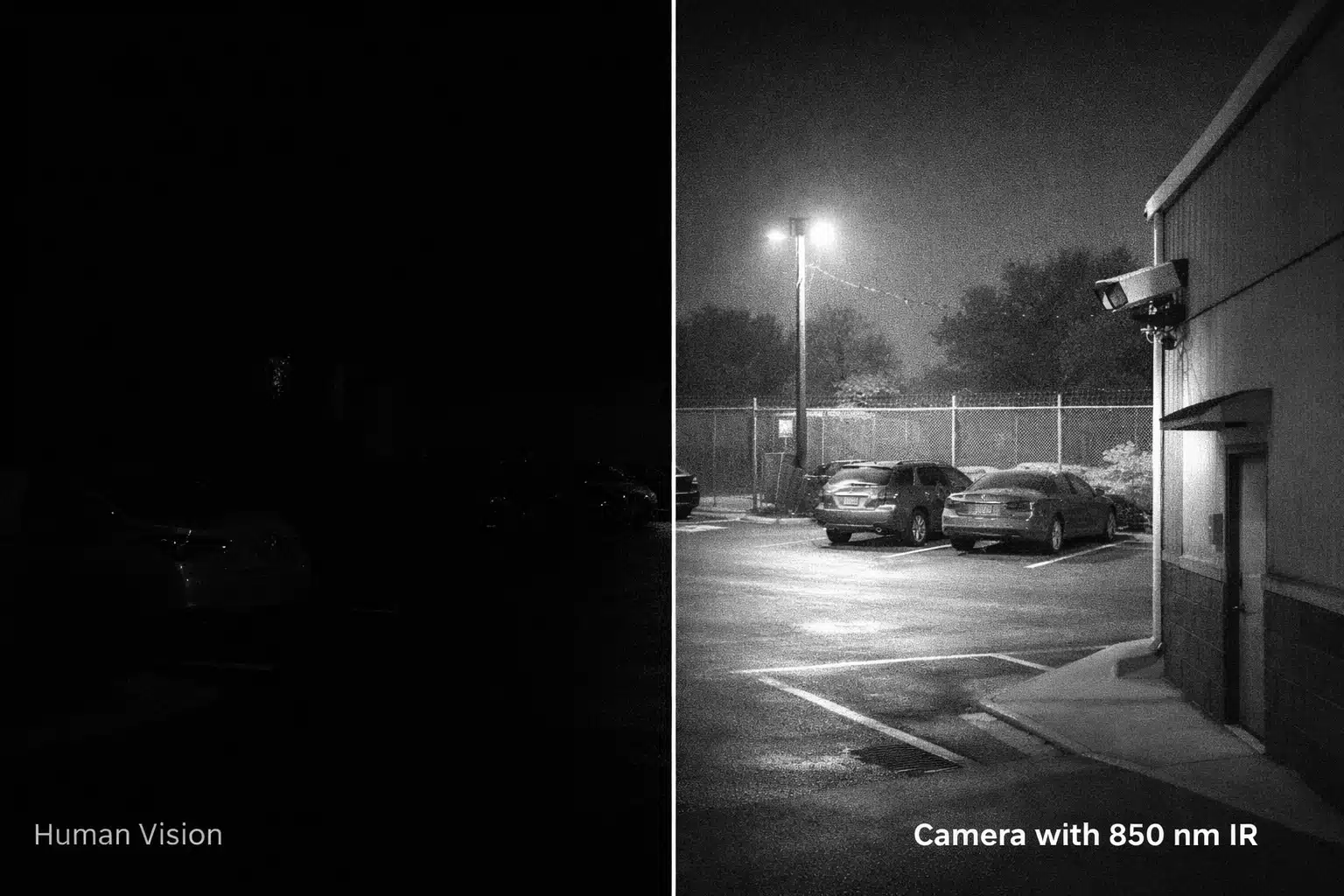
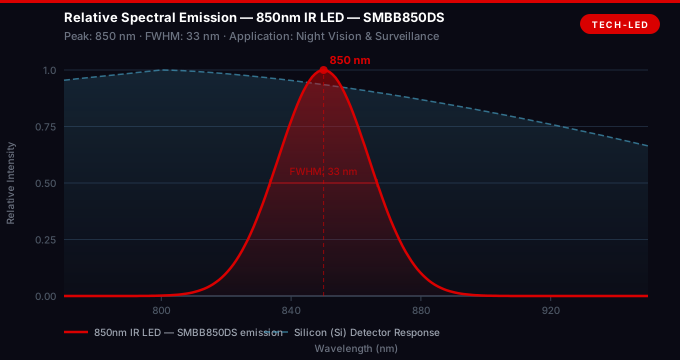
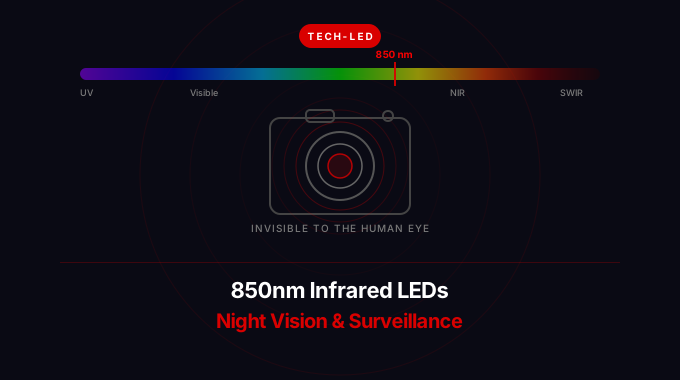
Figure 1: Left: Human vision. Right: Camera with 850 nm IR.
850 nm is part of the near-infrared (NIR) band of the electromagnetic spectrum, just beyond the deep red visible light (~400–700 nm range that visible LEDs cover). In fact, 850 nm lies right outside the wavelengths our eyes can perceive. This 850nm infrared wavelength is essentially invisible to human vision – an 850 nm IR LED emits light that the human eye cannot see, aside from a faint deep red glimmer if the LED is very high-power. In other words, 850 nm infrared light falls into wavelengths that are invisible to the human eye yet readily detected by electronic sensors. (For comparison, a 940nm IR LED may have different characteristics than an 850nm IR LED.) 630 nm red LED or a 660 nm deep red LED emits light that is easily seen by the eye, whereas 850 nm IR output is beyond human vision.) Because it sits at the boundary of the visible and infrared spectrum, 850 nm is often considered “near infrared” IR radiation that offers a blend of strong output and covert operation.
Night vision systems take advantage of 850 nm IR LEDs because silicon-based camera sensors (CCD/CMOS) are highly sensitive at this IR wavelength. Infrared LEDs at 850 nm are used in security cameras and CCTV devices to flood scenes with illumination that only the camera can see. Most day/night surveillance cameras include a mechanical IR-cut filter that flips out at night, allowing the sensor to receive IR light and capture clear images in darkness. Notably, 850 nm falls near the peak responsivity of common silicon detectors – one industry study found silicon sensors exhibit significantly higher quantum efficiency around 850 nm than at longer IR wavelengths. This means an 850 nm LED produces a brighter image and longer range for night vision compared to a higher wavelength like 940 nm. By using 850 nm infrared LEDs in IR / NIR LED illuminators, security systems can achieve excellent low-light performance without alerting human observers. (For an overview of LED wavelength categories from visible to IR, see our LED wavelength guide for both 850nm and 940nm IR applications is essential for optimal performance.
850 nm LED specifications at a glance
Typical specifications for an 850 nanometer infrared LED (for example the Marubeni SMBB850DS):
| Parameter | Typical value (850 nm IR LED) |
|---|---|
| Peak wavelength | 850 nm |
| Spectral bandwidth (FWHM) | ~33 nm |
| Emission | Near-infrared, invisible (faint red glow at high power) |
| Semiconductor | AlGaAs / GaAs |
| Forward voltage | ~1.5 V (typical) |
| Common packages | SMD, COB, SMBB, EDC |
| Best matched detector | Silicon (Si), near peak responsivity at 850 nm |
850 nm vs 940 nm: Key differences in infrared illumination
When comparing 850 nm vs 940 nm infrared LEDs for security lighting, the two wavelengths present a clear trade-off between illumination range and visibility. Both of these near-infrared wavelengths can be used for night vision, but 850 nm LEDs typically produce a stronger reflected signal (brighter image and longer IR range) while 940 nm LEDs offer greater stealth due to total invisibility. The 850 nm light emits a faint red glow that is barely visible, whereas 940 nm light is completely invisible to the human eye. This means 850 nm tends to be used when maximum brightness and camera sensitivity are needed, and 940 nm is chosen when absolute covert surveillance is the priority.
Most camera systems use 850 nm because it aligns with the peak sensitivity of silicon sensors; 940 nm eliminates the faint red glow at the cost of lower sensor response and roughly 30–50% shorter range. Many professional setups use 850 nm for general lighting and add 940 nm emitters where total invisibility is required. For the full head-to-head, silicon quantum-efficiency figures, range trade-offs, daylight ambient-IR rejection, and a when-to-choose-which decision table, see our dedicated 850nm vs 940nm infrared LED comparison. Note: wavelengths beyond ~950 nm move into the short-wave IR (SWIR) range, which typical silicon security cameras cannot see without special sensors.
How 850 nm IR LEDs work: materials, bandgap, and emission principles
An 850 nm infrared LED is a type of semiconductor diode that emits light in the IR spectrum when electrically biased. Like any LED, it works on the principle of electroluminescence: electrons and holes recombine in the LED’s semiconductor junction and release energy as photons. The difference for an 850nm IR LED is that the semiconductor’s bandgap energy is engineered to produce infrared light instead of visible light. In practice, most 850 nm IR LED chips are fabricated from aluminum gallium arsenide (AlGaAs) or related III–V semiconductor compounds, which have a band gap tuned to around 1.4–1.5 eV (corresponding to 850 nm photons). When current flows through the diode, the IR LED emits photons in the near-infrared range. The emitted infrared light has a longer wavelength and lower photon energy than visible light, which is why it is invisible to human eyes.
The materials and construction of an 850 nm LED differ from those of a common LED that emits visible light. For instance, a standard red LED might use an AlInGaP or GaAsP material to emit 630–660 nm visible red light, whereas a NIR LED at 850 nm typically uses an AlGaAs/GaAs material system to achieve the IR wavelength. This material choice allows the LED chip to efficiently emit IR radiation. The forward voltage of an 850 nm LED is also lower (on the order of ~1.2–1.5 V) compared to higher-energy visible LEDs, due to the smaller bandgap. In terms of packaging, the IR LED die is often mounted in a package with transparent epoxy or silicone that is optimized for infrared transmission (since some standard LED encapsulation materials or dyes for visible LEDs might block IR). Overall, an IR LED operates on the same principles as any LED, but its semiconductor structure is optimized so that the LED emits a near-infrared wavelength when energized.
Infrared LED packages: SMD, COB, SMBB, and EDC for surveillance use
IR LEDs are manufactured in a variety of package types to suit different applications. For most surveillance lighting purposes, surface-mount device (SMD) LEDs are widely used – these compact packages can be soldered onto a printed circuit board (PCB) in arrays or rings around a camera. SMD infrared LEDs often come with integrated lenses or domes to shape their beam. For higher output needs, multiple LED chips might be combined in one unit. Chip-on-Board (COB modules) mount many IR LED dies together on a substrate, creating a high-power IR illuminator module. Manufacturers like Tech-LED also offer specialized high-power IR LED packages such as High-Power SMBB and High-Power EDC with 850nm IR technology is becoming increasingly popular. series devices. These packages are designed for efficient thermal dissipation and easier integration into surveillance systems, allowing IR LEDs to be driven at high current without overheating.
The choice of IR LED package can affect the performance and assembly of a night-vision lighting system. Standard SMD LEDs (in formats like 3535 or 5050 packages) are common for board-level IR illuminators, providing a balance of size and power. COB modules, on the other hand, offer even greater infrared light output by clustering many emitter chips on one board – ideal for spotlight-style IR projectors or floodlights. The SMBB and EDC package families are examples of custom-engineered IR LED housings that may use ceramic substrates or metal-core PCBs to handle the heat from high-power operation. These allow an IR LED to emit more infrared light (higher radiant intensity) per package. In some situations, engineers might even use a flexible 850 nm IR LED strip light to distribute infrared emitters over a larger area or an irregular surface. However, compared to purpose-built IR LED boards or lamp-style illuminators, simple LED strips are less commonly used in professional security installations. Most industrial surveillance designs rely on robust SMD or COB packaged IR LEDs mounted on proper heatsinked boards for reliability.
IR illuminators and LED boards for CCTV and security cameras
IR LEDs are used extensively in CCTV cameras and other security imaging devices to provide illumination for night vision. If you look at a typical CCTV security camera (especially dome or bullet cameras labeled for “night vision”), you’ll often see a ring of dark-tinted LED bulbs around the lens – these are infrared LEDs on an LED board that serve as the camera’s IR illuminator. When ambient light drops, the camera’s sensor switches to night mode and the IR LEDs turn on, flooding the camera’s field of view with invisible infrared light. This built-in IR illuminator is usually made up of multiple 850 nm LED emitters (or sometimes 940 nm for covert models) arranged to cover the camera’s viewing angle. The result is that the CCTV camera can capture clear footage in a pitch-dark environment, since the scene is brightly lit by IR light even though it appears dark to the human eye. In consumer-grade security cameras, you might notice a faint red glow from the 850 nm LEDs in the dark – a giveaway that the camera is active – whereas professional-grade or covert surveillance cameras might use 940 nm LEDs to avoid any visible glow.
In addition to those integrated LED boards, dedicated IR illuminator units are also used in many surveillance setups. A standalone IR illuminator is essentially an array of infrared LED lights (often in a weatherproof housing) that can be mounted separately from the camera to cover a larger area or longer distance. These illuminators come in various shapes and sizes, from small clusters of high-power SMD LEDs to bigger panel units using COB LED arrays behind lenses. They serve as infrared floodlights for areas that a fixed camera’s built-in LEDs can’t fully illuminate. For example, a PTZ security camera (pan-tilt-zoom) might use a separate IR spotlight to reach an IR range of over 100 meters at night. Many IR illuminators include built-in light sensors (photodiodes) to automatically switch off during the day and back on at night, ensuring they only emit IR light when needed. By combining a camera’s own IR LED board with additional IR lighting as required, system integrators can achieve uniform coverage and extend the night vision range across a facility. Proper alignment and positioning of IR illuminators is important to avoid hot spots or glare (where too much IR light close to the camera washes out the image). Overall, the synergy of sensitive cameras and well-placed IR LED lighting enables modern security systems to reliably see in conditions that are completely dark to the human eye.
Why 850 nm infrared light is visible as a faint red glow (and when it matters)
One quirk of 850 nm IR LEDs is that they are not entirely “invisible” – they tend to emit a faint red glow that can be seen if you look directly at the LED in the dark. This deep red emission is much dimmer than any normal visible-light LED, but it occurs because 850 nm is close enough to the visible spectrum that the most sensitive cells in the human eye (our red photoreceptors) can still respond slightly. In essence, an 850 nm LED produces invisible IR light plus a tiny amount of barely visible red light. Anyone who has set up a security camera at night has likely noticed the LED modules glowing dull red. By contrast, truly invisible IR LEDs (like those at 940 nm) emit at a longer wavelength that is outside the eye’s detection range, so they produce no visible glow at all.
This faint red glow of 850 nm LEDs is usually very subtle – it doesn’t illuminate anything by itself, but it means the LED is not 100% covert. In most commercial security systems, the slight glow isn’t a problem (and it even reassures users that the infrared lighting is on). However, in some scenarios it matters greatly. For covert surveillance or applications where you don’t want an intruder (or wildlife) to know they are being illuminated, the glow from 850 nm could be undesirable. In these cases, one would choose 940 nm IR LEDs for total invisibility, or take additional measures like concealing the LEDs behind dark IR-transmissive filters. Special infrared-transparent “black glass” is often used on camera fronts to hide the red glow – the glass looks opaque and black to humans but allows IR light to pass through. In this way, even the faint output of an 850 nm LED can be mostly masked, making the illumination effectively invisible to the human eye. Engineers must decide when the increased range of 850 nm is worth the trade-off of a visible glow, versus when the absolute stealth of invisible IR (940 nm) is needed for a given project.
Choosing between 850 nm and 940 nm for different camera types
Engineers and system integrators must weigh the pros and cons of 850 nm vs 940 nm IR illumination for a given camera type or project, especially when considering the use of 850nm IR LEDs. In general, for typical security cameras and night vision systems where maximum range and image brightness are the goal, 850 nm is the common choice. It works best for standard CCTV cameras, IP security cameras, and machine vision setups that are not especially concerned with a small visible glow from 850nm IR LEDs. Most off-the-shelf IR security cameras default to 850 nm LED illuminators because they yield the best performance in terms of IR range and camera sensitivity for the given power. If your lighting needs prioritize distance and clarity over stealth, 850 nm will usually be the appropriate wavelength.
On the other hand, 940 nm IR LEDs are chosen for specialized scenarios and camera types that demand complete invisibility. If you’re deploying covert surveillance cameras (for example, a hidden camera monitoring an entrance or an ATM where you don’t want to alert subjects) or observing wildlife at night, the absence of any glow at 940 nm is a major advantage despite the shorter range. Some consumer devices also use 940 nm for illumination to avoid visible output – for instance, facial recognition cameras and eye trackers in smartphones or VR headsets often use 940 nm IR flood illuminators so that the user does not see any light. These two wavelengths are sometimes mixed in a single system: it’s not uncommon for a security installation to use primarily 850 nm lighting for general coverage and then add a few 940 nm illuminators for specific cameras that need covert operation. Dual-wavelength IR illuminator boards exist that can switch between 850 nm and 940 nm, offering flexibility for security teams to balance reach versus total invisibility on the fly. Ultimately, the decision comes down to the specific use case – a high-security or discreet camera will lean toward 940 nm, whereas general-purpose surveillance and license-plate recognition cameras benefit from the stronger reflections of 850 nm.
Optical design: lens angle, beam spread, and distance performance
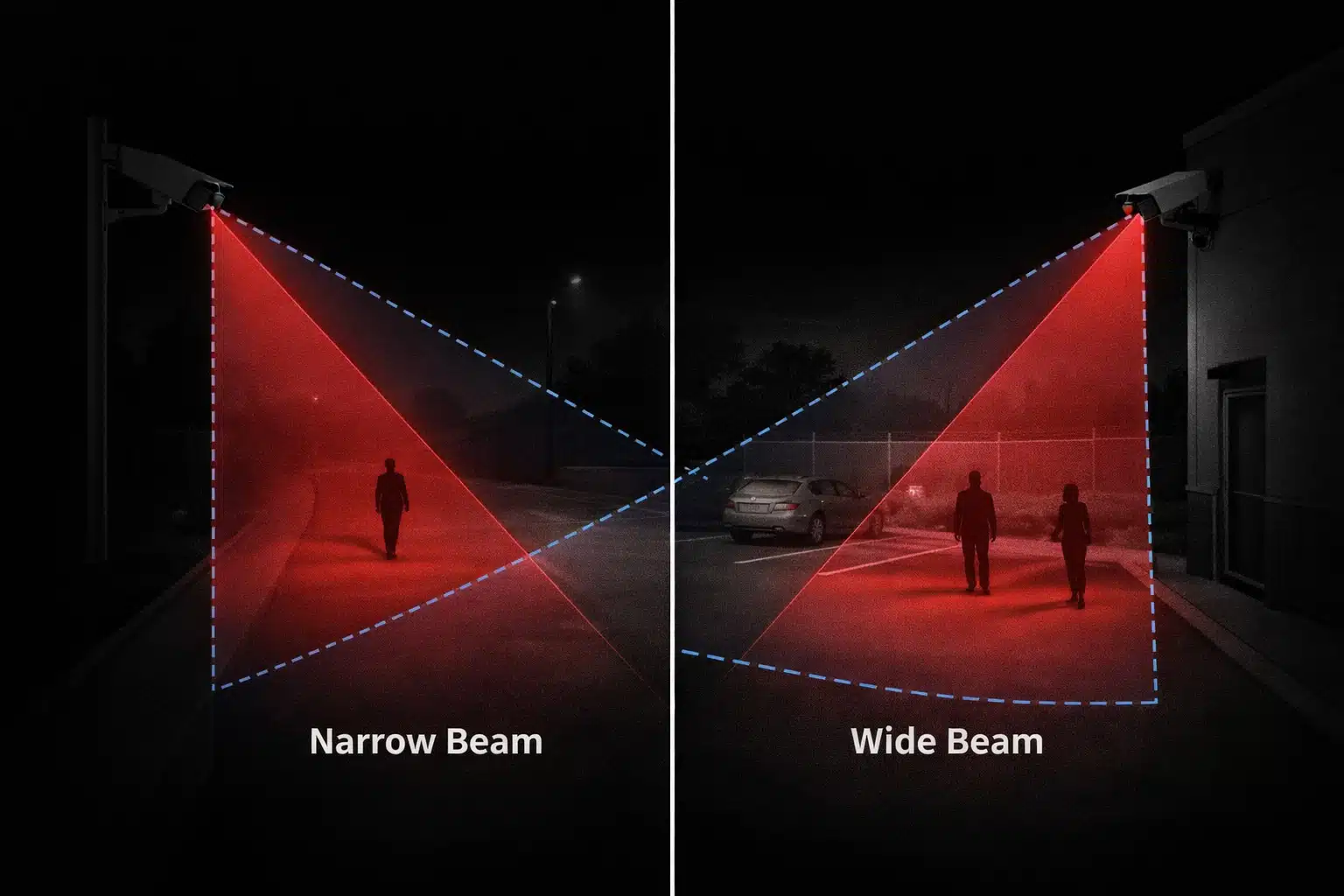
Figure 2: Comparison of narrow-beam and wide-beam infrared LED illumination with camera field of view overlay.
The optical design of an IR LED illuminator – particularly the lensing and beam spread – is critical to achieving the desired surveillance coverage and distance. Infrared LEDs, like visible LEDs, can be equipped with various lens angles (for example, 20°, 30°, 60°, 90° beam widths). A narrower beam angle means the IR light is more concentrated, which increases the intensity and extends the effective IR range (useful for seeing farther down a perimeter or across a parking lot). However, a narrow beam covers a smaller field of view. Conversely, a wide-angle IR LED will illuminate a broad area but with shorter reach. Thus, matching the LED’s emission angle to the camera’s field of view is important: a wide-angle security camera (say 90° FOV) will need IR LEDs or illuminators that also cover ~90° so the entire scene is lit. If you used a very tight IR beam with that camera, you’d get a bright spot in the center and dark edges. Similarly, a long-range PTZ camera with a telephoto lens will benefit from IR LEDs that have a correspondingly narrow beam to throw light further rather than wasting IR energy off to the sides.
Designers often use multiple IR LEDs or specialized optics to get uniform infrared lighting. For example, an illuminator might combine a few narrow-beam LEDs for long-distance punch with several wide-angle LEDs for close-in coverage, achieving an overall even illumination across the scene. Using diffusers, reflectors, or TIR lenses (total internal reflection optics) can also help shape the IR beam to avoid hot spots and ensure the light distribution matches the camera view. According to industry research, upgraded beam-shaping optics can reduce overexposure and “IR bloom” in camera images, improving detection stability and lowering false alerts by around 5–10%. It’s also important to consider distance falloff: IR intensity follows an inverse-square law with distance, so the farther you need to see, the more optical power (or narrower focus) is required to maintain sufficient illumination. In practice, this might mean choosing high-power IR LED emitters with appropriate lenses, or deploying multiple illuminators in an area to cover different zones. By carefully coordinating lens angles, positions, and output power, engineers can ensure that the infrared lighting provides adequate coverage and consistent brightness across the surveillance scene.
Thermal and electrical considerations for high-power IR LEDs
Designing a reliable infrared illuminator means paying close attention to the electrical drive and thermal management of the IR LEDs. High-power IR LEDs (for example, an array of 1-watt 850 nm emitters) will generate significant heat that must be dissipated to maintain performance and longevity. If an IR LED overheats, its light output can drop and its lifespan will shorten dramatically. Therefore, engineers typically mount these LEDs on heat-spreading substrates like aluminum-backed PCBs or ceramic packages, use adequate heat sinks, and limit the current to safe levels. Driving the LEDs with a constant-current driver is recommended to keep the diode current stable as temperature changes. Often, IR LEDs used for continuous illumination at night are run at a fraction of their maximum rated current to reduce heat – a practice known as derating. According to market analysis, optimized thermal engineering (using metal-core boards, proper current derating and high-conductivity interface materials) can extend an IR LED’s L70 lifetime by 20–30% under continuous night duty. In short, you don’t want to push an IR LED at 100% power without cooling; it’s better to use more LEDs at moderate drive or a heat-sinked high-power package than to overstress a single device.
Electrical considerations include the forward voltage and current characteristics of IR LEDs. An 850 nm LED has a forward voltage around 1.2–1.5 V (lower than most visible-color LEDs), which means if you string many of them in series, the total voltage stays relatively low. Many IR illuminators are designed to run on standard low voltages like 12 VDC or 24 VDC, so plan your LED strings and driver circuits accordingly (for instance, 8 LEDs × ~1.3 V ≈ 10.4 V, leaving headroom for a current regulator). Take care with power supply design to avoid flicker or current ripple, which can cause inconsistent illumination or reduce LED life. Additionally, because infrared LEDs often operate unseen (invisible to the human eye), there may be a temptation to drive them harder since the brightness “doesn’t bother anyone” – but the heat and device stress are very real. Good practice involves monitoring LED junction temperatures, using proper thermal interface materials, and possibly adding thermal cutoff circuits or dimming the IR output in warmer ambient conditions to stay within safe operating limits. By ensuring proper heat dissipation and electrical control, high-power IR LED systems can run all night with stable output and a long operational life.
Safety and eye exposure limits for IR illumination
Infrared LEDs may be invisible, but they are still emitting energy – and high-power IR illumination can pose safety risks to human eyes if not used responsibly. The near-infrared 850 nm band (IR-A) is particularly concerning for eye safety because this IR light can penetrate and focus onto the retina just like visible light, yet it will not trigger the natural blink reflex or pain response, as described in infrared photonics safety research. In practical terms, a person could stare directly into a powerful 850 nm IR LED array and not realize their eyes are being exposed to potentially harmful levels of infrared radiation. Retinal heating or damage could occur before the person is even aware. Fortunately, most small IR LEDs used in security cameras are low-power and considered eye-safe under normal use (often classified as Risk Group 1 or “Exempt” in photobiological safety standards). But for high-power IR floodlights – or any time you are concentrating IR beams – you need to follow safety guidelines.
International standards such as IEC 62471 outline exposure limits and hazard classifications for lamp devices, including IR LEDs. According to industry reports, modern IR illuminator products now routinely incorporate eye-safety features and adhere to these guidelines. For example, an illuminator might be rated as RG2 (moderate risk), which means you should avoid staring into it at close range, or it may include diffuser optics to reduce intensity hot spots. Manufacturers often provide recommendations like minimum safe viewing distances for their infrared illuminators. As an integrator or user, it’s wise to treat high-power IR emitters much like you would treat a bright visible lamp or laser – don’t point them toward people’s eyes at close range, and consider shields or automatic shutoffs if there’s a chance of prolonged human exposure. The invisible IR output may lull people into a false sense of security, so clear warnings and design safeguards are important. By following established exposure limits and using IR lighting equipment as intended, one can harness powerful infrared illumination without endangering eye health.
Emerging applications beyond security: biometrics, industrial sensing, and therapy
The usefulness of 850 nm IR LEDs extends into many fields beyond traditional surveillance. One major area for 850nm IR technology is biometrics and consumer electronics. Many modern smartphones and laptops use near-infrared LEDs for facial recognition and eye tracking. For instance, an IR LED flood illuminator at 850 nm (or 940 nm) paired with an IR camera helps devices perform face ID or gaze tracking in complete darkness without using visible light. In automotive systems, driver-monitoring cameras often incorporate 850/940 nm LED emitters to watch the driver’s eyes or alertness at night. Industrial sensing also relies on IR LEDs: they are the invisible beams in break-beam sensors and optical switches on assembly lines, as well as the emitters in remote control units (the classic TV remote control emits a 940 nm IR signal that a photodiode or phototransistor in the TV picks up). Machine vision and quality inspection systems sometimes use IR illumination to reveal features that are not apparent under visible light – for example, checking markings or layers that reflect differently in near-infrared. These examples show that IR LEDs are used across a wide range of applications where invisible light can be harnessed for sensing and communication.
Interestingly, 850 nm LEDs have even made their way into wellness and medical devices. In the realm of photobiomodulation (red light therapy), near-infrared light is believed to stimulate biological processes in skin and muscle. LED light therapy panels often combine deep red LEDs (around 630–660 nm) with 850 nm infrared LEDs to deliver therapeutic light to the body. The 850 nm infrared light can penetrate further into tissue than visible red light, reaching deeper layers of muscle and joints. Indeed, a majority of photobiomodulation research has focused on red (630–670 nm) and NIR (780–850 nm) wavelengths, as summarized in a peer-reviewed review, as these have shown benefits in reducing inflammation and promoting cell repair. Early studies and anecdotal reports suggest this NIR light may help with pain relief, reducing inflammation, and improving circulation in various therapeutic applications. While more clinical evidence is needed, the popularity of “near-infrared light therapy” devices is growing, and 850 nm is a common wavelength in these panels. From advanced biometric sensors to health tech, the 850 nm LED’s role continues to expand. This once-niche 850nm infrared component is now a mainstream option in an ever-growing range of applications beyond just night vision.
Checklist for selecting the right IR LED for your lighting or vision system
- Wavelength (850 nm vs 940 nm): Decide if you need the higher output of 850 nm or the total invisibility of 940 nm for your project. 850 nm is recommended for most applications where maximum IR brightness and range are required, whereas 940 nm is ideal for covert surveillance or scenarios where even a faint red glow is unacceptable.
- Coverage and range: Determine the field of view and distance you need to illuminate. A wide-area security camera will require IR LEDs with a wide beam angle (or multiple LEDs) to cover the scene, while a long-range camera might need narrow-beam IR LEDs or spot illuminators to reach the necessary distance. Match the IR LED’s beam spread to your camera’s coverage needs to ensure even lighting across the target area.
- Output and number of 850nm IR LEDs: Estimate how much IR light (radiant power) is needed for your scene. Longer distances or larger areas may require multiple IR LEDs or higher-power emitters. It’s often better to use an array of LEDs at moderate drive than to push a single LED to its limit. If one LED doesn’t provide enough IR brightness for your lighting needs, plan to use additional units or a more powerful module.
- Package type and form factor: Select an IR LED package that fits your design. For example, use compact SMD IR LEDs on a custom PCB for a built-in camera illuminator, or consider a pre-made COB module if you need a high-power floodlight. High-power packages like SMBB or EDC can handle more current and heat. In some cases, a flexible 850 nm IR LED strip light can be used to line an area with IR illumination, but these are less common in professional installations compared to purpose-built boards or lamp-style illuminators.
- Drive electronics: Use a proper constant-current LED driver or current-limited supply to drive the IR LEDs. Ensure the supply voltage and current are compatible with your LED configuration (for instance, series strings of 850 nm LEDs with appropriate resistors or a current regulator). Avoid simply connecting LEDs to a fixed voltage without current control, as this can cause overheating or inconsistent output. If using pulse modulation (for example, syncing an IR flash with a camera shutter), make sure the LED can handle the peak current and duty cycle.
- Thermal management: Incorporate heat sinking and thermal design, especially for high-power IR LEDs that will run continuously. Mount LEDs on metal-core PCBs or attach them to aluminum heat sinks, use thermal interface materials, and consider ventilation if needed. Keep junction temperatures within safe limits – this ensures stable performance and long life. If necessary, derate the LED current (run below max rating) to reduce heat, and test your system at the worst-case ambient temperature to verify it doesn’t overheat.
- Eye safety and compliance: If your IR illuminator is very powerful or will be accessible to users, review eye safety standards (like IEC 62471) and ensure the design falls into a safe category. Use diffusers or shields to avoid any tightly focused high-intensity 850nm IR beam that could pose a risk. Provide warnings or labels if the device emits strong IR radiation. Remember that lack of visible light does not mean it’s harmless – treat high-power IR LEDs with the same caution as you would a visible spotlight or laser.
- Sensor compatibility: Make sure the camera or sensor you are illuminating is sensitive to the chosen IR wavelength. Most silicon-based cameras see 850 nm very well and 940 nm moderately well, but some specialized sensors (or ones with aggressive IR-cut filters) may not respond beyond a certain wavelength. It’s wise to check the sensor’s spectral response. Additionally, if you are building an active IR sensor (e.g., using 850nm IR technology), consider the implications for performance. a break-beam system), pair the LED with an appropriate photodiode or phototransistor to ensure they share a compatible wavelength.
Frequently Asked Questions
What is 850nm infrared light and how does it compare to 940nm infrared?
850nm infrared light is a near infrared wavelength commonly used in IR LEDs and IR LED strips for surveillance, machine vision, and therapeutic applications. Compared to 940nm infrared, 850nm typically emits a faint red glow visible to the human eye while 940nm is closer to invisible. The practical differences between 850nm and 940nm include range, camera sensitivity, and visible bleed: many CCTV cameras and photodiodes are more sensitive to 850nm, giving better illumination and longer effective range, while 940nm can be preferred when reducing visible light is important.
Can an 850nm ir led strip be used for light for security and CCTV camera systems?
Yes, an ir 850nm LED strip or flexible led strip with high power 850nm LEDs is commonly used for security lighting and CCTV camera applications. 850nm LEDs provide strong illumination that CCTV cameras detect well, improving night vision. When choosing an 850 nm IR LED strip light, consider LED chip type, PCB design, power consumption, and whether you need a red led light glow versus near-infrared invisibility as with 940nm infrared.
What is the difference between 850nm and 940nm for camera ir performance?
The main difference between 850nm and 940nm is sensitivity and visibility. Cameras, especially those with typical IR filters removed or modified, generally detect 850nm more efficiently, producing brighter images at the same power. 940nm is less visible (more covert) but often needs higher power or more LEDs to achieve comparable illumination. Choose based on whether you prioritize covert operation (940nm) or longer effective range and better camera response (850nm).
How does near infrared light therapy work with 850nm infrared light and red light therapy devices?
Near infrared light therapy often uses wavelengths around 850nm because they penetrate deeper into tissue than visible red light, supporting mitochondrial activity and blood circulation. Devices marketed as LED light therapy or near infrared light therapy panels may combine red and 850nm infrared LEDs to target skin, muscle recovery, and pain relief. Always verify that the product uses therapeutic irradiance and appropriate LED chip quality for effective treatment.
Are there high power 850nm 940nm LED options and what about the diode, chip, and PCB?
High power IR LEDs are available in both 850nm and 940nm variants. Manufacturers specify diode package, LED chip type, forward current, and thermal requirements. For strip implementations, a well-designed PCB and heat management are critical to maintain lifetime and consistent emit. Photodiode and phototransistor sensors used in detection systems have different spectral responses, so match the LED wavelength to the detector for optimal performance.
Is 850 nm ir led strip light visible to the human eye and what is the ir range?
Many 850 nm IR LED strip lights emit a faint red glow that can be visible to the human eye at close range, unlike most 940nm which appear dark. The IR range depends on LED power, optics, and camera sensitivity; high power 850nm strips typically offer longer range. Note that "visible to the human eye" depends on ambient light and receiver sensitivity, install tests are recommended for security or covert applications.
Can I use led 850nm products for near infrared or light therapy panel designs and are they safe?
LED 850nm products are used in near infrared light therapy panels and in combined red + NIR therapy devices. Safety depends on irradiance, exposure time, and intended use, follow manufacturer guidelines, use appropriate diffusion, and avoid direct eye exposure to high power IR LEDs because near infrared can be harmful to the retina despite being less visible.
How do I choose between ir 850nm and 940nm for a project involving led light strips and cameras?
Choose based on application priorities: pick 850nm for better camera sensitivity, longer range, and lower power for comparable illumination; pick 940nm if you need reduced visible glow for covert installations. Consider LED strip type (flexible led strip versus rigid arrays), the quality of the LED chip, PCB thermal design, and whether other components (photodiode, phototransistor, CCTV camera) have spectral sensitivity matched to 850nm 940nm. Testing in your actual environment will confirm the best choice.