Tech-led.com


An infrared illuminator is a near-infrared (NIR) light source, typically built from arrays of 850 nm or 940 nm LEDs, that floods a scene with invisible light so cameras can see in the dark while remaining undetectable to human observers. For security camera integrators and OEM designers, the IR illuminator is the component that converts a standard daytime camera into a 24/7 surveillance device. This guide covers the two practical wavelengths (850 nm vs 940 nm) for night vision security cameras, the spec trade-offs that decide which to choose, beam-angle and field-of-view matching, common deployment challenges (IR glare, insect attraction, weather sealing), and Marubeni IR LED components used for OEM-grade integration.
What is an infrared illuminator?
An IR illuminator is a deliberate light source designed to emit near-infrared radiation (typically 700-1000 nm) for active illumination of a scene in conditions where visible light is unavailable, undesirable, or counterproductive. The term covers everything from a single high-power IR LED soldered next to a security camera's lens to a multi-watt IR floodlight on a building wall used to support long-range surveillance.
Three things distinguish an infrared illuminator from a general "IR LED":
- It's the active illumination source, paired with an IR-sensitive camera (most modern day/night CCTV cameras), the illuminator's light is what the camera actually images. The camera sensor's spectral response across 700-1000 nm determines whether 850 nm or 940 nm gives a better picture.
- It's wavelength-tuned for the application, security and surveillance illuminators almost exclusively use 850 nm or 940 nm because of the silicon sensor responsivity curve. Other NIR wavelengths exist (780, 880, 940 nm) but those two dominate in CCTV deployment.
- It carries safety classification, high-power IR illuminators must meet IEC 60825-1 or IEC 62471 photobiological safety standards for accessible emission limits, especially for products in public-facing or workplace environments.
Role of IR LEDs in CCTV (why infrared illumination is used)
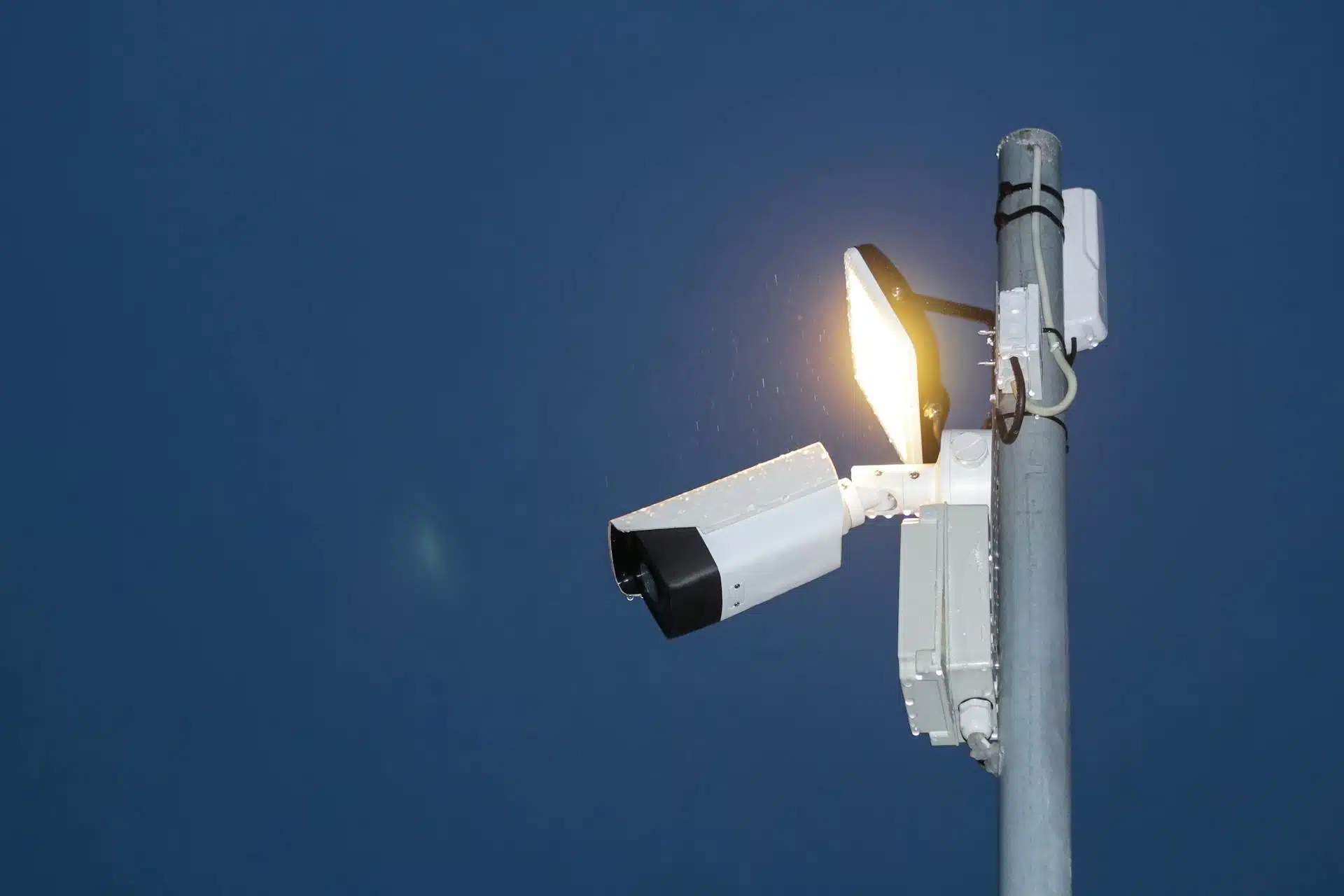
Night-vision security cameras rely on infrared LED illuminators to see in the dark without visible light. Nearly all modern surveillance cameras designated as "day/night" or IR-capable include a ring of IR LED emitters around the lens. At night, these infrared LEDs flood the camera's field of view with invisible light (typically at 850 nm or 940 nm wavelengths) that the camera's sensor can detect. The camera uses a built-in IR-cut filter that moves away in low-light conditions, allowing it to capture IR illumination and produce a clear black-and-white image even in total darkness. This method of active IR lighting enables discreet surveillance since the illumination is largely invisible to the human eye, unlike white-light floodlights that draw attention to the camera's position.
The choice of LED wavelength is constrained by the camera's silicon CMOS or CCD sensor responsivity, which peaks around 800-900 nm and drops sharply past 1000 nm. This is why infrared illuminators in security applications cluster at 850 nm (near the silicon sensitivity peak) and 940 nm (far enough from visible to be fully covert but with reduced sensor signal).
Design Considerations
Integrating an IR illuminator into a camera system requires careful planning to ensure effective night vision performance. Key factors include selecting the appropriate IR wavelength, matching the illumination coverage to the camera's field of view, choosing hardware that can withstand the operating environment, and managing thermal load for sustained operation.
Selecting 850 nm vs 940 nm
The choice between 850 nm vs 940 nm IR illuminators depends on whether maximum range and image brightness or absolute stealth is the priority. 850 nm LEDs provide greater illumination range and brightness, which is why they are the default in standard CCTV IR illuminators. 940 nm LEDs are deployed when invisible illumination is paramount, for example, in covert surveillance, near workspaces where a visible red glow would be distracting, or sensitive locations where even faint indicator light is undesirable. Many professional CCTV systems and OEM camera modules use both wavelengths in parallel: 850 nm for broad-area illumination, 940 nm for cameras that must remain completely undetectable.
Component-level specifications for representative Marubeni IR LEDs at the two wavelengths:
| Specification | 850 nm IR LED | 940 nm IR LED |
|---|---|---|
| Peak wavelength | 850 nm (near-IR) | 940 nm (near-IR) |
| Typical radiant intensity @ 100 mA | ~70 mW/sr | ~30 mW/sr |
| Spectral bandwidth (FWHM) | ~30 nm | ~40 nm |
| Forward voltage @ 100 mA | ~1.6 V | ~1.5 V |
| Camera sensor responsivity (relative) | ~100% (peak silicon sensitivity) | ~50% (silicon QE drops past 900 nm) |
| Visible glow to human eye | Faint red glow when viewed directly | None, fully invisible |
| Effective illumination range (relative) | 100% | ~50-60% |
| Eye-safety classification (typical) | IEC 62471 Class 1 (Exempt) | IEC 62471 Class 1 (Exempt) |
| Common applications | Outdoor CCTV, parking lots, perimeter, license plate readers | Covert surveillance, indoor workplace cameras, facial recognition, wildlife cameras |
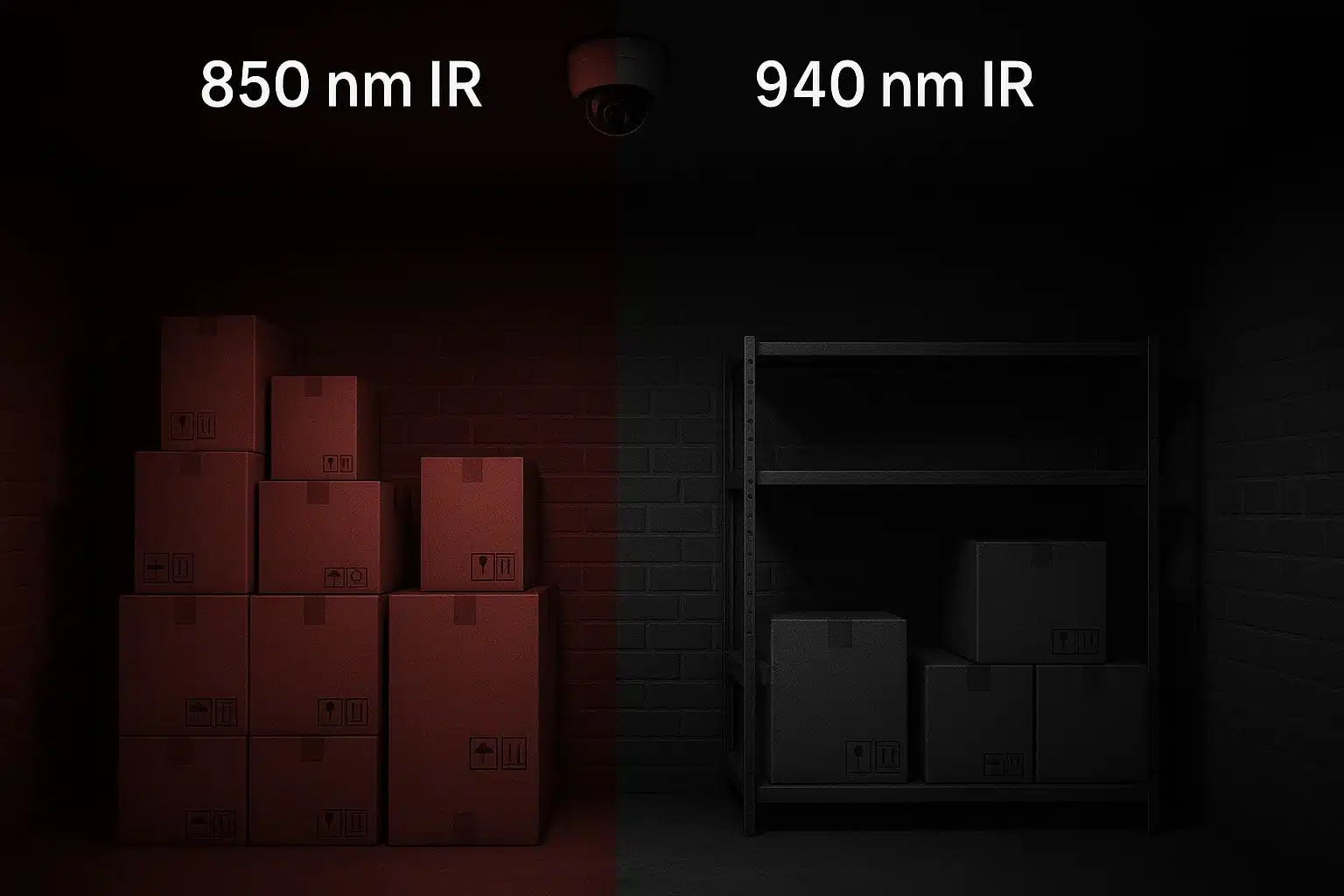
In summary: choose 850 nm IR illuminators when maximizing range and brightness is important and a small red glow at the LED source is acceptable. Choose 940 nm IR illuminators when complete invisibility is required and you can accommodate a 30-50% reduction in effective range, plus design for higher LED count or drive current to compensate. Tech-LED's SMT850-25 and SMT940-25 are representative single-die emitters at these wavelengths; the L850-66-60 IR LED Array is a higher-power multi-die option for long-range or wide-area applications. For deeper wavelength-specific selection guidance, see our 850 nm IR LED cluster article and 940 nm IR LED cluster article.
Illumination Range vs Field of View
Another important design factor is aligning the IR illuminator's coverage with the camera's field of view (FOV). A security camera with a wide-angle lens (90° or 120° FOV) requires an IR LED or array capable of dispersing light broadly across that angle. If the IR emitter's beam is too narrow, parts of the scene will remain under-illuminated and create dark zones that motion-detection algorithms may miss. Conversely, a narrow FOV camera (such as a long-range zoom or PTZ) benefits from a more focused IR beam to reach farther distances rather than wasting light outside the camera's view.
Manufacturers specify infrared illuminators by their beam angle (typically 30°, 60°, 90°, or 120° spread, full-width at half-maximum). When designing a night-vision system, ensure the IR beam angle matches or slightly exceeds the camera's FOV. For wide-area surveillance, multi-die LED arrays or diffused high-power emitters cover the entire scene. High-power IR LED arrays like the L850-66-60 series combine many emitters in one package to deliver both intense optical output and broad beam coverage. Placement matters too: IR illuminators are typically mounted around the camera lens with a slight offset to minimize internal reflections and reduce IR glare into the lens itself.
Thermal management and drive current
High-power IR illuminators (10+ watts of electrical input) generate substantial heat at the LED junction. Sustained operation at maximum drive current without adequate heatsinking will reduce LED output and shorten lifetime. OEM designs typically use metal-core PCBs, copper heat spreaders, or active cooling for the highest-output illuminators. Drive current is often pulsed (10-50% duty cycle) to maintain peak optical output while keeping average junction temperature manageable. Always specify the LED's continuous and peak drive current ratings from the component datasheet and derate by 20-30% for thermal margin.
Case Study – City Surveillance (Deploying IR Illuminators City-Wide)
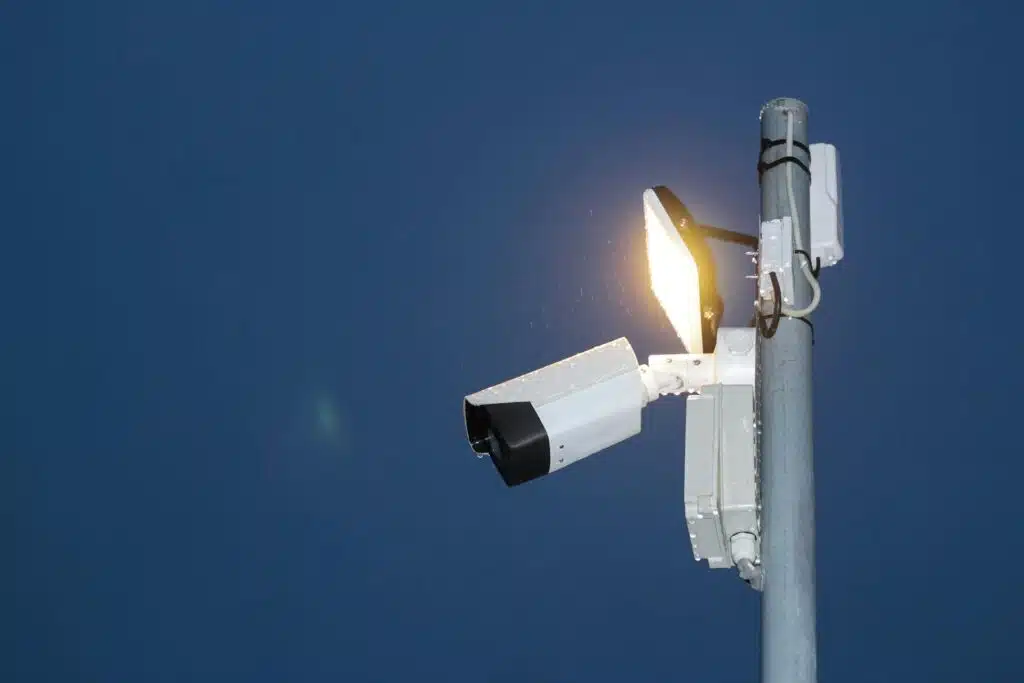
A city-wide surveillance network illustrates how IR illuminator selection plays out at scale. Urban security systems include hundreds of cameras monitoring streets, parking lots, perimeters of critical facilities, and transportation hubs. At night, instead of visible lighting (which causes light pollution and draws attention to camera positions), planners deploy IR LED illuminators on lamp posts and camera mounts to blanket areas in invisible light.
In a typical downtown deployment, standard 850 nm IR illuminators handle most cameras to ensure clear footage at longer distances for traffic monitoring and general public safety, accepting that the faint red glow at each LED source is visible at close range. At sensitive locations, government buildings, covert law enforcement posts, embassy perimeters, 940 nm illuminators provide surveillance that is completely undetectable, at the cost of needing more LED units or higher drive current to maintain the same effective range. This hybrid approach gives the city comprehensive night vision coverage with the right balance of performance and stealth per camera.
One real-world configuration that has been deployed in critical infrastructure monitoring: outdoor camera units equipped with high-power 940 nm LED arrays achieve 0 lux monitoring without any visible glow. Adjacent cameras for broader area coverage use 850 nm illuminators with wider beam patterns paired with pan-tilt-zoom cameras, ensuring that as a camera moves to track a subject the entire scene remains uniformly bathed in IR light.
Overcoming common challenges
When integrating IR illuminators with security cameras, engineers and installers encounter a few recurring issues. Each has a known design pattern:
- IR glare and reflections: If an infrared LED is mounted behind a glass window or inside a camera dome, its light can reflect back into the lens and wash out the image. To avoid this, use cameras with the IR illuminators mounted outside the enclosure, apply anti-reflective coatings to the glass between LED and lens, or offset the illuminator angle so reflected light does not hit the lens directly.
- Insects attracted to IR: Although IR light is invisible to humans, some insects perceive it. Bugs clustering around a camera can trigger false motion alerts or attract spiders that spin webs in front of the lens. Mitigations include using 940 nm LEDs (which insects respond to less than 850 nm), mounting the illuminator slightly away from the camera so insects gather at the light source rather than on the lens, and applying insect-deterrent housings.
- Weather-proofing and heat: Outdoor IR illuminator units must withstand rain, dust, and temperature extremes. Specify an IP rating appropriate to the deployment environment (typically IP66 or higher for outdoor exposure) and use sealed, durable housings. High-power IR LEDs generate heat during operation, proper heat sinks, thermally-conductive PCBs, and adequate airflow are critical for longevity and reliability.
- End-of-life output drop: IR LEDs lose optical output gradually over thousands of hours. Spec the system for end-of-life output (L70 lifetime is a typical industry metric, time to 70% of initial output), not just initial performance, so the camera still has adequate illumination after years of continuous operation.
Future of IR illumination in security
The field of infrared illumination for security continues to advance. One trend is higher-efficiency IR LEDs that illuminate greater distances or wider areas with fewer units, enabled by multi-die LED packages and improved chip efficiency. Large perimeters or open areas (borders, campuses, industrial facilities) can be covered with invisible light more cost-effectively.
Another emerging direction is hybrid IR laser + LED illumination for ultra-long-range night vision. IR laser modules can project infrared light over hundreds of meters in a narrow beam, enabling high-end PTZ cameras or surveillance scopes to see distant targets. Eye-safety becomes critical at laser power levels (since IR laser beams are invisible and don't trigger a blink reflex), modern systems combine eye-safe LED area illumination with carefully-rated IR laser sources for long-range spotting.
"Smart IR" integration is also improving night vision quality. Modern CCTV systems often feature automatic IR intensity adjustment based on scene content, preventing overexposure of close objects while maintaining brightness for distant ones. Future systems may synchronize IR pulses with camera shutter timing to reduce motion blur, or modulate output dynamically to save power. Combined with networking capabilities and AI-driven analytics, IR illumination is becoming more adaptive, efficient, and integrated with the broader surveillance system.
Frequently asked questions
Is 850 nm or 940 nm better for night vision?
It depends on what you're optimizing for. 850 nm is better when range and image brightness matter most, silicon camera sensors are ~2x more responsive at 850 nm than at 940 nm, so the same drive current produces a brighter, longer-range image. 940 nm is better when complete invisibility is required, it produces no visible glow at the LED source, making it ideal for covert surveillance, indoor workplace cameras, or sensitive areas where a red glow would be distracting or revealing. The trade-off for 940 nm is roughly 30-50% reduced effective range at equivalent drive current.
What is the best IR wavelength for night vision security cameras?
For most outdoor surveillance applications: 850 nm. It hits the peak of silicon camera sensor sensitivity, delivers the longest range per LED, and the faint red glow at the source is acceptable for cameras that are visibly mounted anyway. For covert applications (indoor monitoring near workspaces, anti-poaching wildlife cameras, undercover surveillance), 940 nm is the right choice despite its reduced range. Specialty applications occasionally use 780 nm or 880 nm but these are uncommon in mainstream CCTV deployment.
What should I consider when buying an infrared illuminator?
Six factors, in roughly this order of priority: (1) wavelength match to your camera, verify your camera sensor responds well at the LED wavelength; (2) beam angle vs camera FOV, illuminator coverage should match or slightly exceed the camera's field of view; (3) range vs visible glow trade-off, 850 nm for range, 940 nm for stealth; (4) environmental rating, outdoor cameras need IP66+ housings; (5) eye-safety classification for any installation accessible to the public (most LED-based illuminators are IEC 62471 Class 1 Exempt but high-power arrays can escalate); (6) lifetime spec at operating temperature, L70 hours at your expected ambient temperature, not just at 25°C.
What's the difference between IR light and an IR illuminator?
"IR light" is the radiation itself, electromagnetic waves in the 700-1000 nm (near-infrared) range. An "IR illuminator" is the device that produces IR light intentionally for active illumination of a scene. Sunlight, incandescent bulbs, and warm objects all emit IR as a byproduct, but they're not illuminators, they're not designed for the purpose, can't be controlled, and don't have a known spectral output. An IR illuminator is a purpose-built component (single LED, LED array, IR laser module, or combination) with a specified wavelength, beam pattern, and optical output.
Can humans see 940 nm light?
Effectively no. 940 nm sits ~250 nm beyond the long-wavelength edge of human vision (around 700 nm). The eye's photoreceptors have essentially zero response at 940 nm, so the LED appears completely dark to a human observer even when emitting maximum optical output. By contrast, 850 nm is close enough to the visible boundary that a small amount of leaked emission near 700-750 nm (the long tail of the LED's spectrum) appears as a faint red glow when viewed directly at the source, visible up close, but invisible at distance and to any observer not looking directly at the LED.
How can I extend the night vision range of my security camera?
Add more or higher-power IR illumination. An external IR floodlight or high-power LED array (matched to your camera's sensitivity, usually 850 nm) will dramatically increase the effective range. Make sure the illuminator's beam angle covers the camera's field of view, position it to avoid glare or shadows from nearby objects, and verify the camera's IR-cut filter is open in night mode (most day/night cameras handle this automatically). A high-sensitivity camera paired with a 10+ watt 850 nm IR illuminator can achieve clear recognition at 100+ meters in pitch darkness.
Will 940 nm IR illuminators work with any night vision camera?
Most cameras designated as "day/night" or "IR-sensitive" can detect 940 nm, but the picture quality varies. Standard silicon image sensors have lower quantum efficiency at 940 nm than at 850 nm (roughly half), so the same illuminator gives a dimmer image. Cameras with extended-NIR-sensitivity sensors handle 940 nm well; standard CCTV cameras may show a noticeably darker image and shorter effective range than they would with 850 nm. Always verify your specific camera's spectral response curve before committing to a 940 nm deployment.
What's the eye-safety classification of an IR illuminator?
Most commercial IR illuminators using LED sources at moderate power levels are classified as IEC 62471 Class 1 (Exempt), meaning safe for normal observation under foreseeable conditions. High-power IR illuminators (especially focused laser-based long-range units) can escalate to higher risk groups and require interlocked enclosures, viewing-distance warnings, and exposure-time controls. For OEM designs that will deploy in workplaces or public spaces, run the IEC 62471 photobiological safety assessment at the system level, not just at the bare LED component level, because beam-shaping optics can concentrate the emission and raise the risk group.
Related guides
- Near-Infrared (NIR) LED Guide, parent pillar covering all NIR wavelengths and applications
- 850 nm Infrared LEDs, deep-dive on the dominant CCTV wavelength
- 940 nm Infrared LEDs, covert illumination and proximity sensing
- SWIR LED Lighting Guide, sibling pillar for 1050-1750 nm SWIR applications
- Industrial UV LED Guide, sibling pillar for UV-A, UV-B, UV-C
Need help selecting IR illuminator components for your night vision or surveillance camera system? Contact Tech-LED engineering for OEM-specific recommendations, datasheets, and sample requests for Marubeni 850 nm and 940 nm IR LED components.