Tech-Led Blog

Near-Infrared (NIR) LEDs

  • NIR LEDs for fNIRS: Wavelength Selection and Component Guidance for Functional Near-Infrared Spectroscopy Device Design

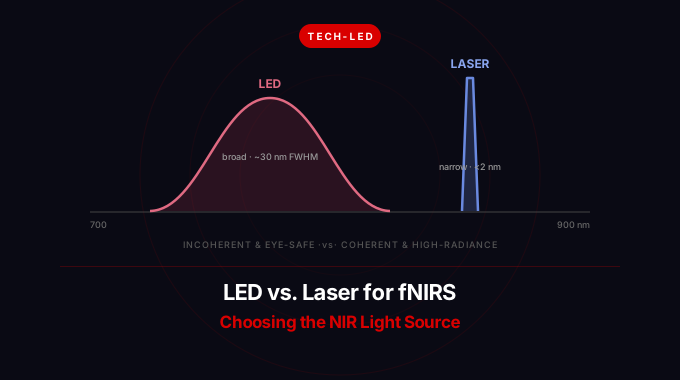
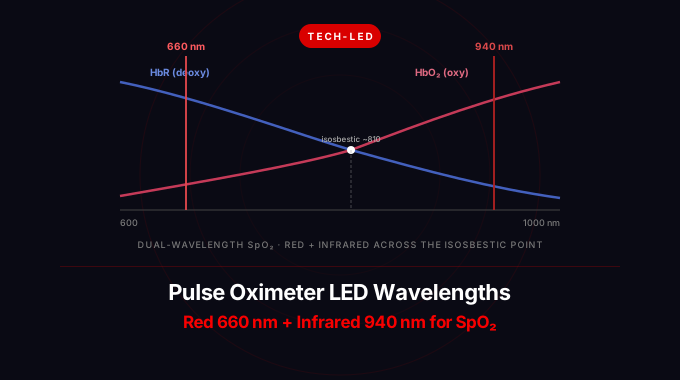
    Functional near-infrared spectroscopy (fNIRS) measures brain activity by shining near-infrared light through the scalp and skull and detecting how much is absorbed by oxygenated and deoxygenated hemoglobin in the cortex. Building an fNIRS device requires at least two NIR wavelengths that straddle the ~810 nm hemoglobin isosbestic point — most commonly a pairing around 760…

    Continue Reading...

  • NIR LEDs for fNIRS: Wavelength Selection and Component Guidance for Functional Near-Infrared Spectroscopy Device Design

    Functional near-infrared spectroscopy (fNIRS) measures brain activity by shining near-infrared light through the scalp and skull and detecting how much is absorbed by oxygenated and deoxygenated hemoglobin in the cortex. Building an fNIRS device requires at least two NIR wavelengths that straddle the ~810 nm hemoglobin isosbestic point — most commonly a pairing around 760…

    Continue Reading...

  • 780 nm Infrared LED Light Sources for Optical Sensing and Control

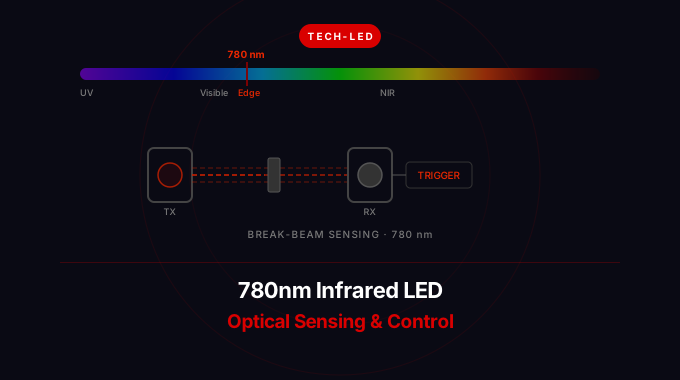
    780 nm is a near-infrared wavelength sitting right at the edge of the visible spectrum – essentially invisible to the human eye but easily detected by common silicon sensors. This makes a 780 nm LED an ideal light source for optical sensing systems – it yields strong detector response without producing distracting visible light. By pairing a…

    Continue Reading...

  • Near Infrared Light Therapy: Photobiomodulation Mechanisms, Benefits, and LED Design Guide
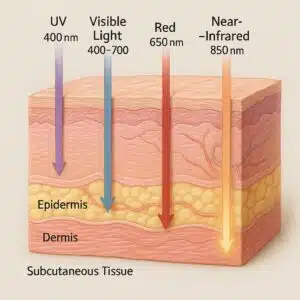
    Near-infrared (NIR) light therapy, a subset of photobiomodulation (PBM), represents a cutting-edge, non-invasive therapeutic modality that harnesses specific wavelengths of light to elicit profound biological effects at the cellular level. Unlike visible light, NIR penetrates deeper into tissues, making it a powerful tool for addressing a wide array of health concerns, from muscle recovery to…

    Continue Reading...

  • LED Light Therapy: A Technical Guide to Red and Infrared Devices for Photobiomodulation
    Infrared (IR) LED light therapy, a rapidly evolving modality within the field of photobiomodulation (PBM), harnesses specific wavelengths of light to elicit therapeutic effects at the cellular level. This non-invasive approach has garnered significant attention for its potential in regenerative medicine, pain management, and dermatological applications. For optoelectronic engineers and integrators, a thorough understanding of…

    Continue Reading...

  • What are infrared LEDs used for?

    1. Introduction to Infrared LEDs Defining IR LEDs: Invisible Light, Wavelengths, and Basic Function Infrared Light-Emitting Diodes (IR LEDs) are specialized semiconductor devices engineered to emit infrared (IR) radiation. This form of electromagnetic radiation possesses wavelengths longer than those of visible light, typically spanning a range from 700 nanometers (nm) to 1 millimeter (mm). A…

    Continue Reading...

  • How do IR LEDs work?

    TLDR: Quick Overview of IR LEDs Infrared (IR) LEDs are semiconductor devices that convert electricity into invisible infrared light. This occurs through electroluminescence, where electrons and holes recombine in a direct bandgap material like Gallium Arsenide (GaAs), releasing energy as photons. Unlike visible LEDs, IR LEDs emit longer wavelengths (typically >700 nm), making them imperceptible to the…

    Continue Reading...

  • How efficient is near-infrared LED?

    In the rapidly evolving world of optoelectronics, near-infrared (NIR) LEDs, particularly those utilizing perovskite materials, are gaining attention in the field of optoelectronics. have emerged as critical components across a myriad of applications, from security systems and industrial automation to medical diagnostics and smart agriculture. But a fundamental question often arises for engineers and integrators:…

    Continue Reading...

  • IR LED vs. Normal LED & IR Sensor: Understanding the Differences

    On a recent site visit to a high-tech security installation, I noticed a bank of LEDs glowing bright red on one panel, while a nearby infrared camera’s LED illuminators glowed completely unseen by my eyes. This simple scene highlights the fundamental difference: normal LEDs emit light in the visible range (so we can see them),…

    Continue Reading...

  • What are near-infrared LEDs?

    This light wasn’t from a bulb or laser but from an array of 850 nm near-infrared LEDs providing illumination invisible to the human eye. In simple terms, Near-infrared (NIR) LEDs are essential light sources in various applications. are light-emitting diodes engineered to emit photons just beyond the visible spectrum. Though we can’t see their beam,…

    Continue Reading...

  • Do LEDs Emit Near-Infrared?

    Visible vs IR Emission in LEDs Contrary to common assumptions, standard LED lighting emits virtually no near-infrared (NIR) light. By design, LEDs produce light in a narrow visible band (roughly 400–700 nm) rather than across the infrared spectrum. In fact, engineers and lighting experts emphasize that standard white LEDs generate essentially no IR in the beam….

    Continue Reading...

  • Use Cases of LED Light & Infrared: Lower Carbon Emissions Through New Technology

    In many industries, near-infrared (NIR) LEDs are transforming how machines illuminate and sense. These LEDs emit invisible light (700–1000 nm) and are extremely efficient, contributing to sustainability. For example, LED manufacturers notes their NIR LED designs *"minimize energy use and carbon footprint."* In practice, switching to NIR LED lighting and sensing can dramatically cut power…

    Continue Reading...

  • The Role of Near Infrared LEDs in Energy Efficiency and Sustainability

    Think energy-efficient lighting is only about visible LEDs? Think again. Near-infrared (NIR) LEDs are quietly transforming how we save power and design greener electronics. These invisible light sources – emitting just beyond the red end of the spectrum – are key enablers for modern smart devices and eco-friendly systems. In fact, as detailed in our…

    Continue Reading...

  • How Near Infrared LEDs Are Revolutionizing Medical Devices

    pulse oximeter

    Near-infrared LEDs in medical devices are quietly transforming patient care, from high-tech hospital equipment to everyday health monitors. These invisible wavelengths of light give medical designers new ways to sense and heal the human body without invasive procedures. As detailed in our Near-Infrared (NIR) LED Guide, a near-IR LED (also called an infrared diode) emits…

    Continue Reading...

  • The Future of Near Infrared LEDs in Industrial Applications

    machine vision LED

    Current Use of NIR LEDs in Industry Near-infrared (NIR) LEDs have already become workhorses in industrial settings. They serve as invisible illuminators and sensors in machine vision systems, production line monitors, and automation sensors. For example, factories employ IR LED spotlights and ring lights to enable machine vision cameras to inspect products for defects without…

    Continue Reading...

  • Near Infrared LED Guide

    What Is a Near-Infrared LED? A near-infrared (NIR) LED is a light-emitting diode that outputs invisible infrared light typically in the 700 nm to 1000 nm wavelength range, just beyond the deep red portion of the visible spectrum. Like any LED, it’s a semiconductor device: when forward-biased, electrons and holes recombine to emit photons of light. The…

    Continue Reading...

Email