Tech-led.com


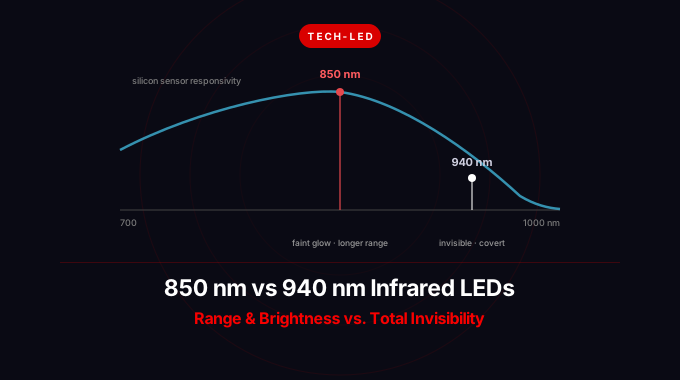
The choice between an 850 nm and a 940 nm infrared LED comes down to one trade-off: brightness and range versus total invisibility. Silicon camera sensors are roughly twice as responsive at 850 nm as at 940 nm, so an 850 nm illuminator produces a brighter image and 30–50% longer effective range at equal power, but it emits a faint red glow visible up close in the dark. A 940 nm LED is completely invisible to the human eye under all conditions, at the cost of lower sensor response and shorter range. Choose 850 nm when image quality and distance matter most (general CCTV, long-range night vision); choose 940 nm when the illumination must not be seen (covert surveillance, facial-recognition flood illuminators, user-facing sensors).
| Your priority | Choose | Why |
|---|---|---|
| Maximum range and image brightness | 850 nm | Silicon sensors ~2× more responsive; longer reach at equal power |
| Completely covert, no visible glow | 940 nm | Zero visible emission, even at high drive current |
| Facial recognition / illuminating a person | 940 nm | No glow in the subject's eyes; non-disturbing |
| Lowest cost per unit of detected signal | 850 nm | More photons reach the sensor per watt |
| Bright daylight / mixed lighting rejection | 940 nm | Sits in a solar-irradiance dip, reducing ambient IR interference |
Side-by-side comparison
| Parameter | 850 nm IR LED | 940 nm IR LED |
|---|---|---|
| Visible glow | Faint deep-red glow up close in the dark | None, fully invisible |
| Silicon sensor responsivity | Higher (near silicon's NIR peak) | ~50% of the 850 nm value |
| Relative QE (typical CMOS) | ~18% | ~7% (at ~950 nm) |
| Effective range at equal power | Baseline (longer) | ~30–50% shorter |
| Image brightness / SNR | Brighter, lower noise | Dimmer, more gain needed |
| Covertness | Partial (glow gives away position) | Full |
| Forward voltage | ~1.2–1.5 V | ~1.2–1.5 V |
| Ambient-IR rejection | Lower (more solar IR overlap) | Higher (940 nm solar dip) |
| Typical applications | CCTV, ANPR/LPR, long-range night vision, machine vision | Covert surveillance, face/iris recognition, gesture & proximity sensing |
Both wavelengths sit in the near-infrared band, are invisible-to-near-invisible to the eye, and are detected by standard silicon (CMOS/CCD) sensors, so a day/night camera with its IR-cut filter removed will see either one. The difference is entirely in how efficiently the sensor sees it and whether a human can.
Why silicon sees 850 nm better
Silicon image sensors and photodiodes have a quantum-efficiency curve that peaks in the 800–900 nm region and falls off steadily toward 1000 nm. At 850 nm the sensor is near that peak; by 940–950 nm responsivity has dropped to roughly half. Industry measurements put typical CMOS QE near ~18% at 850 nm versus ~7% around 950 nm, and silicon detectors are commonly cited as 30–40% more responsive to 850 nm than 940 nm under equal conditions. That responsivity gap is what gives 850 nm its brighter image and longer range, an 850 nm illuminator of a given power simply delivers more detected signal than a 940 nm one.
Why 940 nm is fully invisible
An 850 nm LED's emission spectrum has a small tail that creeps into the deep visible red, so when you look directly at one in darkness you see a dim red glow. A 940 nm LED sits far enough from the visible band that there is no perceptible glow at any drive current. For covert surveillance this is decisive: an 850 nm illuminator can reveal a hidden camera's position, while a 940 nm one stays dark. It is also why 940 nm is preferred for facial- and iris-recognition flood illuminators, pointing an 850 nm source at someone's face produces a visible red spot, while 940 nm illuminates without the subject noticing.
A secondary 940 nm advantage: the solar spectrum has a water-absorption dip near 940 nm, so there is less ambient infrared at that wavelength outdoors. This can improve signal-to-ambient ratio in bright daylight, which is one reason consumer face-unlock and gesture sensors favor 940 nm.
When to choose which
Choose 850 nm when:
- Range and image quality are the priority, long-driveway CCTV, perimeter security, parking-lot ANPR/LPR.
- The system is power- or budget-constrained and needs the most detected signal per watt.
- A faint red glow is acceptable (the camera is overt, or mounted out of direct view).
- The application is machine vision or sensing where brightness and SNR drive accuracy.
Choose 940 nm when:
- The illumination must be undetectable, covert or tactical surveillance, wildlife cameras.
- The source points at people, facial recognition, driver-monitoring, iris scanners, gesture and proximity sensing.
- Outdoor daylight operation benefits from the 940 nm solar dip and reduced ambient IR.
- A visible glow would compromise the application or the user experience.
Many professional systems use both: 850 nm emitters for general long-range illumination plus a few 940 nm emitters for cameras or zones that must stay invisible.
Pros and cons
850 nm, pros: brighter image, longer range, higher sensor QE, best signal-per-watt, lower effective cost for a given range. Cons: visible red glow (not covert); more ambient solar-IR interference outdoors.
940 nm, pros: completely invisible; ideal for face-facing and covert use; better daylight ambient-IR rejection. Cons: ~30–50% shorter range; dimmer image needing more sensor gain (more noise); lower signal-per-watt.
A note on cost and longer wavelengths
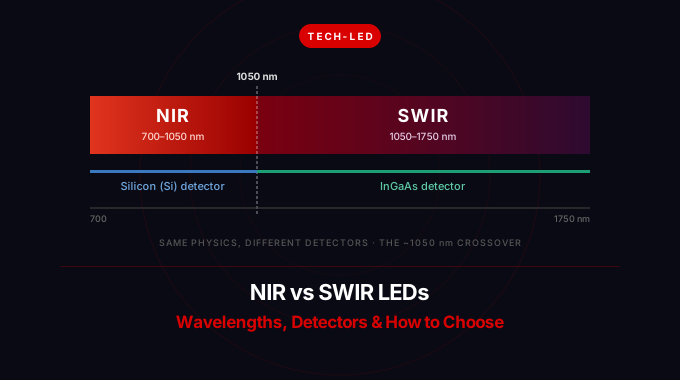
850 nm and 940 nm LEDs are both mature, GaAs-based NIR emitters with similar forward voltages (~1.2–1.5 V), similar package options, and comparable cost, neither carries a meaningful price premium over the other, so the decision is driven by performance, not budget. Note that wavelengths beyond ~950 nm move toward the short-wave infrared (SWIR) region, where standard silicon cameras lose sensitivity and InGaAs sensors are required; 940 nm is the practical upper limit for silicon-based night vision.
Frequently asked questions
What is the difference between 850nm and 940nm infrared LEDs?
850 nm produces a brighter image and longer range because silicon camera sensors are about twice as responsive at 850 nm as at 940 nm, but it emits a faint visible red glow. 940 nm is completely invisible to the human eye but gives a dimmer image and roughly 30–50% shorter range at the same power. 850 nm favors performance; 940 nm favors covertness.
Which is better for security cameras, 850nm or 940nm?
For most general surveillance, 850 nm is better because it delivers brighter images and longer range. Choose 940 nm specifically when the camera must be covert (no visible glow) or when it illuminates people's faces. Many installations combine both.
Is 940nm completely invisible?
Yes. A 940 nm IR LED has no perceptible glow at any drive current, which is why it's used for covert surveillance and face-facing illumination. An 850 nm LED, by contrast, shows a faint deep-red glow when viewed directly in the dark.
Why does 850nm have longer range than 940nm?
Because silicon sensors detect 850 nm far more efficiently, quantum efficiency is roughly 18% at 850 nm versus about 7% near 950 nm. More of the reflected light is converted to signal, so an 850 nm illuminator reaches farther and produces a cleaner image at equal optical power.
Can a normal camera see 940nm?
Yes, standard silicon CMOS/CCD sensors detect 940 nm, just less efficiently than 850 nm. A day/night security camera must have its IR-cut filter removed or flipped out (night mode) to see either wavelength. Beyond ~950 nm, silicon sensitivity drops toward zero and SWIR (InGaAs) sensors become necessary.
Why do facial recognition and face-unlock systems use 940nm?
Two reasons: 940 nm is invisible, so it doesn't shine a visible red spot in the user's eyes, and the solar spectrum has an absorption dip near 940 nm, which reduces ambient infrared interference in daylight and improves the signal-to-ambient ratio.
Do 850nm and 940nm LEDs cost differently?
Not meaningfully. Both are mature GaAs near-infrared emitters with similar forward voltage and packaging, so price is comparable. The selection is a performance-versus-covertness decision, not a budget one.
Related guides
- 850 nm Infrared LEDs: The Backbone of Night Vision and Surveillance Lighting, full 850 nm wavelength detail
- 940 nm Infrared LEDs for Invisible Gesture Recognition and Proximity Sensing, full 940 nm wavelength detail
- Integrating Near-Infrared LEDs into Night-Vision Security Cameras, system-level camera integration
- Near-Infrared (NIR) LED Guide, the parent NIR pillar
Selecting between 850 nm and 940 nm for a night-vision, security, or sensing design? Contact Tech-led engineering for IR LED recommendations, datasheets, and samples.