Tech-led.com


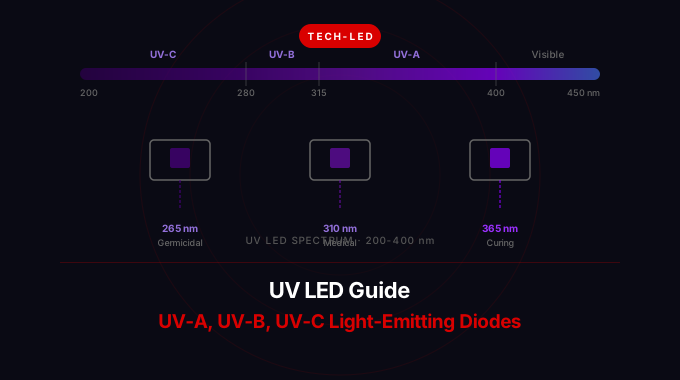
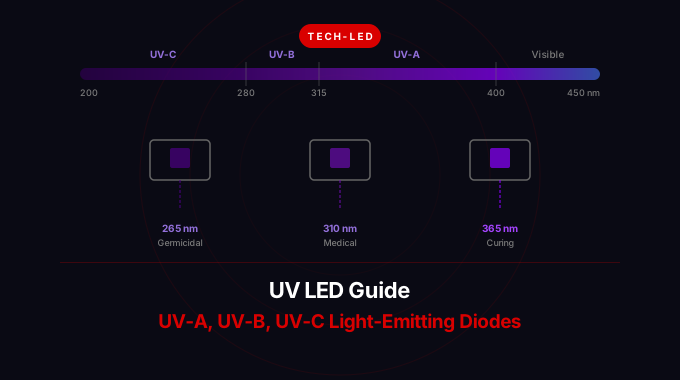
Industrial UV LEDs span 200-420 nm across three sub-bands: UV-C (200-280 nm) for germicidal and water-disinfection applications including surface disinfection and water purification, UV-B (280-315 nm) for narrow medical and specialty curing uses, and UV-A (315-400 nm) for industrial curing of inks, coatings, and adhesives, plus fluorescence excitation and optical inspection. Selection depends on three factors: the absorption profile of the target material, the required dose at the target plane, and the form factor required for the integration. Common ultraviolet LED wavelengths by band include 265-275 nm UV-C (germicidal peak, sometimes written UVC), 365 nm UV-A (industrial curing standard, photoinitiator-matched), 385-395 nm UV-A (higher radiant flux, slight visible violet), and 405 nm UV-A (fluorescence excitation, silicon-detector-friendly). As a focused light source for narrow-band UV illumination, ultraviolet LEDs replace traditional mercury arc, xenon, fluorescent, and excimer lamps across most industrial applications. This guide covers the technology, selection criteria, packaging considerations, thermal management, and safety standards for engineers specifying UV LEDs in OEM systems.
The UV spectrum at a glance
| Band | Wavelength range | Common LEDs | Primary applications | Eye / skin hazard |
|---|---|---|---|---|
| UV-A | 315-400 nm | 365, 385, 395, 405 nm | Industrial UV curing, fluorescence excitation, optical inspection, counterfeit detection, photolithography | Low (with proper enclosure) |
| UV-B | 280-315 nm | 295-310 nm | Medical dermatology (narrow-band UVB), specialty photopolymerization, scientific instrumentation | Moderate; direct exposure damages skin and eye |
| UV-C | 200-280 nm | 255-275 nm | Surface and water sterilization, air disinfection (HVAC), germicidal applications | High; direct exposure causes acute photokeratitis and skin burns; requires interlocked enclosures |
The historical "UV lamp" market was dominated by mercury arc lamps (broad electromagnetic emission with peaks at 254 nm UV-C and 365 nm UV-A), fluorescent UV tubes, xenon flash bulbs, and excimer lamps. The legacy UV bulb has been displaced in most industrial applications by LED-based emitters, which offer narrower spectral output, longer lifetimes and longevity (typically 10,000-30,000 hours for UV-A LEDs vs. 1,000-2,000 for mercury lamps), instant on/off control, no mercury content, higher reliability under thermal cycling, and form factors that traditional UV sources cannot match.
UV-A LEDs (315-400 nm)
UV-A is the most mature and commercially significant UV LED band. The 365-405 nm window contains four standard wavelengths used in industrial photonics: 365 nm, 385 nm, 395 nm, and 405 nm. Each has a distinct application profile.
365 nm is the industry standard for UV curing applications. Most commercial photoinitiators are absorption-matched to the 350-370 nm range, making 365 nm the most efficient choice for inks, coatings, and adhesives. 365 nm output is deep enough in the UV range that there is minimal visible glow, which prevents stray light from exciting non-target fluorophores during inspection.
385 nm and 395 nm sit closer to the visible boundary. They typically deliver higher radiant flux per electrical watt than 365 nm devices (often 30-100% more output at the same drive current), but the emission spectrum includes a small visible-violet component. They are common in lower-cost UV flashlights, hybrid curing systems, and applications where deeper-penetrating cure is more important than spectral purity.
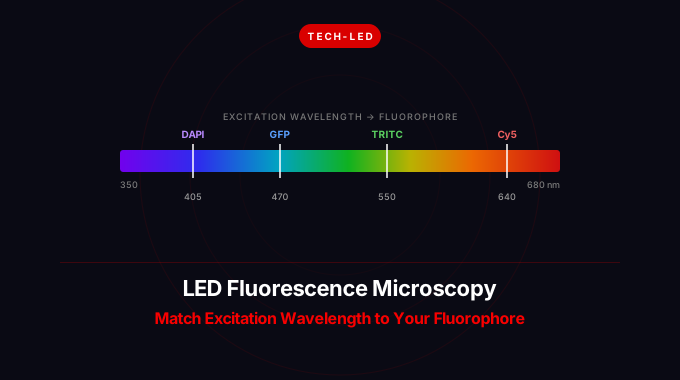
405 nm is the most commonly used wavelength for fluorescence excitation because silicon-based detectors and standard CMOS cameras are responsive at 405 nm but largely blind at 365 nm. Many fluorophores (e.g., porphyrins, DAPI stains, UV-reactive inks) excite efficiently at 405 nm, making it the practical choice for fluorescence microscopy, machine vision, and forensic inspection.
For applications that need depth-cure plus surface-cure, multi-wavelength UV-A arrays combining 365 nm and 395 nm emitters are common in industrial curing heads.
UV-B LEDs (280-315 nm)
UV-B LEDs occupy a narrower commercial niche. The dominant applications are medical (narrow-band UVB phototherapy for psoriasis and eczema, typically at 308-311 nm), specialty UV-B-cured photopolymers, and scientific instrumentation. Available wavelengths are narrower than UV-A or UV-C, most commercial UV-B LEDs cluster around 295-310 nm.
UV-B LEDs are less efficient than UV-A LEDs (typical wall-plug efficiency 1-5% vs. 20-40% for UV-A) and more expensive per milliwatt. They require quartz or specialized polymer windows for transmission (standard glass and most plastics absorb UV-B). For most applications considering UV-B, either a UV-A LED at a slightly higher wavelength or a UV-C LED at a slightly lower wavelength is a more cost-effective alternative.
UV-C LEDs (200-280 nm)
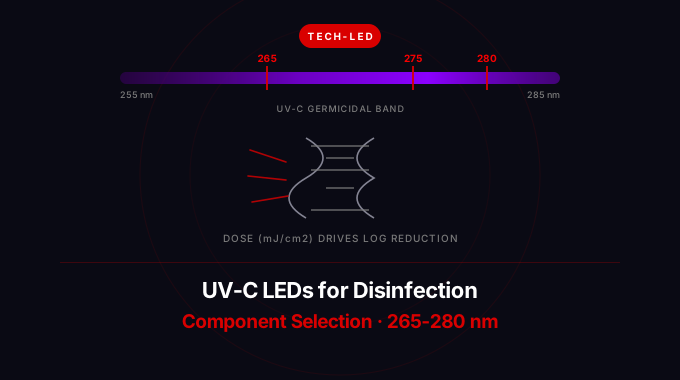
UV-C is the fastest-growing UV LED category, driven by post-2020 demand for non-mercury germicidal solutions. UV-C LEDs typically emit at 255-275 nm, with the germicidal peak around 265 nm (matching the DNA absorption maximum). Applications include surface sterilization, water disinfection, air purification (HVAC integration), and laboratory germicidal protocols.
UV-C LED technology is still maturing. Commercial devices are roughly 10-100x more expensive per milliwatt than UV-A LEDs, with wall-plug efficiencies of 1-5%. Lifetime degradation is also more aggressive, many UV-C LEDs lose 30-50% output within 5,000-10,000 hours. UV-C LED selection requires close attention to:
- Dose-at-target calculations, germicidal log-reduction depends on cumulative UV fluence (mJ/cm²); engineers must size the array for both initial dose and end-of-life dose.
- Optical materials, quartz, fused silica, or sapphire optics; most polymers absorb UV-C and degrade rapidly under exposure.
- Thermal management, high heat loads per milliwatt of output; metal-core PCBs or ceramic substrates are typical.
- Safety enclosures, direct UV-C exposure causes acute photokeratitis ("welder's flash") within minutes; integrated systems require interlocks, viewing windows that block UV-C, and operator training.
Tech-led's Marubeni UV LED portfolio focuses on UV-A wavelengths (365-405 nm). UV-C LEDs are typically sourced from specialty suppliers (e.g., Bolb, Crystal IS, Seoul Viosys) given the different fabrication processes (AlGaN deep-UV vs. InGaN for UV-A).
UV LED vs. UV lamp: a comparison
Engineers evaluating UV illumination for new product designs face a build-vs-replace decision: integrate UV LEDs from the start, or use proven UV lamps with retrofit-LED upgrade paths later. The trade-offs:
| Factor | UV LED | UV lamp (mercury arc / fluorescent) |
|---|---|---|
| Spectral output | Narrow band (10-20 nm FWHM); selectable wavelength | Broad emission with peaks; mercury lamps emit 254, 313, 365, 405 nm simultaneously |
| Lifetime | 10,000-30,000 hours (UV-A); 5,000-10,000 hours (UV-C, current generation) | 1,000-2,000 hours typical |
| Warmup / on-off | Instant on; supports pulse modulation | Several-minute warmup; degraded by frequent cycling |
| Form factor | Compact SMD/COB packages; integrates into board-level designs | Bulky tube or arc geometries; require external power supply |
| Mercury content | None | Contains mercury (regulatory disposal requirements; banned in some markets) |
| Wall-plug efficiency | 20-40% (UV-A), 1-5% (UV-C) | 15-30% typical |
| Cost per milliwatt | Higher upfront; lower over operational life | Lower upfront; higher TCO with lamp replacements |
For new product designs, UV LEDs are almost always the correct choice for UV-A applications. For UV-C, the decision is application-dependent: high-volume continuous-disinfection systems may still favor mercury lamps for now; targeted, pulsed, or portable applications favor LEDs.
Selecting a UV LED by application
| Application | Recommended band | Common wavelength | Primary selection criteria |
|---|---|---|---|
| UV curing (inks, coatings, adhesives) | UV-A | 365 nm primary; 385-395 nm depth-cure supplement | Photoinitiator match, radiant flux at target, thermal envelope |
| Fluorescence excitation (microscopy, inspection) | UV-A | 405 nm (silicon detector compatible) or 365 nm (deeper UV) | Fluorophore absorption peak, spectral purity, modulation rate |
| Counterfeit / document inspection | UV-A | 365 nm | Visible-glow rejection, beam uniformity |
| Photolithography (specialty) | UV-A | 365 nm or 405 nm | Beam collimation, dose uniformity, exposure time |
| Phototherapy (medical) | UV-B | 308-311 nm narrow band | FDA / IEC 60601 compliance, beam profile, safety interlocks |
| Surface sterilization | UV-C | 265-275 nm | Cumulative dose, dwell time, EOL dose budget |
| Water disinfection | UV-C | 265 nm | Flow rate, transmittance of water, log reduction target |
| Air purification / HVAC | UV-C | 265-275 nm | Air-change rate, dose at flow speed, lamp count for coverage |
Packaging and thermal considerations
UV LEDs are more thermally sensitive than visible-light LEDs. Wall-plug efficiency is lower (especially for UV-C), so a larger fraction of input electrical power becomes heat at the junction. Each photon emitted at 250 nm carries roughly 5 eV of energy versus ~2 eV for visible-light photons, but the conversion process is less efficient and the surplus power becomes heat. Junction temperature directly affects both output power density and lifetime, most UV LED datasheets specify maximum junction temperatures of 80-100°C, forward voltage in the 4-6 V range for UV-A and 6-8 V for UV-C, and operating at lower temperatures (50-70°C) significantly extends L70 lifetime. Effective heat sink design (copper-core PCB, aluminum housing, active cooling for high-power arrays) is the single most important driver of UV LED reliability in OEM systems.
Package options:
- Surface-mount (SMD), most common for board-level integration. Tech-led's high-power SMD packages include the SMBB (5×5 mm ceramic) and EDC (3.5×3.5 mm) series, designed for multi-chip configurations with low thermal resistance.
- Chip-on-Board (COB), multiple UV LED chips mounted directly on a substrate for high-power, large-area applications (e.g., UV curing fixtures, sterilization arrays).
- Through-hole, less common in modern UV LED designs; primarily used in retrofit applications.
Optical materials:
- UV-A (365-405 nm): standard optical glass and many polymers (polycarbonate, acrylic) transmit adequately. Silicone encapsulants common in LED packages are UV-stable at UV-A wavelengths.
- UV-B and UV-C: require quartz, fused silica, or sapphire optics. Standard glass and most plastics absorb significantly below 320 nm. Silicone encapsulants degrade under UV-C exposure; ceramic packages without polymer windows are preferred.
For high-power UV LED applications, thermal management via metal-core PCBs, copper heat spreaders, and active cooling (fans or thermoelectric coolers) is standard practice. Always derate UV LED drive current relative to the datasheet maximum to extend operational life, many integrators run at 70-80% of maximum rated current to roughly double L70 lifetime.
Safety and IEC 62471 compliance
All UV LED products that are visible to humans require photobiological safety evaluation per IEC 62471 (Photobiological Safety of Lamps and Lamp Systems). The standard classifies sources into risk groups (Exempt, RG1, RG2, RG3) based on exposure thresholds for actinic UV, near-UV, and other hazards.
Practical implications for OEM designers:
- UV-A LEDs at typical industrial drive currents are usually Exempt or RG1 when viewed at the standard 200 mm distance. Concentrated beams (lensed or focused) can escalate to RG2.
- UV-B and UV-C LEDs are RG2 or RG3 in virtually all commercial configurations. Direct viewing causes acute injury; designs must include interlocked enclosures, UV-opaque viewing windows, and operator warnings.
- Eye protection (UV-rated safety glasses, ANSI Z87.1 with UV labeling) is mandatory during maintenance, alignment, and any operation where the source may be accessed.
- Marketing and labeling claims that overstate "eye-safe" or "skin-safe" properties of UV products are increasingly subject to regulatory action; design for the worst-case exposure scenario and document compliance.
For consumer-facing products containing UV LEDs (germicidal wands, UV nail lamps, etc.), additional FDA, CE, and regional safety standards typically apply. Engineering teams should engage compliance specialists early in the design cycle.
Marubeni UV LED portfolio
Tech-led distributes Marubeni's industrial UV LED portfolio for OEM integration. The lineup is UV-A focused, with standard wavelengths at 365 nm, 395 nm, and 405 nm in surface-mount and high-power packaging:
- 365 nm SMD and high-power packages for industrial curing systems, fluorescence inspection, counterfeit detection
- 395 nm SMD packages for hybrid curing and inspection applications
- 405 nm SMD and COB packages for fluorescence excitation, machine vision, photolithography
For complete product specifications, drive characteristics, and packaging options, see the UV LED product category or contact Tech-led engineering for OEM specification support.
Frequently asked questions
What is a UV LED?
A UV LED is a light-emitting diode that emits ultraviolet radiation (200-400 nm). UV LEDs are categorized into three sub-bands: UV-C (200-280 nm) for germicidal use, UV-B (280-315 nm) for medical and specialty applications, and UV-A (315-400 nm) for industrial curing, fluorescence excitation, and inspection.
What is the difference between UV-A, UV-B, and UV-C LEDs?
UV-A LEDs (365-405 nm) are the most common commercial type, used for UV curing and fluorescence. UV-B LEDs (280-315 nm) occupy a narrow niche in medical phototherapy and specialty curing. UV-C LEDs (200-280 nm) are used for sterilization and water disinfection. The three bands differ significantly in fabrication technology (InGaN for UV-A, AlGaN for UV-C), efficiency, cost per milliwatt, and safety profile.
Which UV LED wavelength is right for my application?
For UV curing of inks, coatings, and adhesives: 365 nm is the standard (photoinitiator-matched). For fluorescence excitation in microscopy or machine vision: 405 nm for silicon-detector compatibility, or 365 nm for deeper UV. For surface or water sterilization: 265-275 nm UV-C. For medical phototherapy: 308-311 nm UV-B (narrow band). Always consult application-specific guidance and validate dose-at-target before final design lock.
Are UV LEDs better than UV lamps?
For UV-A applications, yes, UV LEDs offer 10-30x longer lifetime, instant on/off, narrower spectral output, no mercury content, and compact form factors. For UV-C, the answer is application-dependent: high-volume continuous disinfection systems may still favor mercury arc lamps due to lower cost per milliwatt; targeted, pulsed, or portable applications favor LEDs.
Are UV LEDs safe?
UV-A LEDs at typical industrial drive currents are usually IEC 62471 Exempt or RG1, meaning safe for normal observation. UV-B and UV-C LEDs are RG2 or RG3, direct exposure causes acute eye and skin injury. All UV LED designs require photobiological safety evaluation, appropriate enclosures, and operator protection (UV-rated safety glasses, interlocks).
What is the most powerful UV LED?
Single-chip UV-A LEDs at 365-405 nm commonly deliver 1-5 watts of optical output. High-power multi-chip COB modules and arrays can exceed 100 watts of optical output. UV-C LEDs are more limited, single chips typically deliver tens of milliwatts to a few hundred milliwatts; high-power UV-C arrays reach 5-10 watts. "Most powerful" is application-dependent: optical power, beam intensity, and dose-at-target are different metrics.
How long do UV LEDs last?
UV-A LEDs typically rate L70 (time to 70% output) at 10,000-30,000 hours when operated within thermal and electrical specifications. UV-C LEDs have shorter lifetimes, 5,000-10,000 hours for the current generation, with some applications seeing 30-50% output loss in that window. Lifetime is highly sensitive to junction temperature; derating drive current and adding heat sinking can substantially extend operational life.
What's the difference between a UV LED and a UV laser?
UV LEDs are spontaneous-emission devices with broader emission (10-20 nm FWHM), wider beam patterns, and lower cost per device. UV lasers are coherent sources with narrower spectral output (sub-nm), tighter beams, and higher cost. LEDs are preferred for area illumination, curing, and inspection where coherence is not required. Lasers are preferred for precision lithography, spectroscopy, and metrology where beam quality and coherence matter.
Related guides
- LED Wavelength Guide: From UV to Infrared, parent pillar covering the full LED spectrum
- 365 nm UV LED Curing: UVA vs 395 nm Comparison, deep coverage of the industry-standard curing wavelength
- 405 nm Violet (UV-A) LED for Fluorescence and Optical Detection, fluorescence and machine-vision applications
- UV LED product category, Marubeni UV LED component portfolio
Need help selecting a UV LED for your OEM integration? Contact Tech-led engineering for application-specific component recommendations, datasheets, and sample requests.