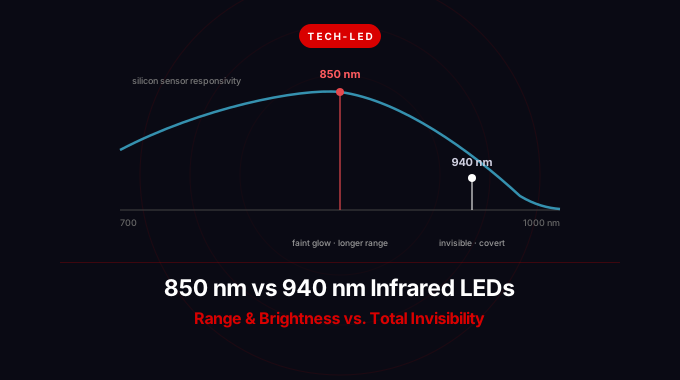
The choice between an 850 nm and a 940 nm infrared LED comes down to one trade-off: brightness and range versus total invisibility. Silicon camera sensors are roughly twice as responsive at 850 nm as at 940 nm, so an 850 nm illuminator produces a brighter image and 30–50% longer effective range at equal power…
Tech-Led Blog
Industrial & Machine Vision
-
-
If you are looking for an LED supplier for industrial equipment, research systems, custom instrumentation, or OEM development, the challenge is rarely just finding a part number. The real challenge is finding a sourcing partner that can help match wavelength, package style, power, voltage, reliability, and long-term availability to the exact demands of your application….
-
Short-wave infrared (SWIR) LEDs around 1200 nm represent a pivotal transition point between traditional infrared and the deeper SWIR region. This article explores what makes the 1200 nm wavelength special, how photodiode detectors behave at this crossover, and why engineers often choose LED emitters over lasers at 1200 nm. We delve into the semiconductor technology behind 1200nm LEDs,…
-
Infrared illumination at the 850 nm wavelength has become the backbone of modern night vision and surveillance lighting. This near-infrared light provides high radiant energy that silicon-based camera sensors can detect easily, while remaining almost invisible to the naked eye. By operating just beyond the visible spectrum, an 850 nm IR LED offers a powerful…
-
Infrared LEDs at the 940 nm wavelength emit near-infrared light that is invisible to the human eye, making them ideal for gesture recognition and proximity sensing applications where illumination must be covert. Unlike shorter-wavelength IR emitters (e.g. 850 nm) that produce a faint red glow, a 940 nm LED is completely invisible to the naked…
-
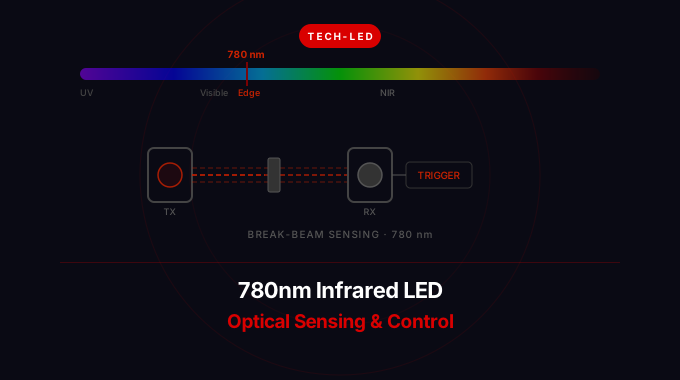
780 nm is a near-infrared wavelength sitting right at the edge of the visible spectrum – essentially invisible to the human eye but easily detected by common silicon sensors. This makes a 780 nm LED an ideal light source for optical sensing systems – it yields strong detector response without producing distracting visible light. By pairing a…
-
Infrared Illuminators for Night Vision Security Cameras: NIR LED Integration Guide for OEM Designers
An infrared illuminator is a near-infrared (NIR) light source — typically built from arrays of 850 nm or 940 nm LEDs — that floods a scene with invisible light so cameras can see in the dark while remaining undetectable to human observers. For security camera integrators and OEM designers, the IR illuminator is the component…
-
Current Use of NIR LEDs in Industry Near-infrared (NIR) LEDs have already become workhorses in industrial settings. They serve as invisible illuminators and sensors in machine vision systems, production line monitors, and automation sensors. For example, factories employ IR LED spotlights and ring lights to enable machine vision cameras to inspect products for defects without…
-
The evolution of Light Emitting Diode (LED) technology has revolutionized numerous industries by providing energy-efficient, durable, and versatile lighting solutions. LEDs operate across a broad spectrum of wavelengths—from ultraviolet (UV) through visible light to infrared (IR)—each offering unique properties that are harnessed for specialized applications. Below is a list of industrial applications associated with various…
-
A solar simulator reproduces sunlight — its spectrum, intensity, and uniformity — so photovoltaic cells and materials can be tested under controlled, repeatable conditions. An LED solar simulator does this by combining many LED wavelengths into a tunable array that approximates the standard AM1.5G reference spectrum across roughly 300–1200 nm (and out to the SWIR…
-
Optical sorters separate materials at speed by reading a light signal and firing an air jet or ejector at items that don't match. The LED light source is what makes the distinction possible, and the wavelength is chosen by what you're sorting on: visible light for color (ripe vs. unripe, product vs. foreign matter), SWIR…
-
Machine vision lighting is the practice of selecting an LED light source — its wavelength and its geometry — to maximize the contrast a camera needs to detect a feature reliably. The wavelength is matched to the material and the defect: UV (365–405 nm) to excite fluorescence and reveal surface flaws, visible (450–660 nm) for…
-
Surveillance imaging in the dark relies on infrared LED illuminators — light the camera can see but the human eye cannot. The wavelength sets the trade-off: 850 nm gives the brightest image and longest range because silicon sensors are most responsive there (at the cost of a faint visible glow), 940 nm is completely invisible…
-
In an optical sensor, an LED is the emitter and a photodiode is the detector; the sensor measures how a target changes the light passing between them. The wavelength is chosen so the light interacts with the thing being measured: NIR (940 nm) for invisible proximity and gesture sensing, a specific absorption line (e.g. 4.26…
-
LEDs (Light Emitting Diodes) have become a cornerstone technology in industrial applications, offering precision, energy efficiency, and adaptability. Tech-LED provides specialized products designed to meet the technical demands of various industries. What Are Industrial LED Applications? Industrial LED applications involve the use of LED technology to enhance performance, improve efficiency, and achieve specific operational goals….