Tech-led.com



In an optical sensor, an LED is the emitter and a photodiode is the detector; the sensor measures how a target changes the light passing between them. The wavelength is chosen so the light interacts with the thing being measured: NIR (940 nm) for invisible proximity and gesture sensing, a specific absorption line (e.g. 4.26 µm CO₂, or near-IR overtones) for gas sensing, scattering of any wavelength for particle and smoke detection, red + infrared (660 + 940 nm) for pulse oximetry, and UV/violet (365–405 nm) to excite fluorescence. This guide covers how LED optical sensors work, the main sensing modalities and their wavelengths, and the emitter specifications that determine measurement quality.
| Sensing modality | What it measures | Typical LED wavelength |
|---|---|---|
| Proximity / gesture | Reflected IR off a nearby object | 940 nm (invisible) |
| Pulse oximetry / PPG | Blood oxygen and pulse | 660 nm + 940 nm |
| Particle / smoke detection | Light scattered by particulates | 850–940 nm or blue |
| Gas sensing (NDIR / optical) | Absorption at a gas's signature line | Application-specific IR |
| Fluorescence detection | Emission from an excited fluorophore | 365–405 nm |
| Turbidity / colorimetry | Absorbance or scatter in liquids | Visible, matched to analyte |
How an LED optical sensor works
Every optical sensor pairs an emitter with a detector and exploits one of four physical interactions:
- Absorption, light passes through a medium and the detector measures the intensity drop. The wavelength is chosen to sit on an absorption feature of the target (a gas line, a dye's absorption band, hemoglobin in blood).
- Reflection, light bounces off a surface or object back to the detector, used for proximity, position, and presence sensing.
- Scattering, particles redirect light to a detector placed off-axis, the basis of optical smoke alarms and particulate monitors.
- Fluorescence, short-wavelength light excites a fluorophore that re-emits at a longer wavelength, which the detector isolates with a filter.
In every case the LED's job is to deliver stable, known light at the right wavelength so the detector's reading reflects the target, not drift in the source. That makes wavelength match and output stability the two decisions that govern sensor accuracy.
Sensing modalities and their wavelengths
Proximity and gesture sensing
A 940 nm IR LED emits invisible light; a photodiode measures the portion reflected from a nearby hand or object. 940 nm is preferred over 850 nm here because it produces no visible glow and the solar spectrum dips at 940 nm, improving the signal-to-ambient ratio in daylight. Used in consumer electronics, touchless controls, and machine automation.
Pulse oximetry and heart-rate (PPG)
Optical biomedical sensors shine red (660 nm) and infrared (940 nm) light through tissue and read the pulsatile signal to derive blood-oxygen saturation and pulse. Wearables add a green LED for motion-tolerant heart rate. See the dedicated pulse oximeter LED wavelength guide and, for brain-activity sensing, the fNIRS guide.
Particle and smoke detection
Optical smoke detectors and particulate monitors use a light source and an off-axis photodiode: in clean air little light scatters into the detector, but smoke or dust scatters light onto it, triggering the alarm or reading. Both IR (850–940 nm) and blue LEDs are used; blue scatters more efficiently off small particles, improving sensitivity to fine smoke.
Gas sensing
Non-dispersive infrared (NDIR) and optical gas sensors choose a wavelength that coincides with a target gas's absorption line and measure how much light the gas absorbs. The wavelength is gas-specific, and stable, narrow-band emission is essential so the reading tracks gas concentration rather than source drift.
Fluorescence and colorimetric detection
UV/violet LEDs (365–405 nm) excite fluorophores in assays, water-quality monitors, and inspection systems; the detector reads the longer-wavelength emission through a filter. Visible LEDs matched to an analyte's absorption drive colorimetric and turbidity measurements. See the fluorescence excitation guide.
Emitter specifications that drive sensor accuracy
- Peak wavelength accuracy and binning, the sensor's calibration assumes a specific wavelength; an off-target or batch-variable emitter biases the reading.
- Output stability, drift in LED intensity appears directly as measurement noise. A constant-current driver is standard.
- Modulation capability, many sensors pulse the LED and use synchronous (lock-in) detection to reject ambient light and boost signal-to-noise. The emitter must support the drive scheme.
- Thermal stability, junction temperature shifts both output and peak wavelength; heat-sinking and duty-cycling hold the measurement steady.
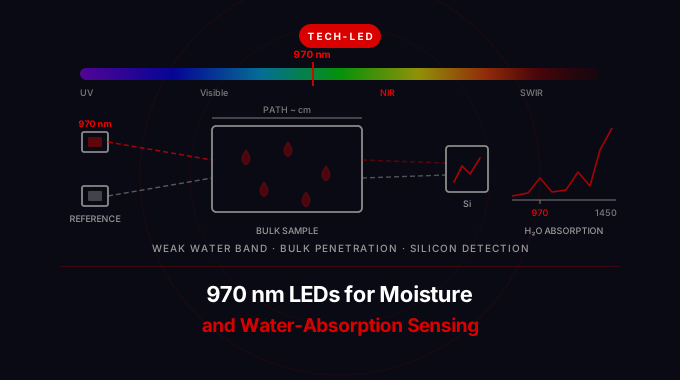
- Detector pairing, the photodiode must be responsive at the emitter's wavelength; silicon covers ~400–1000 nm, while longer IR needs other detector materials.
Tech-led supplies the LED emitters behind these optical sensors across UV, visible, and IR/NIR wavelengths. For component selection, datasheets, and samples, contact Tech-led engineering.
Frequently asked questions
What is an LED optical sensor?
It's a sensor that uses an LED as a light source and a photodiode as a detector, measuring how a target changes the light between them, by absorbing, reflecting, scattering, or fluorescing it. The LED wavelength is chosen so the light interacts usefully with what's being measured.
Which LED wavelength should I use for proximity sensing?
940 nm is the usual choice. It's completely invisible (no glow to distract users), and the solar spectrum dips near 940 nm, which reduces ambient-light interference outdoors and improves the signal-to-ambient ratio.
How do LEDs work in a smoke detector?
Optical smoke detectors place a photodiode off-axis from an LED. In clean air, little light reaches the detector; smoke particles scatter light onto it, and the rise in signal triggers the alarm. Blue LEDs improve sensitivity to small smoke particles; IR LEDs are also common.
Can LEDs be used for gas sensing?
Yes. Non-dispersive infrared (NDIR) and optical gas sensors use an LED (or IR source) at a wavelength matching the target gas's absorption line, measuring how much light the gas absorbs to infer concentration. Stable, narrow-band emission is essential for accuracy.
What wavelengths do biomedical optical sensors use?
Pulse oximeters and PPG heart-rate sensors use red (~660 nm) and near-infrared (~940 nm) LEDs, often with a green LED for motion-tolerant heart rate. fNIRS brain-activity sensors use two NIR wavelengths around 760 and 850 nm. The wavelengths are chosen around hemoglobin's absorption behavior.
Why does LED stability matter so much in sensors?
Because the sensor infers its measurement from changes in detected light. If the LED's own output drifts, from temperature, aging, or an unstable driver, that drift is indistinguishable from a change in the target, corrupting the reading. Constant-current drive, thermal management, and often lock-in detection keep the source stable.
How do I pair a photodiode with a sensor LED?
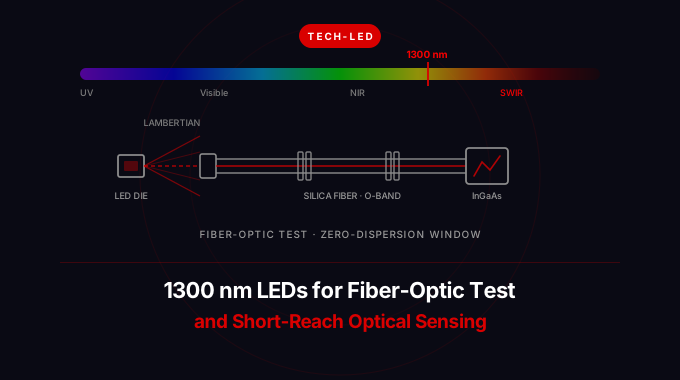
Choose a detector responsive at the LED's wavelength. Silicon photodiodes cover roughly 400–1000 nm (good for visible through 940 nm); wavelengths beyond ~1000 nm need InGaAs or other detector materials. Synchronizing the detector to a modulated LED rejects ambient light.
Related guides
- Pulse Oximeter LED Wavelengths, red + IR biomedical sensing
- 940 nm Infrared LEDs, proximity and gesture sensing
- Choosing an LED for Fluorescence Microscopy, fluorescence excitation
- LED Wavelength Guide: From UV to Infrared, the full spectrum map
Designing an optical sensor and selecting the emitter? Contact Tech-led engineering for LED wavelength recommendations, datasheets, and samples.