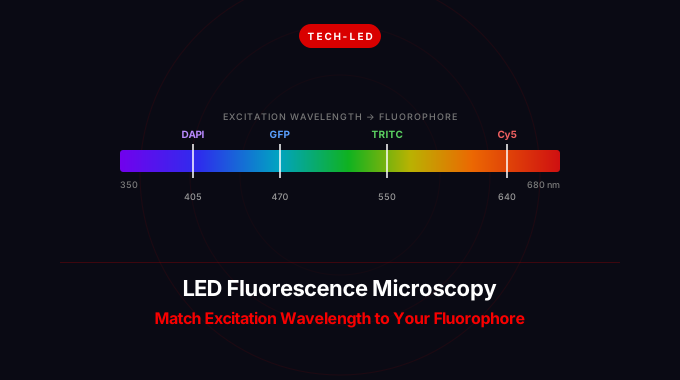
The light source in a fluorescence microscope has one job: deliver a band of excitation light that overlaps the absorption peak of the fluorophore you are imaging, then get out of the way so the longer-wavelength emission can be detected. Choosing the LED is therefore a wavelength-matching problem. DAPI excites near 358 nm (a 365…
Tech-Led Blog
Sensing & Detection
-
-
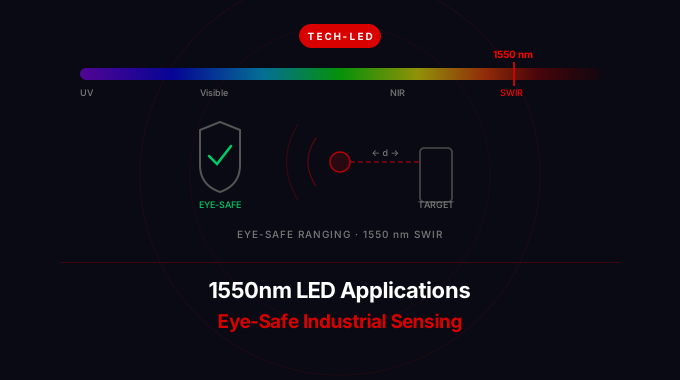
A 1550 nm LED sits in a strategically important part of the SWIR spectrum for sensing, imaging, and industrial inspection. This wavelength is often associated with eye-safer system design, detector compatibility, and specialized optical tasks where standard visible or shorter-wave IR illumination is not the best fit. For engineers evaluating industrial sensing systems, 1550 nm…
-
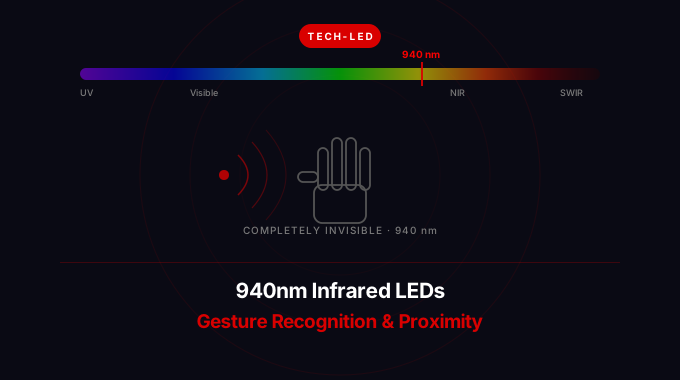
Infrared LEDs at the 940 nm wavelength emit near-infrared light that is invisible to the human eye, making them ideal for gesture recognition and proximity sensing applications where illumination must be covert. Unlike shorter-wavelength IR emitters (e.g. 850 nm) that produce a faint red glow, a 940 nm LED is completely invisible to the naked…
-
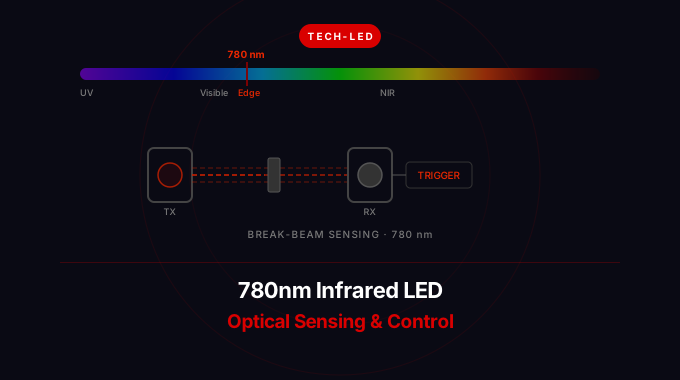
780 nm is a near-infrared wavelength sitting right at the edge of the visible spectrum – essentially invisible to the human eye but easily detected by common silicon sensors. This makes a 780 nm LED an ideal light source for optical sensing systems – it yields strong detector response without producing distracting visible light. By pairing a…
-
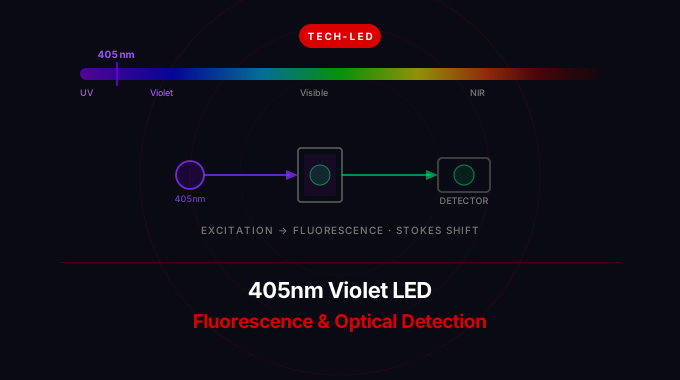
405 nm LED technology sits at the border of visible violet and ultraviolet light (UV-A), effectively functioning as an ultraviolet LED in the UV-A range, making it a unique member of the UV & Near-UV LEDs (235–420 nm) category. This near-ultraviolet wavelength offers distinct advantages for industrial optical systems. From fluorescence microscopy and machine vision…
-
A solar simulator reproduces sunlight — its spectrum, intensity, and uniformity — so photovoltaic cells and materials can be tested under controlled, repeatable conditions. An LED solar simulator does this by combining many LED wavelengths into a tunable array that approximates the standard AM1.5G reference spectrum across roughly 300–1200 nm (and out to the SWIR…
-
In an optical sensor, an LED is the emitter and a photodiode is the detector; the sensor measures how a target changes the light passing between them. The wavelength is chosen so the light interacts with the thing being measured: NIR (940 nm) for invisible proximity and gesture sensing, a specific absorption line (e.g. 4.26…