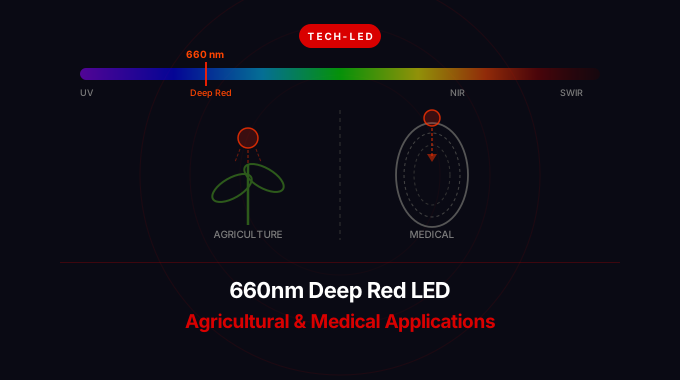
Deep red 660 nm LED emitters have become essential components in both advanced agricultural lighting and biomedical systems. At a wavelength of 660 nanometers – the heart of the red light spectrum – these LEDs align with peak chlorophyll absorption to maximize photosynthetic light for plants, while also offering an optimal balance of optical penetration and…
Tech-Led Blog
Horticulture & Agriculture
-
-
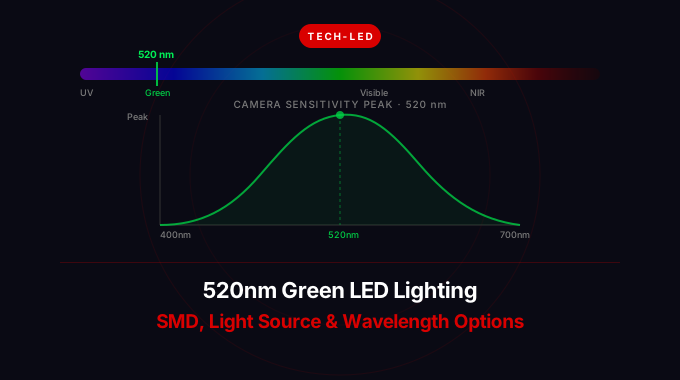
520 nm green LEDs are crucial in industrial vision systems and agricultural sensors. In machine vision, this green wavelength aligns with peak camera sensitivity and helps produce balanced white-light illumination for accurate imaging. In agricultural applications, green light is strongly reflected by plant foliage, providing a means for canopy imaging and photosynthesis detection proxies like…
-
LEDs play two distinct roles in smart agriculture, and both are wavelength-driven. As sensing emitters, they measure crop and soil condition: red (~660 nm) plus NIR (~800 nm) for vegetation indices like NDVI and chlorophyll/stress assessment, SWIR (~1450 nm) for soil and crop moisture, and UV (365–405 nm) to excite the fluorescence that flags early…