Tech-led.com


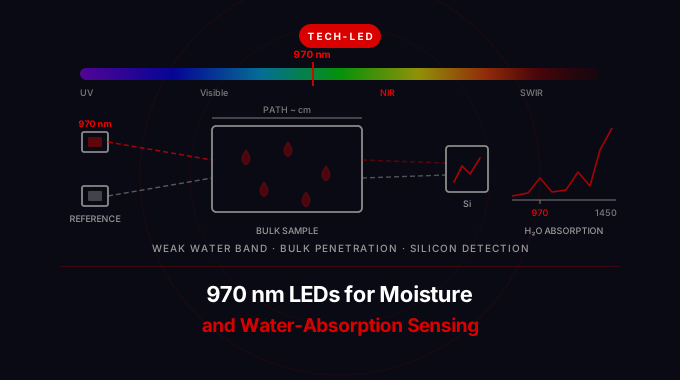
Summary: A 970 nm LED is a near-infrared emitter aimed at the weak water absorption band centered near 970 nm. That weakness is the point. Where 1450 nm saturates in a fraction of a millimeter of water, 970 nm penetrates on the order of centimeters, so it measures moisture through the bulk of a sample rather than at its surface. It is also the last useful water band that silicon still sees, which keeps the detector a cheap photodiode or a standard CMOS imager instead of an InGaAs array. This guide covers the water band structure and why band strength decides your sample thickness, silicon and InGaAs detection at 970 nm, reference-wavelength pairing for ratiometric measurement, what to specify (center wavelength, FWHM, radiant power, temperature coefficient, package), and how 970 nm compares with 940, 1050, 1200, and 1450 nm.
For where 970 nm sits in the wider near-infrared range and how wavelength selection works across the band, see our NIR LED guide.
The water bands, and why the weak one is useful
Liquid water absorbs across the near-infrared in a series of overtone and combination bands of the O-H stretch. They are not equal. Each successive overtone toward shorter wavelengths is roughly an order of magnitude weaker than the one below it, and that ladder of strengths is the whole basis of wavelength selection for moisture work.
| Water band | Common assignment | Approximate absorption coefficient | 1/e penetration in pure water | What that suits |
|---|---|---|---|---|
| 760 nm | Third overtone region | ~0.03 cm⁻¹ | ~30 cm and beyond | Too weak for most moisture work; long optical paths only |
| 970 nm | Second overtone combination (2ν₁+ν₃) | ~0.45 cm⁻¹ | ~2 cm | Bulk and through-sample moisture, thick or dense product |
| 1190 nm | Combination band | ~1.0 cm⁻¹ | ~1 cm | Bulk moisture where more contrast is needed |
| 1450 nm | First overtone of the O-H stretch (ν₁+ν₃) | ~26 cm⁻¹ | ~0.4 mm | Surface moisture, thin films, web and coating gauges |
| 1940 nm | ν₂+ν₃ combination | ~120 cm⁻¹ | ~0.08 mm | Very thin films, trace water in dry solids |
Read the penetration column and the design rule writes itself. Absorption strength and usable sample thickness trade against each other directly. A strong band gives large contrast per unit of water but saturates almost immediately, so it reports on a surface layer. A weak band gives less contrast per unit of water but stays inside the linear part of the Beer-Lambert law through a thick sample, so it reports on the bulk.
That is why 970 nm and 1450 nm are not competitors. They answer different questions. If the measurement is "how wet is the surface of this web, film, or coating," the answer is 1450 nm. If the measurement is "what is the moisture content of this grain kernel, this piece of lumber, this bottle of solvent, this volume of tissue," 1450 nm never gets past the outer layer and 970 nm is the working wavelength.
One caveat on the penetration numbers. They are absorption-only depths in clear water. Real samples scatter, and in a scattering medium like grain, powder, or tissue the photon path is far longer than the geometric thickness while the useful depth is far shorter than the table implies. Treat the column as a ranking of the bands, not as a spec for your sample.
Why 970 nm keeps you on silicon
The second reason to choose this band has nothing to do with water. It is the detector.
Silicon's response falls away past roughly 900 nm and is gone by about 1100 nm, and every water band above 1100 nm therefore forces an InGaAs detector into the design. 970 nm sits inside the last stretch of usable silicon response. That single fact changes the bill of materials for a moisture instrument.
| Detector | Response at 970 nm | Practical note |
|---|---|---|
| Silicon PIN photodiode | Roughly 0.5 A/W, past the peak near 900 nm but still strong | The default. Inexpensive, low dark current, wide supplier base |
| Silicon CMOS imager, standard front-illuminated | Quantum efficiency typically under 10% | Works with longer integration or more radiant power; verify on the sensor's QE curve |
| Silicon CMOS imager, NIR-enhanced or deep-depletion | Roughly 20 to 30% quantum efficiency | The sensible choice for 970 nm imaging; many machine-vision sensors offer an NIR variant |
| InGaAs photodiode | Roughly 0.4 to 0.5 A/W on the rising edge of the response | Only worth it if the system already carries InGaAs for other bands |
| Germanium photodiode | Responds, but with high dark current | Rarely the right answer at 970 nm when silicon works |
For a hyperspectral or multispectral instrument this is the decisive point. Adding a water channel at 1450 nm means adding an InGaAs sensor, its cooling, its optics, and its cost to a system that was otherwise silicon. Adding a water channel at 970 nm means adding one more LED to the existing illuminator and reading it on the camera already in the machine. The contrast is weaker, but the integration cost is close to nothing.
What a 970 nm LED is made of
A 970 nm emitter is built on gallium arsenide, with a strained InGaAs quantum-well active region. That is the same material system behind the 980 nm pump diodes used in fiber amplifiers, and it is a mature, high-volume, well-behaved technology.
Three consequences matter for design.
- Efficiency is good. GaAs-based near-infrared emitters convert electrical power to optical power far more effectively than the InP-based SWIR devices above 1100 nm. Cost per milliwatt at 970 nm is a different order of magnitude from cost per milliwatt at 1450 nm, and the available radiant power per package is much higher.
- It is fully invisible. There is no residual glow at 970 nm, unlike the faint red visible from an 850 nm emitter. For instruments deployed near people or in view of a color camera, that is a practical benefit.
- It is spectrally broad and incoherent. Expect a full width at half maximum on the order of 40 to 70 nm, confirmed on the specific datasheet. There is no speckle and no modal noise, and the radiation pattern is Lambertian rather than a beam.
That broad linewidth is usually treated as a drawback, and at 970 nm it mostly is not. The water band here is itself broad, on the order of 60 to 80 nm wide, so an LED with a 50 nm FWHM sits inside the feature rather than smearing across it and the neighboring baseline. Compare that with narrow, sharply peaked absorption features in gas sensing, where an LED's linewidth genuinely destroys the measurement and a laser is required. Water in the near-infrared is a broad-feature problem, and a broad-source solution fits it.
Two related parts are easy to confuse with this one. A 980 nm pump laser diode is a narrow-line, high-brightness, fiber-coupled device for amplifier pumping, not a diffuse illuminator. And a 940 nm LED, which the catalog stocks in far greater depth, sits just below the water band on a comparatively flat baseline, which makes it a poor moisture emitter and an excellent reference emitter. That second point is the basis of the next section.
Ratiometric measurement and reference-wavelength pairing
A single-wavelength transmission reading at 970 nm is not a moisture measurement. It is a measurement of everything that attenuated the beam: water, but also scattering from particle size and packing density, surface texture, sample thickness variation, window fouling, LED output drift with temperature and age, and detector responsivity drift.
The standard fix is a two-wavelength ratio. Measure at 970 nm, where water absorbs, and at a nearby reference wavelength where it essentially does not. Everything that is common to both channels divides out, and what remains tracks water content.
| Role | Candidate wavelengths | Why |
|---|---|---|
| Measurement channel | 970 nm | The water band; the only channel that should respond to moisture |
| Reference, short side | 850 nm, 910 nm, 940 nm | Low water absorption, comfortably inside silicon response, high stock depth |
| Reference, long side | 1050 nm | Also low absorption; brackets the band from above so the 970 nm channel sits between two references |
| Second water band, optional | 1190 nm | Adds a stronger band for thin or low-moisture samples; still near the silicon edge |
Bracketing with references on both sides is better than a single reference when the sample's baseline slopes with particle size or color, which is common in agricultural and powder work. Two references define a local baseline under the 970 nm peak, and the depth of the peak below that baseline is the moisture signal.
Three implementation details decide whether the ratio actually cancels anything:
- Share the optical path. The channels must see the same sample volume through the same window at the same geometry. Separate optical paths reintroduce exactly the common-mode errors the ratio was meant to remove.
- Multiplex in time, not just in space. Driving the emitters in sequence and reading one detector removes detector-to-detector responsivity differences. Modulating and using synchronous or lock-in detection also rejects ambient light and 1/f noise, which matters on a factory floor with hot lamps and daylight.
- Calibrate against a reference method. The ratio is a proxy. It has to be regressed against oven-drying, Karl Fischer titration, or whatever your industry treats as the primary method, on your material, over your moisture range. That calibration is material-specific and does not transfer between products.
Where 970 nm is the working wavelength
| Application | Why 970 nm | What to watch |
|---|---|---|
| Grain, seed, and bulk agricultural moisture | Penetrates whole kernels rather than reading surface film; silicon detection keeps the instrument cheap enough for in-line and handheld use | Scattering varies with kernel size and packing density; needs reference channels and a per-crop calibration |
| Lumber and wood products | Reads through the sample rather than the surface layer, which is where kiln-drying gradients matter | Species and grain direction change scattering; calibrate per species |
| Water in fuel, oil, hydraulic fluid, and solvent | Weak absorption keeps a long flow cell inside the linear range, and the extra path length buys sensitivity to small water fractions | Emulsified and dissolved water behave differently; particulates add scattering |
| Skin hydration and tissue water fraction | Falls in the tissue optical window where penetration is deepest, so a diffuse-reflectance probe reaches real tissue volume | Hemoglobin and lipid also absorb here; a multi-wavelength model is needed, not a single ratio |
| Multispectral and hyperspectral water channel | Adds a moisture band to a silicon system without adding an InGaAs sensor | Contrast is lower than at 1450 nm; budget more integration time or radiant power |
| Leaf water content and plant water status sensing | Established index wavelength for canopy water, paired against a near-860 nm baseline | This is a sensing use, not a growth-lighting use; specify radiometric output, not photosynthetic units |
| Condensation, wet-surface, and liquid-level detection | Simple threshold detection needs only that water absorb measurably, and the long penetration tolerates thick containers | Translucent container walls add their own absorption; take a dry-container baseline |
The thread through that list is thickness. Every one of those samples is millimeters to centimeters deep, and the measurement is about what is inside. Push toward thinner samples, coatings, films, and surface layers and the correct wavelength moves up the band ladder to 1450 nm or 1940 nm.
Optical safety at 970 nm
This is the one place where 970 nm is less comfortable than the SWIR moisture wavelengths, and it is worth stating plainly because it catches teams migrating down from 1450 nm.
The eye-safety margin engineers associate with SWIR comes from water absorption in the cornea and aqueous humor above roughly 1400 nm, which stops light before it reaches the retina. 970 nm is well below that threshold. It is inside the retinal hazard region, it is focused by the eye onto the retina, and because it is completely invisible it triggers no blink reflex and no aversion response.
A 970 nm illuminator therefore needs the same treatment as an 850 or 940 nm illuminator: risk-group classification under IEC 62471, or laser product classification under IEC 60825-1 if the source is a laser, evaluated at the radiant intensity and viewing distance the product actually presents. High-power arrays for in-line inspection deserve particular attention, since it is easy to assemble an emitter array whose combined output exceeds the exempt group limits even though each die is harmless.
Specifying a 970 nm LED
| Parameter | Why it matters at 970 nm | How to specify |
|---|---|---|
| Center wavelength and bin | The measurement sits on the flank of a broad band, so a shifted center changes the absorption seen and therefore the calibration | State the target center and tolerance; tighter bins are sorted parts and cost more, but they let one calibration serve a production run |
| Spectral width (FWHM) | Sets how much of the band the source integrates over, and how much it overlaps a nearby reference channel | Take it from the datasheet; check that the measurement and reference spectra do not overlap significantly |
| Radiant power and radiant intensity | The signal budget, before scattering losses in the sample | Radiant power in mW at a stated forward current for transmission work; radiant intensity in mW/sr when flooding a target |
| Temperature coefficient of peak wavelength | GaAs emitters drift on the order of 0.25 to 0.3 nm/K, which moves the source along the absorption flank and looks like a moisture change | Either stabilize junction temperature, monitor it and correct, or rely on a reference channel that drifts the same way |
| Radiation pattern and emitting area | Decides uniformity across the sample and how much light reaches the detector | Ask for half-angle and die dimensions; a narrow-angle lensed part concentrates flux, a wide-angle part gives even flood |
| Rise and fall time | Determines whether the emitter can be multiplexed or modulated for lock-in detection | Specify at the modulation frequency the design will use; standard NIR LEDs handle typical chopping rates comfortably |
| Package and thermal path | Junction temperature sets both the wavelength drift above and the output derating | Choose from the package families the catalog carries across the near-infrared range: SMT and SMBB surface-mount, EDC and EDCC high-power, L-series through-hole lamp, and COB arrays for multi-die illuminators |
| Forward voltage and drive scheme | A GaAs emitter at 970 nm runs at a low forward voltage, and drivers sized for visible parts will misbehave | Design the constant-current driver around the actual Vf across the operating temperature range |
The temperature coefficient deserves emphasis because it interacts with the measurement in a way that is easy to misdiagnose. The 970 nm band has steep flanks. A source whose center wavelength walks 5 nm as the instrument warms up is sampling a different part of the absorption feature, and the reading drifts even though the sample has not changed. If the reference channel is a different material system or sits on a flat part of the spectrum, it will not drift the same way and the ratio will not save you. Stabilize the emitter, or characterize the drift and correct for it in firmware.
How 970 nm compares with neighboring wavelengths
| Wavelength | Chosen for | Water absorption | Detector | Retinal hazard region |
|---|---|---|---|---|
| 850 nm | Night vision, surveillance, general NIR illumination | Negligible | Silicon, near peak | Yes |
| 940 nm | Invisible proximity and gesture sensing | Low, useful as a reference baseline | Silicon, strong | Yes |
| 970 nm | Bulk moisture and water-absorption sensing | Weak band, ~2 cm penetration | Silicon, roughly 0.5 A/W | Yes |
| 1050 nm | Short-range SWIR imaging, deeper tissue work | Low; sits between water bands | At the silicon edge; InGaAs in practice | Yes |
| 1200 nm | The NIR to SWIR crossover, semiconductor inspection | Moderate, near the 1190 nm band | InGaAs | Yes |
| 1450 nm | Surface moisture, food and web inspection | Strong, ~0.4 mm penetration | InGaAs, near peak | No |
| 1650 nm | Oil and plastic sorting, hydrocarbon detection | Low; chosen for C-H, not O-H | InGaAs | No |
Two boundaries fall out of that table. The silicon boundary sits between 970 and 1050 nm, and it is a cost boundary as much as a technical one. The eye-safety boundary sits near 1400 nm, between 1200 and 1450 nm. 970 nm is the only genuine water band that falls on the cheap side of both, which is exactly why it exists as a sensing wavelength rather than as a curiosity, and it is also why the eye-safety work is on you.
FAQ
What is a 970nm LED used for?
Moisture and water-absorption sensing, almost exclusively. 970 nm coincides with a weak overtone band of the O-H stretch in water, weak enough that light still penetrates roughly two centimeters of pure water, so it measures moisture through the bulk of a sample rather than at its surface. Typical uses are grain and seed moisture meters, lumber moisture measurement, water-in-fuel and water-in-oil detection, tissue water fraction in biomedical instruments, plant water status sensing, and adding a water channel to a silicon-based multispectral imaging system. It is not an illumination part.
Why use a 970nm LED instead of 1450 nm for moisture measurement?
Sample thickness. The 1450 nm band is roughly sixty times stronger, which sounds better but means it saturates within about 0.4 mm of water. It reports on a surface layer and tells you nothing about the interior of a grain kernel or a piece of lumber. 970 nm stays in the usable, roughly linear part of the Beer-Lambert law through centimeters of material. The second reason is cost: 1450 nm requires an InGaAs detector, while 970 nm works with an inexpensive silicon photodiode or a standard CMOS imager. Choose 1450 nm for films, coatings, and webs. Choose 970 nm for bulk samples.
Can a silicon photodiode detect a 970nm LED?
Yes, and that is one of the main reasons to pick this wavelength. A silicon PIN photodiode holds roughly 0.5 A/W at 970 nm, past its peak near 900 nm but still comfortably usable. Silicon CMOS imagers are weaker: quantum efficiency at 970 nm is typically under 10% on a standard front-illuminated sensor, rising to roughly 20 to 30% on an NIR-enhanced or deep-depletion variant. For imaging at this wavelength, specify the NIR-enhanced sensor version and check its published QE curve rather than assuming.
What reference wavelength should I pair with a 970nm LED?
Something close by where water barely absorbs, so that scattering, path length, window fouling, and source aging cancel in the ratio. On the short side, 850, 910, or 940 nm all work and are well stocked. On the long side, 1050 nm brackets the band from above, though it is past the silicon edge and needs its own detector. If the sample's optical baseline changes with particle size or color, which is normal for grain and powders, use references on both sides of 970 nm so the two of them define a local baseline and the depth of the peak below it becomes the moisture signal.
Is a 970nm LED eye-safe?
Not inherently, and it should be treated with more caution than a SWIR moisture emitter. Wavelengths above roughly 1400 nm are absorbed in the cornea before reaching the retina, which is where the eye-safety reputation of 1450 nm and 1550 nm comes from. 970 nm is below that threshold, so it reaches and focuses on the retina, and because it is entirely invisible it produces no blink reflex or aversion response. Classify a 970 nm illuminator under IEC 62471 at the radiant intensity and viewing distance the product actually presents, and pay particular attention to multi-die arrays, whose combined output can exceed exempt-group limits even when each emitter is individually harmless.
Where 970 nm fits in the portfolio
970 nm is a measurement wavelength, not an illumination wavelength. It is selected because water absorbs there weakly, and weakly is what a bulk measurement needs. If your problem statement contains the words moisture content, water fraction, kernel, bulk sample, water-in-oil, or tissue hydration, and the sample is millimeters to centimeters thick, this is the band to evaluate first. If it contains coating, film, web, or surface moisture, the right answer is 1450 nm. If it contains covert illumination or proximity detection with no water in the problem at all, 850 and 940 nm are cheaper and better stocked.
For available packages, datasheets, and sample requests across the near-infrared range, see the NIR LED product category.