
 Tech-led.com


Short-wave infrared inspection at 1450 nm is especially useful when moisture-sensitive contrast matters. In food processing, agricultural handling, and industrial quality control, a 1450 nm LED can help reveal differences that are difficult to see under visible light or more conventional IR illumination. That makes this wavelength particularly relevant for teams working with SWIR sensor systems, machine vision, and targeted moisture analysis.
In this article, we’ll look at why 1450nm sits in such an important part of the spectrum, how it supports food inspection and imaging workflows, and what technical buyers should consider when selecting emitters, optics, and related system components. If you’re evaluating illumination for SWIR-based inspection, this is a useful place to start.
In this guide
- What makes 1450 nm important for inspection work?
- Why is 1450 nm useful for moisture analysis?
- How are 1450 nm LEDs used in food inspection?
- How does a SWIR sensor work with 1450 nm illumination?
- What do cameras, lens choices, and filters add to the system?
- What should you look for in package, power, and performance?
- How does 1450 nm compare with nearby SWIR wavelengths?
- What should buyers ask a supplier or manufacturer?
- Where does 1450 nm fit in the broader LED wavelength spectrum?
- So when is a 1450 nm LED the right choice?
What makes 1450 nm important for inspection work?
The value of 1450 nm comes from where it sits in the SWIR region. This part of the spectrum can reveal material differences that visible light often misses, which is why it matters in inspection, sensing, and machine vision. A 1450 nm LED is not just another emitter in a catalog. It is a component chosen for a specific job.
In practice, the wavelength matters because certain materials interact with infrared energy differently depending on their composition. That makes this region valuable in food lines, agricultural workflows, and quality-control environments where appearance alone is not enough. A well-selected illumination device can help a SWIR sensor reveal information that supports faster and more consistent inspection decisions.
It is also worth noting that this is a more application-driven part of the spectrum than many visible or near-IR bands. Engineers do not typically choose 1450 simply because it sounds specialized. They choose it because the inspection objective demands it.
Why is 1450 nm useful for moisture analysis?
The short answer is moisture-sensitive absorption behavior. In many inspection scenarios, 1450nm is useful because water-related absorption in this part of the spectrum can create contrast that supports moisture analysis. That makes it especially interesting in food and agricultural systems where water content affects quality, handling, or classification.
For a technical buyer, this is where the application matters more than the label on the part. A SWIR LED at this band is not valuable just because it can emit at 1450 nm. It becomes valuable when paired with the right camera, optics, and inspection logic to reveal differences tied to moisture distribution, surface condition, or product state.
This is also why it helps to think in terms of useful contrast instead of headline specs alone. In many systems, the real goal is not maximum raw output. The goal is inspection signal that supports better decisions.
How are 1450 nm LEDs used in food inspection?
Food inspection is one of the clearest use cases for this wavelength. A 1450 nm LED can support inspection workflows where moisture-related contrast matters in sorting, quality assessment, or process monitoring. That can be useful for identifying variation in produce, prepared foods, or other items moving through industrial lines.
In these environments, the illumination system is not there to create a pretty image. It is there to make hidden differences more visible. A SWIR sensor or camera paired with the right infrared light source can help operators and automated systems detect patterns linked to moisture, contamination, surface differences, or product condition.
The best setup depends on what exactly you are trying to inspect. One line may be looking at surface consistency, while another may be evaluating internal moisture variation or sorting product by condition. That is why system design matters as much as the emitter itself.
Where 1450 nm is especially relevant
For food and agricultural inspection, 1450 nm is most compelling when the system needs to highlight moisture-related differences that are difficult to see under visible or standard IR illumination. In those cases, it can serve as a practical SWIR illumination option for classification, quality control, and automated sorting workflows.
How does a SWIR sensor work with 1450 nm illumination?
A SWIR sensor does not work in isolation. It needs illumination that matches the inspection objective, and that is where a 1450 nm LED can become useful. In a typical setup, the LED provides controlled illumination, the sensor captures reflected or transmitted signal, and the system interprets contrast in a way that supports decision-making.
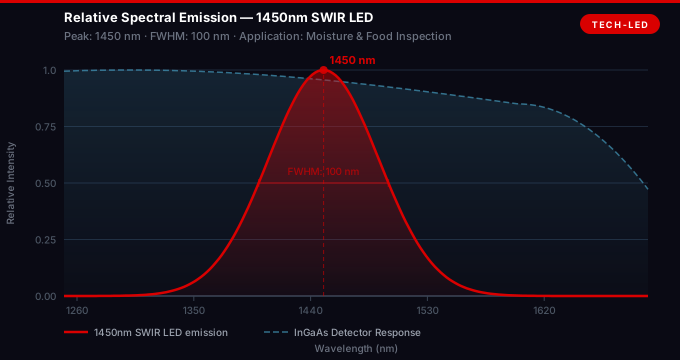
The important point is that source and detector must be compatible. A sensor optimized for one part of the SWIR range may not perform equally well elsewhere. The same goes for optics, exposure control, and system geometry. That is why a buyer should think of the LED not as a standalone tool, but as one element within an imaging chain.
This is also where the phrase “led that emits 1450 nm” becomes meaningful. What matters is not merely that the device can operate in this band. What matters is whether the full system can turn that illumination into useful inspection contrast with the needed resolution and repeatability.
What do cameras, lens choices, and filters add to the system?
Optics can make or break a SWIR inspection setup. A lens designed for visible imaging is not automatically the right choice for SWIR work. Materials, coatings, and transmission behavior all affect how much useful light reaches the sensor and how clean the resulting image will be.
The same is true of the camera and any filter strategy. A good filter can help isolate the desired band and reduce unwanted signal, while the camera must be suitable for the relevant spectrum. In some systems, swir cameras are selected specifically because they support the needed band with better sensitivity and cleaner imaging performance than a more generic option.
That is why it is rarely enough to think only about the emitter. In a real inspection environment, optics, sensor sensitivity, geometry, and control logic all influence the final result. The LED may be the headline component, but the surrounding system design is what makes it useful.
What should you look for in package, power, and performance?
Once the application is clear, the next question is implementation. Buyers should evaluate the package, mounting approach, thermal design, and electrical requirements alongside the optical goal. In some systems, an SMD LED format may be a suitable option for compact integration, while in others a different package type may better support stability or alignment.
This is also where fields like power, radiant output, optical characteristics, and current handling become meaningful. A proper specification sheet should help you understand not only nominal output, but how the part behaves under real operating conditions. If a manufacturer provides strong technical description and operating detail, that is usually a positive sign.
You may also see terms such as mw, optical output, or related performance language. Those numbers matter, but only in context. The best product is the one that supports the actual inspection objective, not just the one with the biggest number in isolation.
How does 1450 nm compare with nearby SWIR wavelengths?
1450 nm sits in an important neighborhood. Nearby bands such as 1300, 1550, 1650, and 1750 nm each support different kinds of inspection. That is why wavelength selection should be driven by use case rather than habit. A team choosing illumination for moisture-sensitive inspection may land on 1450 nm for reasons that would not apply to plastic sorting or eye-safe sensing.
This is one reason broader SWIR content is helpful but not sufficient. A SWIR LED family may cover a wide range of bands, but the right type depends on what the system needs to reveal. In some inspection systems, a 1450nm IR source is the better fit because the contrast logic is tied directly to moisture-related behavior.
It also helps to distinguish LEDs from other source classes. A laser source has different coherence and system implications than an LED emitter. For many industrial imaging tasks, the better answer is the one that balances illumination quality, system simplicity, safety, and cost of integration.
What should buyers ask a supplier or manufacturer?
A serious buyer should ask more than “what is the price?” The better questions are about package options, spectral behavior, output consistency, thermal limits, and whether the component is suitable for the intended inspection application. That is especially important in SWIR work, where small technical differences can produce big differences in system results.
It also helps to ask whether the supplier can provide supporting integration information, including optical guidance, recommended operating conditions, and system-level examples. A vendor that understands the inspection use case is usually more useful than one that only provides a part number and leaves the user to guess.
For comparison, technical buyers may also look at how other vendors or references describe similar parts, including names like Thorlabs. That can be useful for orientation, but the best fit still depends on the actual inspection problem, the optical architecture, and the level of support needed for production deployment.
Where does 1450 nm fit in the broader LED wavelength spectrum?
In the full LED spectrum, 1450 nm belongs to the more specialized end of the infrared conversation. It is well beyond visible bands and beyond the more familiar surveillance-oriented IR ranges. That is why it is better understood as part of a deeper inspection and sensing strategy than as a generic infrared LED category.
For readers who want the broader context, Tech-LED’s LED wavelength guide is the right place to start. That article explains how UV, visible, NIR, and SWIR bands relate to one another. This article then narrows the focus to a specific band with a more targeted inspection role.
That internal-link structure matters. The pillar explains the landscape; this article explains why one band within that landscape is especially relevant to moisture-sensitive inspection.
So when is a 1450 nm LED the right choice?
A 1450 nm LED is the right choice when the inspection goal is closely tied to moisture-sensitive contrast, especially in food and industrial quality-control workflows. It becomes most useful when paired with a suitable SWIR sensor, proper optics, and an imaging system designed around the real demands of the application.
For many teams, that means thinking in system terms. The LED, lens, camera, mounting, and signal interpretation all shape the result. A strong 1450 solution is not simply a part that turns on. It is a source that is suitable, technically sound, and ideal for moisture-related inspection logic in real production environments.
The practical takeaway is straightforward: if moisture analysis and food inspection are central to the problem, this part of the SWIR range deserves serious attention. It is one of the clearest examples of how spectral selection can improve system functionality rather than just adding complexity.
- A 1450 nm LED is especially relevant to moisture-sensitive SWIR inspection.
- This wavelength is useful in food inspection, material evaluation, and other targeted sensing workflows.
- A SWIR sensor needs to be paired with the right illumination, camera, and optical design.
- System design matters as much as the emitter itself, including camera, lens, and filter choices.
- Package, thermal behavior, and output characteristics should be evaluated in the context of the actual inspection task.
- 1450 nm should be understood as part of a broader SWIR strategy, not as a generic IR light source.
- The best selection process starts with the inspection goal, then works backward to the right emitter and system architecture.

