Tech-led.com


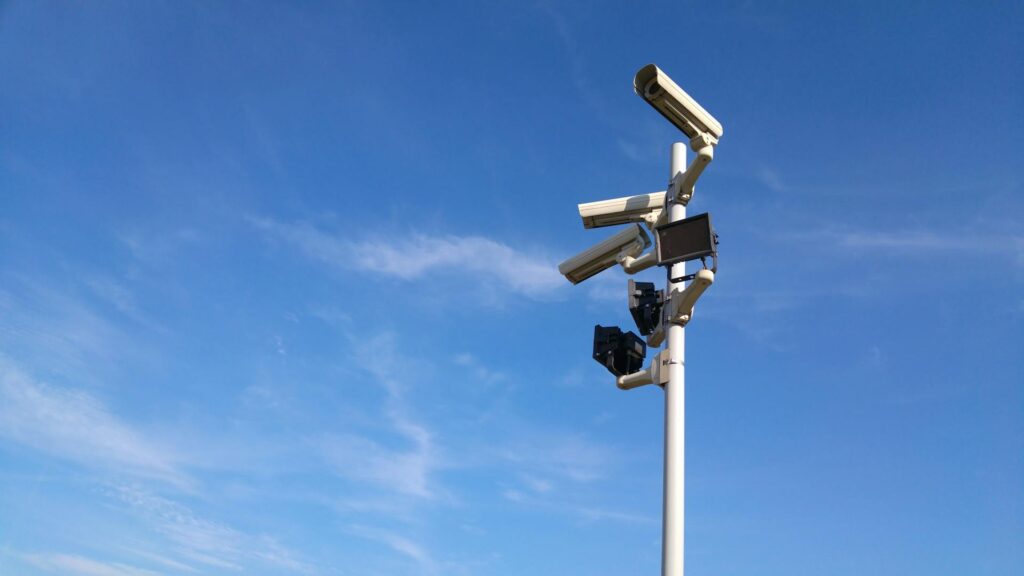
Surveillance imaging in the dark relies on infrared LED illuminators — light the camera can see but the human eye cannot. The wavelength sets the trade-off: 850 nm gives the brightest image and longest range because silicon sensors are most responsive there (at the cost of a faint visible glow), 940 nm is completely invisible for covert installations and for illuminating faces, SWIR (1050–1650 nm) penetrates fog, smoke, and haze that defeat ordinary cameras, and near-IR floods faces and irises for biometric recognition. This guide covers each wavelength's role, the 850-vs-940 decision, and what matters when designing an IR illuminator.
| Surveillance need | Wavelength | Why |
|---|---|---|
| General night vision, long range | 850 nm | Brightest image, longest range (silicon ~2× more responsive) |
| Covert / hidden cameras | 940 nm | No visible glow at any power |
| Facial / iris recognition | 940 nm | Invisible to the subject; daylight ambient-IR dip |
| Through fog, smoke, haze | SWIR (1050–1650 nm) | Penetrates obscurants silicon cameras can't |
How IR illumination makes cameras see in the dark
Day/night security cameras have an IR-cut filter that swings out at night, letting the silicon sensor respond to near-infrared light. An IR LED illuminator then floods the scene with light the sensor detects but people don't, producing a clear monochrome image in total darkness without revealing visible light. The illuminator's wavelength, power, and beam pattern determine the range, image quality, and whether the installation stays covert.
850 nm vs 940 nm: the core decision
The two standard surveillance wavelengths trade range against invisibility. Silicon sensors are roughly twice as responsive at 850 nm as at 940 nm, so an 850 nm illuminator delivers a brighter image and 30–50% longer range at equal power — but emits a faint red glow visible up close. A 940 nm illuminator is fully invisible, ideal for covert cameras and for pointing at faces, at the cost of shorter range and a dimmer image.
For the full head-to-head — silicon quantum-efficiency figures, range trade-offs, daylight ambient-IR rejection, and a when-to-choose-which decision table — see our dedicated 850nm vs 940nm infrared LED comparison. For system-level integration, see integrating NIR LEDs into night-vision cameras.
SWIR for fog, smoke, and obscurant penetration
When fog, smoke, haze, or dust defeat ordinary cameras, SWIR (short-wave infrared) illumination extends visibility. Longer SWIR wavelengths scatter less off small particles than visible or near-IR light, so a SWIR camera with SWIR LED illumination can see through obscurants and distinguish materials that look identical to a silicon camera. SWIR imaging requires an InGaAs sensor rather than silicon, which is the main cost driver — but for maritime, perimeter, and degraded-visual-environment surveillance it sees what nothing else can.
Near-IR for facial and iris recognition
Biometric systems flood a face or iris with near-infrared light and image the reflection. 940 nm is favored because it's invisible — there's no red spot in the subject's eyes — and the solar spectrum's dip near 940 nm reduces ambient-IR interference outdoors, improving the signal-to-ambient ratio. Iris recognition specifically exploits NIR because iris texture is far more legible under infrared than visible light, across all eye colors.
Designing an IR illuminator
- Range and dose — required radiant intensity scales with the square of distance; long-range illuminators use high-power emitters or arrays with beam-shaping optics.
- Beam pattern — match the illuminator's beam angle to the camera's field of view to avoid hotspots and wasted light.
- Wavelength match — pair the emitter to the camera's spectral response (silicon for 850/940 nm; InGaAs for SWIR).
- Eye safety — invisible IR doesn't trigger the blink reflex, so high-power illuminators must be evaluated under IEC 62471 and kept within safe exposure limits, especially face-facing systems.
- Thermal management — stable output and lifetime depend on keeping junction temperature in check; high-power arrays need heat-sinking.
Tech-led supplies the IR/NIR and SWIR LED emitters behind surveillance illuminators. For component selection, datasheets, and samples, contact Tech-led engineering.
Frequently asked questions
What wavelength IR LED is best for security cameras?
850 nm for most general surveillance, because silicon camera sensors are most responsive there, giving the brightest image and longest range. Choose 940 nm when the camera must be covert (no visible glow) or illuminates people's faces. SWIR (1050–1650 nm) is used to see through fog and smoke.
Why do covert cameras use 940nm instead of 850nm?
940 nm produces no visible glow at any drive current, so it doesn't reveal a hidden camera's position. 850 nm emits a faint red glow up close in the dark, which can give away the installation — fine for overt cameras but not for covert ones.
Can security cameras see through fog or smoke?
Standard silicon cameras struggle, but SWIR (short-wave infrared, 1050–1650 nm) illumination paired with an InGaAs camera penetrates fog, smoke, and haze far better, because longer wavelengths scatter less off small particles. This is used in maritime and degraded-visual-environment surveillance.
What IR wavelength is used for facial recognition?
940 nm is the common choice: it's invisible, so it doesn't shine a visible spot in the subject's eyes, and the solar dip near 940 nm reduces daylight interference. Iris recognition also uses near-infrared because iris texture is far more legible under IR than visible light.
How far can an IR LED illuminator reach?
It depends on emitter power, beam angle, camera sensitivity, and wavelength. Because required intensity rises with the square of distance, long-range illuminators use high-power emitters or arrays with focusing optics. At equal power, an 850 nm illuminator reaches 30–50% farther than a 940 nm one.
Are infrared illuminators eye-safe?
Invisible IR doesn't trigger the blink reflex, so high-power illuminators must be assessed under IEC 62471 photobiological safety and kept within exposure limits — particularly for face-facing biometric systems. Most low-power emitters fall in the Exempt or low-risk groups, but high-power arrays require evaluation.
Do I need a special camera for 940nm or SWIR?
940 nm is detected by standard silicon cameras (with the IR-cut filter removed), just less efficiently than 850 nm. SWIR (beyond ~1000 nm) requires an InGaAs sensor — silicon is effectively blind there — which is the main cost driver of a SWIR surveillance system.
Related guides
- 850nm vs 940nm Infrared LEDs — the covert-vs-range decision in depth
- 850 nm Infrared LEDs — the night-vision workhorse wavelength
- Integrating NIR LEDs into Night-Vision Security Cameras — system-level integration
- SWIR LED Lighting Guide — through-obscurant imaging
Designing a surveillance illuminator? Contact Tech-led engineering for IR/NIR and SWIR LED recommendations, datasheets, and samples.